A snack factory in Emilia-Romagna ran five products on one cartoner and still lost a shift every week. Nothing was broken. The machine simply spent more hours switching between formats than it spent making cartons.
Changeover time is the quiet tax on every multi-SKU line. It never appears as a downtime event on a report, so nobody owns it. Yet it eats capacity every single day.
Quick answer: Cartoning machine changeover time is the clock from the last good carton of one SKU to the first good carton of the next. Cutting it follows SMED: move as much work as possible out of the stopped machine and into pre-staging done while it runs, then streamline what remains. Tool-less format parts and recipe recall do most of the heavy lifting. Reported industry benchmarks put typical unsupported changeovers at roughly 45 to 90 minutes. With a disciplined SMED and tool-less design, that can fall to about 15 to 25 minutes. Those are reported ranges rather than guaranteed values. Confirm the real number on your machine at your factory acceptance test.
That last point matters. A changeover figure that is not measured on your product, with your operators, is a promise, not a specification.
Key takeaways
– Cartoning machine changeover time is a hidden OEE killer because it hides inside scheduled time and rarely gets its own downtime code.
– SMED splits tasks into external (done while the machine runs) and internal (machine stopped), then shrinks the internal set.
– Tool-less, keyed format change parts remove the two most common losses: hunting for tools and fitting a part the wrong way.
– Recipe recall turns servo positions into stored data, so an operator selects an SKU instead of winding handwheels.
– Reported industry benchmarks of about 45 to 90 minutes down to 15 to 25 minutes are ranges rather than guarantees; measure yours at FAT.
– Write a changeover clause into the purchasing spec: define it, measure it twice, and make the supplier hit it with your operators.

Why changeover time is the hidden OEE killer
OEE has three parts: availability, performance and quality. Changeover lands squarely on availability, and it is the easiest loss to ignore.
A jam shows up as an alarm and a downtime code. A changeover shows up as normal scheduled time, so it looks productive even when it is not. See OEE’s treatment of changeover as an availability loss.
The damage is proportional to how often you switch. A plant running two SKUs a week barely notices. A plant running eight SKUs a day feels every one of those minutes.
Do the arithmetic once and you cannot unsee it. If a changeover takes 60 minutes and you run three a day, that is three hours gone, every day, before any unplanned stop.
For a multi-SKU cartoning line, changeover is not a maintenance topic. It is a throughput topic.
A beverage co-packer in Vietnam measured its own line for the first time and was shocked. Its cartoner was not slow; its changeover discipline was. The team found that two-thirds of each changeover was spent walking to the tool crib and back. Simply pre-staging the next SKU’s parts on a cart cut the changeover by more than half before any hardware was touched. That is the SMED idea in a single observation. (Synthesized composite scenario, not a specific UBL customer.)
What SMED means for a cartoning machine
SMED stands for Single-Minute Exchange of Die, a method developed by Shigeo Shingo inside Toyota. “Single minute” means single-digit minutes, as in under ten. For the original method, see the Lean Enterprise Institute’s SMED lexicon entry.
The method rests on one idea: most of the work people do during a changeover does not actually require the machine to be stopped. Move that work out, and the machine restarts far sooner.
SMED is a method, not a machine. A supplier cannot sell you SMED, but it can build a SMED packaging machine that makes the method pay off.
For a cartoner, SMED means rethinking every step of a format change and asking one question. Can this be done while the machine is still running the old SKU?
Internal versus external tasks
Every changeover task is either internal or external. Internal tasks need the machine stopped. External tasks do not.
The highest-value SMED move is converting internal tasks into external ones. Fetching a part is external. Fitting it is internal. So fetch it before you stop the machine.
| Task | Type | SMED move |
|---|---|---|
| Fetch next format parts | Internal (if done late) | Pre-stage on a cart: external |
| Change carton magazine | Internal | Pre-load second magazine: external |
| Swap format parts | Internal | Tool-less quick release: shrink internal |
| Enter recipe settings | Internal | Recipe recall: shrink internal |
| First-article check | Internal | Pre-approved sample: shrink internal |
| Clean residue from old SKU | Internal | Design for cleanability: shrink internal |
Read the table from top to bottom and the logic is obvious. Almost everything you can pre-stage is time you do not pay for.

Where the minutes actually go
On a typical cartoner, changeover time does not go to one big task. It fragments into small ones.
Format part removal and fitting, guide adjustment, carton magazine change, film or carton change, recipe entry, and first-article approval each take a slice. The first-article check alone can take as long as every mechanical step combined if the sample has to go to a lab.
That is why SMED attacks the fragmentation. Ten small tasks of three minutes each cost more than one task of thirty, because each carries its own walk, reach and hesitation.
Tool-less format change parts: the biggest single lever
If you change only one thing about your next cartoner, make it the format parts.
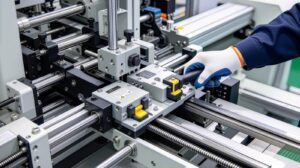
Tool-less change parts swap without wrenches. Quick-release handles, quarter-turn fasteners and keyed fittings replace bolts and set screws.
The saving is not only the wrench time. It is the time spent finding the wrench, and the time lost when a part is fitted the wrong way and produces bad cartons.
What tool-less actually requires
Tool-less is not a marketing label. It has to be engineered into every part, not just the obvious ones.
Ask whether the change parts are keyed so they cannot be installed incorrectly. Ask whether a part can be fitted by feel alone, without a drawing. Ask whether the same handle frees every part, or whether each needs its own tool.
Then watch a changeover with your own operators rather than the supplier’s technician. A tool-less part that only a technician can fit quickly is not tool-less in practice.
A snack manufacturer in Turkey replaced bolted carton guides with keyed, tool-less clips on a single cartoner. The parts cost a fraction of a new machine. Changeover between two of its SKUs dropped enough to add a full production run each week without touching line speed. The gain came entirely from removing the wrench and the wrong-way risk. A true quick changeover cartoner is built from these small, unglamorous details. (Synthesized composite scenario, not a specific UBL customer.)
Recipe-based changeover: the settings live in the controller
Handwheels and scales turn changeover into a craft. Only the operator who has done it for years can hit the right positions quickly.
Recipe recall replaces the craft with stored data. Each SKU has a recipe: guide positions, count, carton size, sealing temperature, and camera settings.
The operator selects the SKU and the machine moves to the stored positions. The knowledge lives in the controller instead of in one person’s memory.
This also protects you against the retirement cliff. When your most experienced operator leaves, the recipes stay. That logic is the foundation of recipe-based stick pack cartoning.
Recipe recall also removes variance between shifts. Without it, the day shift and the night shift will each have their own idea of the right settings, and first-article checks will keep catching the difference. Stored recipes make every shift start from the same baseline. This is why recipe-based cartoner changeover beats even a very skilled hand, and the same principle carries over to a multi-SKU supplement cartoning line. When one line serves many different clients, that reset discipline matters even more, and our guide to specifying a cartoner for many SKUs covers the co-packer case.
A cosmetics co-packer in New Jersey learned both lessons at once. Its veteran changeover operator retired, and within a month changeover times had doubled because the settings lived only in his head. A recipe-based retrofit pulled the times back below the old benchmark and made them repeatable across shifts. (Synthesized composite scenario, not a specific UBL customer.)
Setting a realistic benchmark
Benchmarks are useful for planning and dangerous for buying. Treat any figure as a starting point for a conversation, not a specification you can sue on.
Reported industry benchmarks suggest typical unsupported cartoner changeovers run about 45 to 90 minutes. A disciplined SMED approach, with tool-less parts and recipe recall, can bring that to roughly 15 to 25 minutes.
Those are reported ranges rather than guaranteed values, and they are not a UBL commitment. Your number depends on how many format parts change, how many SKUs you run, and how well your team has been trained.
Why the numbers vary
Three variables drive most of the spread. The first is the number of format parts that must change; a carton-only change is fast, a full bottle-to-jar change is not.
The second is SKU frequency. A line that rarely changes never develops the muscle, so its changeovers stay slow.
The third is documentation. A written, timed procedure that is rehearsed cuts minutes that improvised changeovers always lose.
Measure twice before you trust any figure. Once at factory acceptance, and again after a month in your plant.
How to measure cartoning machine changeover time honestly
Most plants measure changeover wrongly, which is why their improvement projects stall at the first review.
The common error is to start the clock when the operator touches the machine and stop it when the last part is fitted. That skips the first-article check, which is often the longest step. It also skips the walk to fetch parts, which SMED specifically targets.
The honest definition starts earlier and ends later. Start when the last good carton of the old SKU is produced, and stop when the first good carton of the new SKU is produced. Everything in between is cartoning machine changeover time.
Measure it by hand, with a stopwatch, for the first twenty changeovers. You need the baseline before you can claim an improvement. Anecdotes about how fast changeover used to be are not a baseline.
Then plot the times. If they vary wildly, your process is improvised rather than standardized, and the fix is a written, timed procedure before it is any hardware.
Want a realistic changeover number for your cartoner? Send us your SKU list and format pairs, and our engineers will benchmark what your line can achieve.
Common changeover mistakes that add minutes
Even a well-designed cartoner loses time to the same handful of habits. Fixing these costs nothing but discipline.
- Doing internal tasks that could be external, such as fetching tools after the machine stops.
- Letting each operator invent their own sequence, so no two changeovers look alike.
- Skipping the pre-staged cart, then hunting for parts across the plant.
- Running the first-article check at the end instead of preparing a pre-approved sample.
- Relying on one expert instead of a written procedure anyone can follow.
Each mistake adds minutes that no amount of machine speed can recover. Together they explain why two plants with the same cartoner can differ by a factor of three in changeover time.
Putting changeover into the purchasing spec
Changeover is only real when it is written into the contract. Otherwise it is a talking point that fades after the invoice.
Cartoning machine changeover time is measurable, and what can be measured can be specified.
Define the term precisely in the spec. Changeover is the time from the last good carton of the previous SKU to the first good carton of the next, measured by your operators, without a factory engineer.
Then add the clause that makes it binding. The machine must hit the agreed changeover time at factory acceptance with your product, your operators and your change parts.
The FAT timing clause
A factory acceptance test is your one clean chance to verify changeover before the machine ships. Use it.
Ask the supplier to demonstrate a changeover between your two most different SKUs, timed from last good to first good. Ask your own operator to do it.
Record the time and attach it to the contract. If the machine cannot hit the number at the factory, it will not hit it in your plant under real production pressure.
Send us your two most different SKUs and your target changeover time, and our engineers will tell you what is realistic on your product and put the timing clause in the offer.
Changeover and the multi-SKU cartoning line
Changeover does not sit alone. It interacts with how you plan the line and how the line is balanced downstream.
Every changeover consumes capacity, so planning must count it. A schedule that assumes the cartoner runs flat out ignores the hours lost to switching. Those lost hours are one of the hidden costs beyond the machine price that a landed-cost budget has to carry.
Changeover also ripples downstream. A faster changeover on the cartoner changes how much buffer the rest of the line needs, which is an end-of-line throughput planning question as much as a cartoner question.
The broader principle holds: changeover is a design and planning input, not an afterthought.
If you run cartons for products like snacks, our guide to snack cartoning formats shows how format variety raises changeover frequency, and why the changeover clause matters more on those lines.
If your end-of-line includes case packing, remember that the changeover problem does not stop at the cartoner. Our comparison of the case erector and case packer covers where the next format change will surprise you. When that next change sits on the case packer itself, the loading axis decides how hard it is; our guide to top load vs side load case packing compares the axes.
For a line built as one system, where changeover is designed in from the start rather than retrofitted, a turnkey line build usually delivers a cleaner result than assembling machines piece by piece.
FAQ
What counts as cartoning machine changeover time?
It is the clock from the last good carton of the previous SKU to the first good carton of the next one. That definition matters because it includes the first-article check, which is often the longest single step. Measuring only the mechanical swap understates the real loss.
What is SMED and does it apply to cartoners?
SMED, or Single-Minute Exchange of Die, is a method for cutting changeover time by separating internal tasks, done with the machine stopped, from external tasks, done while it runs. It applies directly to cartoners. The biggest gains come from pre-staging parts and moving work outside the stopped window.
How much can tool-less change parts save?
Tool-less, keyed change parts remove the time spent finding tools and the time lost to incorrectly fitted parts. Combined with recipe recall, they are the two biggest levers. Reported industry benchmarks suggest changeovers can fall from roughly 45 to 90 minutes to about 15 to 25 minutes, but treat those as ranges to verify.
Why are the benchmark figures a range and not a fixed number?
Because changeover depends on your product, your SKUs and your team. The number of format parts that change, how often you switch, and how well the procedure is documented all move the result. That is why the benchmark should be confirmed on your machine with your operators at factory acceptance.
How do I make changeover time enforceable in a contract?
Define it precisely, then make it a factory acceptance condition. Specify the time from last good carton to first good carton, measured by your operators with your product, and attach the measured result to the contract. A number the supplier must hit before shipping is worth far more than a brochure claim.