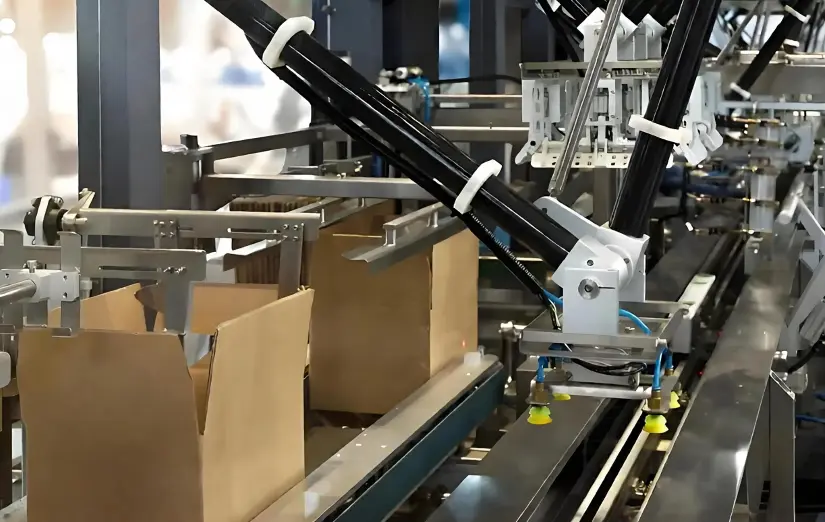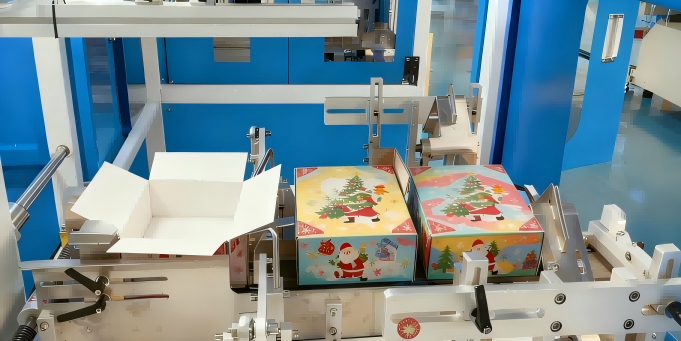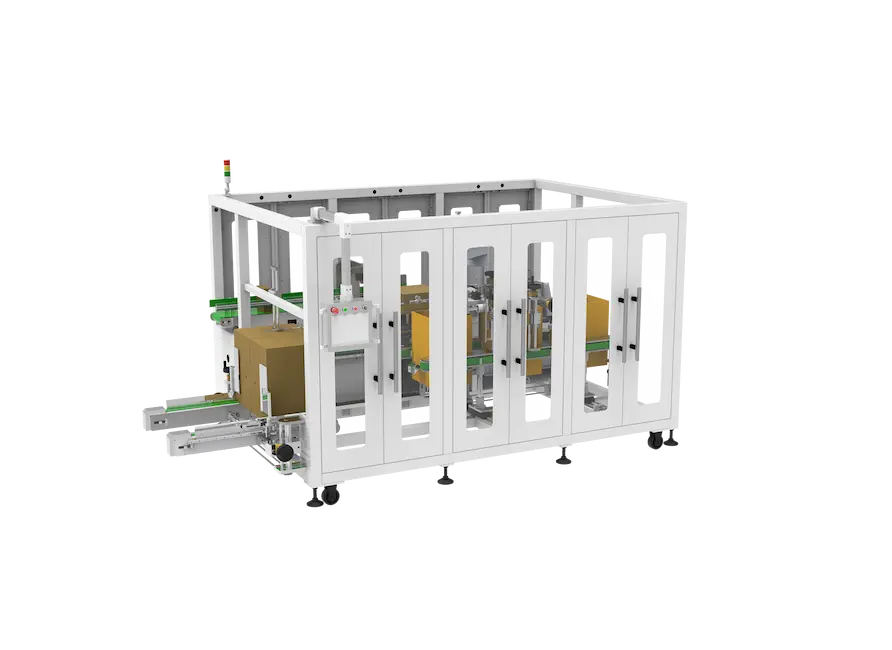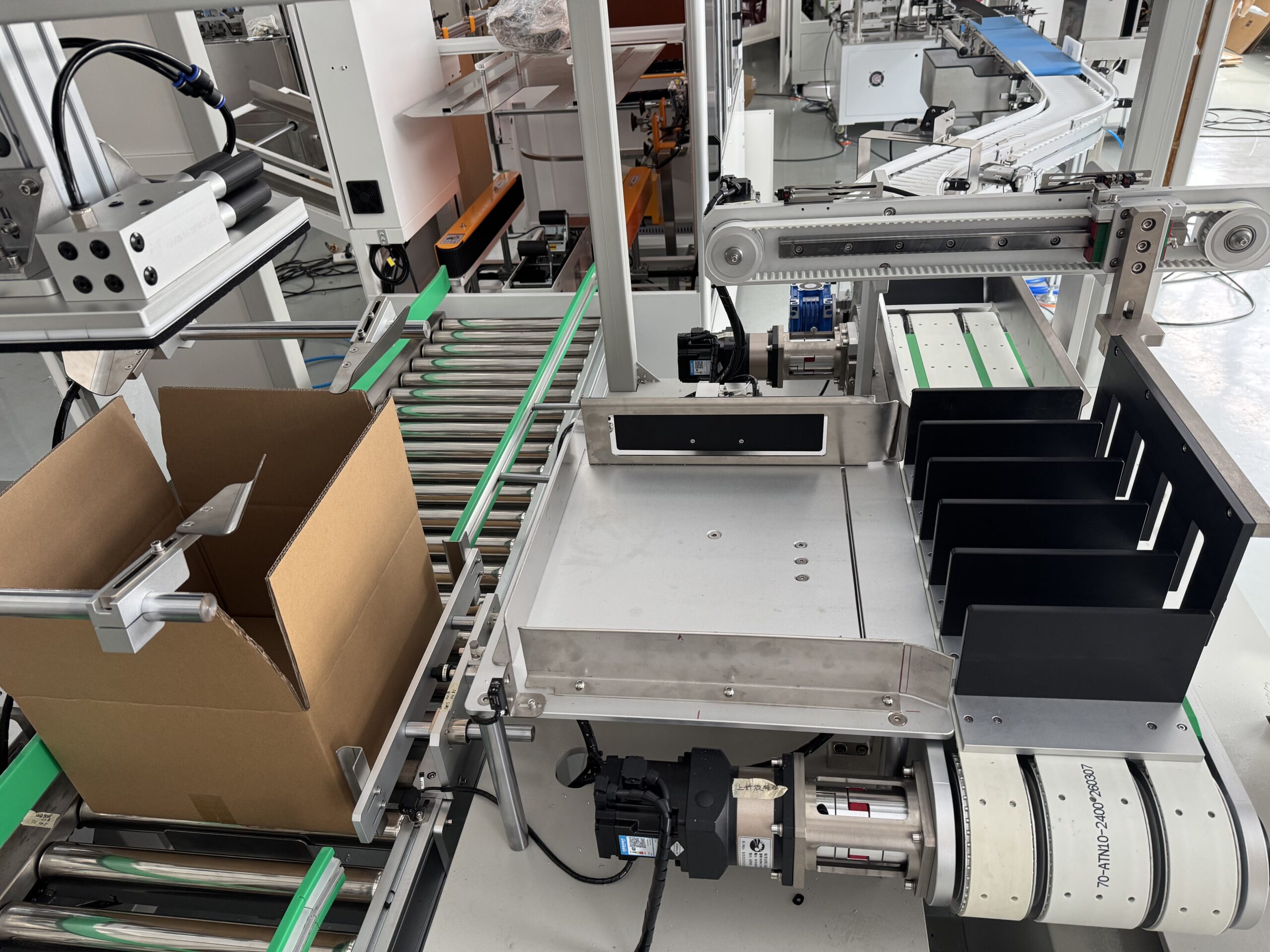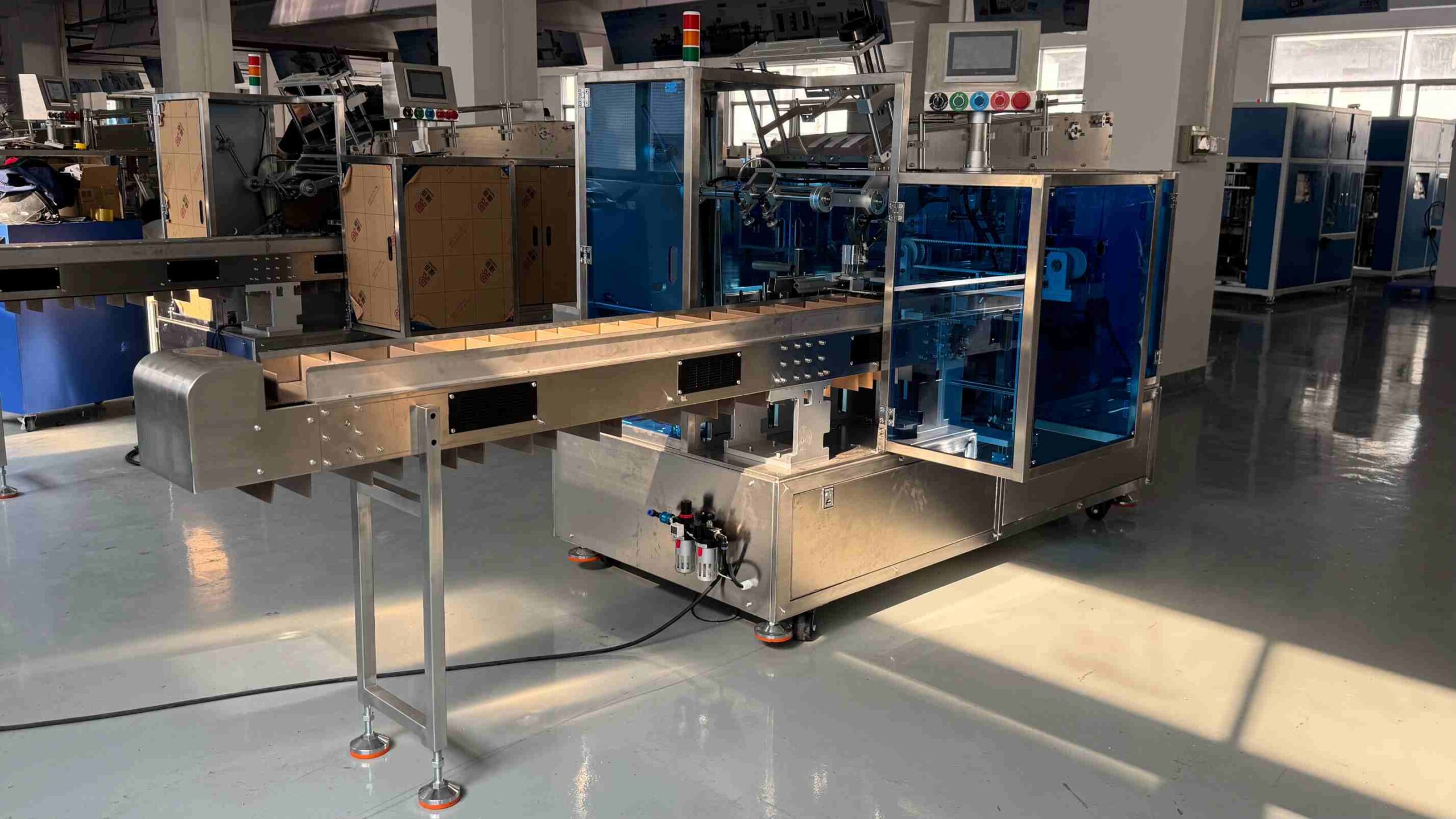
Quick answer: A supplement cartoning machine takes filled bottles, jars or stick packs and puts them into retail-ready cartons, adding the leaflet, batch code and, where required, a moisture-absorbing insert or cotton. Choosing one comes down to three things: how your products behave (gummies stick, capsules carry static), how your counting or bottling line feeds the cartoner, and how many SKUs you change over each shift.
A supplement brand in Poland had a counting line that filled gummy bottles at 60 bottles a minute and a cartoning step that ran at 25. Between them sat four people folding flat cartons by hand, dropping in a desiccant sachet, and writing the lot number on each box with a marker. When the brand launched a second flavour with a nearly identical carton, two pallets shipped with the wrong lot code before anyone noticed. Nobody had measured the gap between the filler and the carton. (Synthesized composite scenario, not a specific UBL customer.)
The filling line is where supplement brands spend their attention. The carton is where the margin quietly leaks. Hand-folding, hand-labelling and manual code-stamping are slow, prone to error, and impossible to audit the way a regulated product needs. It is also the step where the physical quirks of gummies and softgels show up as jams, double-feeds and misfilled cartons.
This guide covers the supplement and gummy segment specifically, from counting line to retail carton: matching throughput, handling sticky and static-prone products, integrating desiccant or cotton insertion, and telling a competent supplement cartoning machine specification from a brochure.
Key takeaways
– Match the cartoner to the counting or bottling line, not to a nameplate. A filler at 60 bottles/min feeding a cartoner at 25 creates a permanent queue, or a permanent undertime.
– Gummies and softgels behave differently from tablets: they stick, they carry static, and they do not stack squarely. Collation and infeed design matter more than headline speed.
– Moisture-absorbing insert and cotton insertion can be automated on the cartoner with photo-eye monitoring and a low-material alarm, so a missing insert is detected rather than shipped.
– Retail-ready means display cartons, a printed batch and expiry code, tamper evidence, and multilingual labelling where your market requires it.
– No cartoner carries a GMP certificate. It can be GMP-ready: stainless construction, cleanable surfaces, missing-part detection and reject, and documentation that supports your validation.
– Multi-SKU lines live or die on changeover. Bottle, jar and stick-pack formats share a chassis only when the format parts are designed for it.
Why the carton, not the bottle, is the bottleneck
Walk a supplement plant and you will find the newest, best-maintained machine at the filler and the oldest, most manual step at the carton. That inversion is the core problem. A counting or bottling line produces a steady, measurable stream. The carton step absorbs that stream, and when it is manual, it becomes the line’s true ceiling.
Three costs hide in manual cartoning:
- Throughput. A hand-folding team cannot match a machine filler. The queue in front of the carton station is the visible symptom; the overtime behind it is the invisible one.
- Accuracy. A hand-written or hand-applied batch code is a compliance and recall risk. If the code cannot be traced to the batch, the product cannot be reliably recalled, and that is the failure regulators care about most.
- Consistency. Hand-folded cartons vary in squareness and glue line, which affects how they stack, how they present on a retail shelf, and how they survive shipping.
Automating the carton step adds more than speed. It converts an unmeasurable manual process into a machine-verified one, where every carton either has the right product, the right leaflet and the right code, or it is rejected. That shift, from manual to verified, is what a supplement cartoning machine is actually for.
Throughput check: Send us your filler or counting-line output and your current carton step, and our engineers will tell you what the cartoner needs to consume and where the queue is forming.
Where counting and bottling meet the supplement cartoning machine
The first design question is a rate question, and it is the same one that governs any packaging line: what does the cartoner have to consume, and what does the upstream produce? For a gummy bottle cartoning machine, that question is usually where projects go wrong first. Vague answers here produce a line that runs at the speed of its slowest station forever.
The mismatch usually appears in one of two directions. Either the filler outruns the cartoner, and a queue builds in front of a manual or undersized carton station, or the cartoner outruns the filler, and it spends part of every cycle waiting. The second case is at least honest: an oversized cartoner has headroom for growth. The first case is the expensive one, because it caps output at the carton.
Map the interface before you buy:
| Upstream stage | Typical output range (industry) | What the cartoner consumes | Interface note |
|---|---|---|---|
| Tablet/capsule counter | Tens to hundreds of bottles/hour, product-dependent | One filled bottle per carton | Verify count accuracy at the collation point |
| Gummy bottle filler | Commonly tens of bottles/min | One filled bottle per carton | Sticky product needs gentle handling |
| Jar filler | Lower rate than bottles, by fill weight | One filled jar per carton | Jar weight affects infeed support |
| Stick-pack line | High packs/min, multi-lane | A counted collation per carton | Needs accurate counting and collation |
The rule is to match sustained rates, not nameplate rates, and to size a small buffer between the filler and the cartoner so a short cartoner stop does not reach back and stop the filler. That buffer is the same end-of-line buffer design idea, applied at the front of the line. The same matching applies whether the machine is a bottle cartoner, a vitamin jar cartoner or a multi-lane nutraceutical cartoning line; only the container geometry changes.
Three physical challenges: sticking, static and uneven collation
Gummies, softgels and certain coated tablets do not behave like rigid boxes, and a cartoner specified for rigid products will struggle. Three physical behaviours cause most of the trouble.
Sticking
Gummies and softgels adhere to each other and to handling surfaces, especially when warm, so they reach the collation point in clumps rather than as counted units. The fix is gentle, low-contact handling through the infeed, with short dwell times and non-adhesive surfaces.
Static
Lightweight capsules accumulate electrostatic charge as they move, which makes them cling, fly or feed two at a time. Grounded handling surfaces and static control through the infeed and collation area keep the product predictable. A static double-feed is a count error waiting to happen.
Uneven collation
Bottles and jars are uniform; gummies are not. Irregular geometry makes collation and seating harder when a carton expects a neat row or a fixed stack. The answer is a collation and infeed design matched to your product’s real shape, with a loading approach (top-load or end-load) chosen to suit how it settles.
None of these are exotic engineering problems. They are, however, problems that a cartoner specified from a catalogue without product samples will get wrong. Send samples, run them, and specify against what you observe.
Retail-ready cartons: display, coding and multilingual labels
A supplement carton that only holds product is half a carton. The other half is everything the retail channel and the regulator need it to carry.
- Display-ready formats. Shelf-ready and display cartons open and sit straight onto a shelf, which needs consistent folding and glue lines at machine speed.
- Batch and expiry coding. The lot number and expiry date are printed or applied on the cartoner and matched to the batch. This is the most important shelf-ready feature from a compliance standpoint, because it is what makes a recall possible.
- Tamper evidence. A glued end or security label gives the pack tamper evidence that many markets expect for ingestible products.
- Multilingual labelling and traceability. Cross-border cartons carry multilingual text, and an optional QR code ties a carton to its batch.
Regulators treat that code as the anchor of a recall, and FDA’s plain-language reference, FDA guidance on supplement packaging and labeling operations, sets out the lot and label controls that make traceability possible.
The cartoner’s job is to apply these consistently at line speed. A code printed slightly out of position, or a display carton folded a degree off square, is a retail reject, not a rounding error.
Integrating desiccant and cotton insertion
Supplements are moisture-sensitive, which is why so many bottles and jars ship with a moisture-absorbing insert, a canister, or cotton. Historically this was a manual step: an operator drops a sachet into each bottle or carton, slowly, and a missing insert stays invisible until a customer finds the product spoiled.
This is where cartoner specification separates suppliers. A desiccant insertion module can be integrated so the insert is placed automatically at line speed, with no separate manual station. The important feature is not the mechanism but the verification: a photo-eye monitors each insert, and a low-material alarm signals when the feed runs low. A missing insert is detected and the pack is rejected rather than shipped.
Cotton insertion works on the same principle for formats that use it, placed before the cap or inside the carton. Whether insertion happens at the filler, at the cartoner, or between them depends on your container and count, but what matters is that the insert is verified, not merely attempted.
If your product is moisture-sensitive, treat insert verification as a core specification item, not an optional extra. It is the difference between a carton line that protects the product and one that only appears to.
The logic is not unique to supplements: the same moisture protection thinking runs through upstream packaging too, as our breakdown of moisture-proof packaging shows.
A US gummy brand learned this the expensive way. Customers began reporting clumped, sticky gummies from a product shipped only months earlier, and an internal audit traced the complaints to moisture-absorbing inserts that had never made it into the bottle. The insert had been a manual step, and a missing sachet left no trace. Adding an automated insert station with photo-eye verification turned an invisible failure into a rejected pack. (Synthesized composite scenario, not a specific UBL customer.)
Multi-SKU changeover on a supplement line
A supplement brand rarely sells one product. The same factory runs several flavours, sizes and formats, and each change eats production time. On a supplement line, the formats change more than the product does: a carton sized for a 60-count bottle is the wrong carton for a 120-count jar.
Format part design decides your flexibility. A cartoner with tool-less, recipe-driven change parts moves between bottle, jar and multi-pack formats in a defined, repeatable time. One that needs wrenches and tribal knowledge for every switch quietly caps how many SKUs you can run per shift.
Two questions expose the real capability. How long does changeover take between your two most different formats, measured from last good pack to first good pack? And can your own operators do it on a normal weekday without a factory engineer? A third question covers the shared chassis: can bottles, jars and stick packs run on the same machine at all? Stick packs follow their own collation and counting rules, and stick-pack and bar-format cartoning has its own design logic.
Multi-SKU changeover rewards the same discipline as the rest of lean packaging: separate the work that can be done while the line runs from the work that needs it stopped, then reduce the stopped work to the minimum. If changeover time is your real constraint, that is a specification problem you can design out before you buy.
What “GMP-ready” means and does not mean
Supplement buyers often ask whether a cartoner can hold a GMP certificate. The honest answer is that none can, because GMP is a manufacturing process standard, not a machine certificate. The standard itself is process-based: FDA’s 21 CFR Part 111 CGMP for dietary supplements governs manufacturing, packaging and labelling operations, not the equipment. What a machine can be is GMP-ready: designed and built so it supports a compliant process.
In practice, GMP-ready means certain build and design choices:
- Construction and cleanability. Stainless-steel contact and nearby surfaces, smooth finishes, minimal crevices, and drainage that does not trap product or dust.
- Detection and reject. Missing-leaflet, missing-insert and count verification with automatic rejection, so incomplete packs do not leave the machine.
- Documentation. The drawings, material certificates and verification records your validation team needs to qualify the equipment.
- Traceability features. Coding and, where useful, QR-based records that tie output to batches.
What GMP-ready does not mean
These features support your compliance program. They do not replace it, and any supplier claiming a cartoner is “certified” is using the wrong word. Independent verification exists as well: USP’s Dietary Supplement Verification Program audits facilities against 21 CFR Part 111 and USP manufacturing practices, a useful benchmark when a retail customer asks who else checked.
Specifying a supplement cartoning line
Bring the whole line into one specification conversation, and use this checklist to keep it honest:
The specification checklist
| Item | What to specify | Why it matters |
|---|---|---|
| Rate match | Sustained bottles/min vs cartons/min | Prevents a permanent queue or permanent undertime |
| Product behaviour | Sticking, static, collation | Drives infeed and loading design |
| Insertion | Desiccant and/or cotton, with photo-eye verification | Prevents spoiled product and recalls |
| Shelf-ready | Display fold, batch and expiry code, tamper evidence | Shelf presentation and traceability |
| Labelling | Languages, leaflet, print positions | Cross-border compliance |
| Changeover | Time between two most different formats, operator-run | Multi-SKU flexibility |
| Compliance | GMP-ready construction and documentation | Supports your validation, does not replace it |
| Support | Response time, spare parts, remote diagnostics | Keeps the line running after installation |
If your formats are food-adjacent rather than pharma-adjacent, the general how to choose a food cartoning machine framework applies, and the container-side mechanics are covered in bottle cartoning in beverage lines. Supplement cartoning sits between the two: food-grade handling with pharma-adjacent traceability.
Sample-first suggestion: Before you commit to a cartoner, send us your gummies, capsules and containers. Our engineers will run them and tell you how the product collates, where it sticks, and which infeed suits it. Start with a supplement cartoning machine built around your product →
FAQ
How is a gummy cartoning machine different from a standard cartoner?
The mechanism is similar; the infeed and collation differ. Gummies stick, carry static and do not stack squarely, so the machine needs gentle, low-contact handling, static control, and a collation design matched to irregular product geometry. A cartoner specified for rigid boxes will jam on gummies unless the infeed is designed for them.
Can bottles, jars and stick packs run on the same cartoner?
Sometimes, and only when the machine is designed for shared formats. Bottles and jars usually share a cartoner with different format parts, while stick packs follow their own counting and collation logic and may need a dedicated infeed. Ask for a changeover time between your specific formats before assuming one chassis covers all three.
Can desiccant or cotton be inserted automatically?
Yes. Desiccant and cotton insertion can be integrated into the cartoning process and placed automatically at line speed. The critical feature is verification: a photo-eye monitors each insert and a low-material alarm signals when the feed runs low, so a missing insert is detected and rejected rather than shipped.
How long does changeover take on a supplement cartoner?
It depends on the format part design, not the machine’s age. Tool-less, recipe-driven changeovers between two different bottle or jar formats can be short and operator-run, while wrench-and-tribal-knowledge changes take far longer. Measure from last good pack to first good pack, with your own operators, before you buy.
What compliance does a supplement cartoner need?
No cartoner carries a GMP certificate; it can be GMP-ready. Look for stainless-steel, cleanable construction, missing-part detection with reject, and documentation that supports your validation. The machine supports a compliant process and traceability through batch and expiry coding. It does not replace your compliance program.