
“Why are we still paying 30 workers to fold clothes when machines can do it faster, cleaner, and more consistently?” That question came from a U.S.-based protective garment supplier producing 14 million pieces a year. After installing 7 UBL automatic clothes folding packaging machines, their entire back-end folding and bagging line now runs with zero manual contact — and only 10 people remain on the floor, all handling outbound logistics. If your factory still relies on manual folding, this article explains exactly what an automatic clothes folding packaging machine does, which garment types it handles, and how to decide whether your production volume justifies the switch.
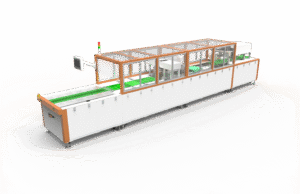
What Is an Automatic Clothes Folding Packaging Machine?
An automatic clothes folding packaging machine is an inline system that takes flat or loosely stacked garments, folds them to a precise dimension, and immediately bags or wraps them — all without human hands touching the product between steps. Depending on the configuration, the same line can apply labels, print barcodes, and deposit finished packs onto a conveyor for case packing.
UBL’s FC-Series covers the full spectrum: from entry-level semi-automatic single-station units (SA-61A) suitable for small workshops to high-throughput fully automatic models (FC-252A) designed for continuous production at 600–700 pieces per hour. Each machine in the line is built around three core actions: fold, bag, and seal.
How the Folding Cycle Works
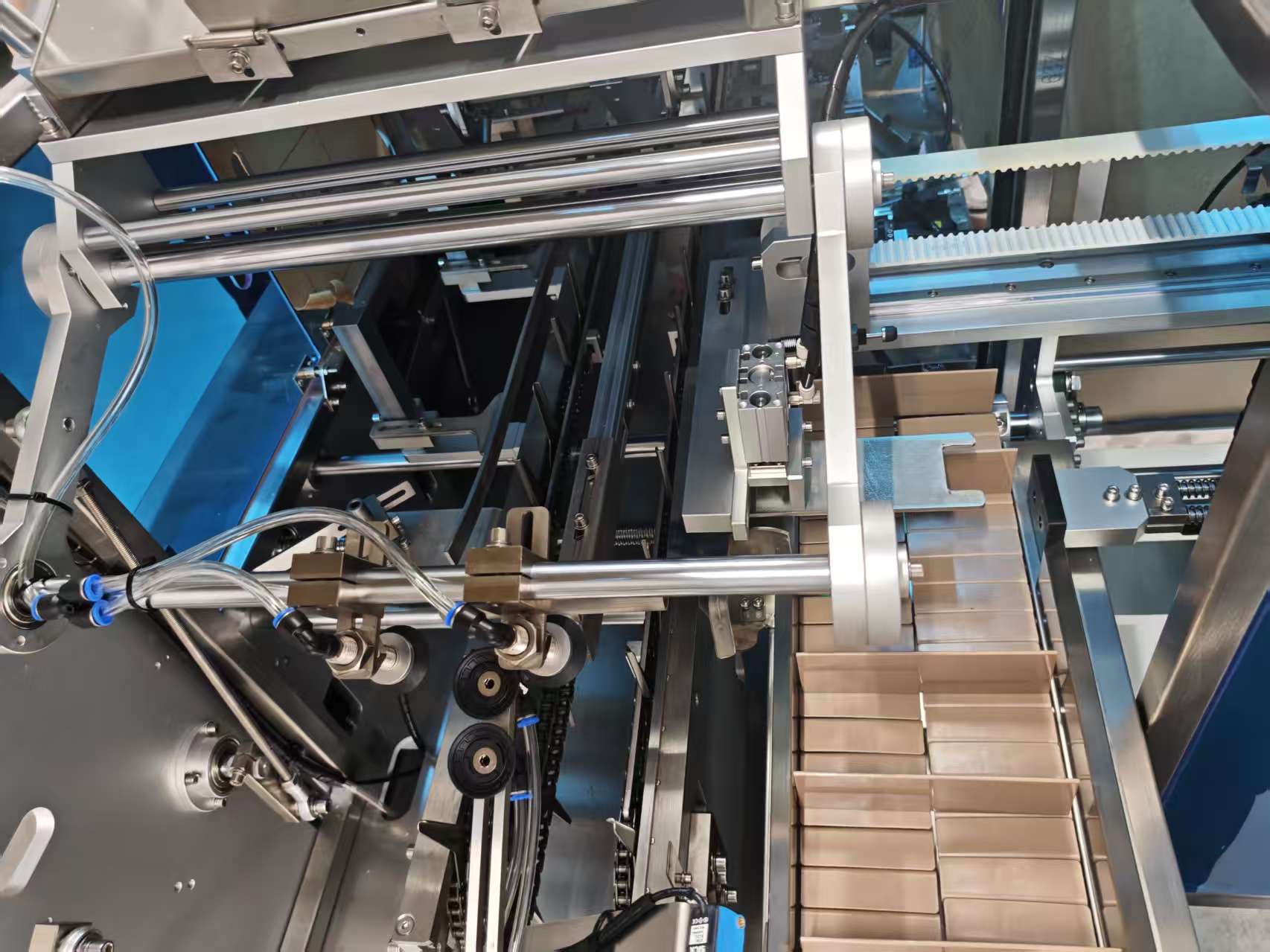
The garment enters the feed zone, either placed manually on a semi-automatic model or fed automatically via conveyor on a fully automatic unit. Mechanical folding arms execute a dual-fold sequence — first folding the garment lengthwise, then crosswise — before a bagging station slips a pre-opened poly bag over the folded piece and heat-seals the open end. The entire cycle takes under six seconds per piece on a standard FC-252A.
Which Garment Types Does It Handle?
The FC-Series is designed for a wide range of folded apparel and textile products. Thin, medium-weight, and even heavyweight garments can all be processed with the appropriate machine variant.
T-Shirts, Polos, and Knitwear
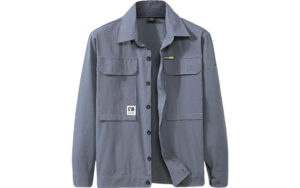
Lightweight single-jersey and piqué fabrics are the most common application. The FC-152A handles thin single-layer garments with a tear-tape seal finish, while the FC-252A adds a dual-flip fold mechanism for larger or thicker pieces that need a tighter, more uniform fold before bagging.
Jeans and Heavier Apparel
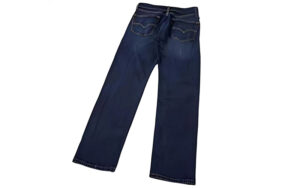
Denim and workwear require more clamping pressure during the fold cycle. UBL’s FC-252A adjusts fold width and bag tension to accommodate garment weights up to the machine’s rated capacity, making it a practical choice for factories that run both T-shirts and bottoms on the same shift.
Sets and Multi-Piece Combinations
The FC-252T variant is purpose-built for suit sets, activewear kits, and any combination of one to five garment pieces that need to be folded and bagged together. This is particularly useful for subscription box fulfillment and retail sets that must maintain a specific presentation inside the bag.
Towels, Blankets, and Hotel Linen
Hospitality linen requires a different fold geometry — wider, flatter, and often with a specific crease pattern that makes the end-product display-ready on a shelf or in a room. The BZ-832B handles towels and blankets at 400–600 pcs/h, and the BW-801 is available for oversized blankets and duvets when volume demands it.
Protective Garments and Cleanroom Apparel
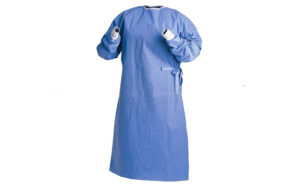
Disposable coveralls, isolation gowns, and cleanroom suits benefit most from the zero-contact feature of full automation. Minimizing human handling reduces contamination risk and helps manufacturers maintain compliance with hygiene standards — the core reason one U.S. protective garment supplier cited when choosing UBL equipment.
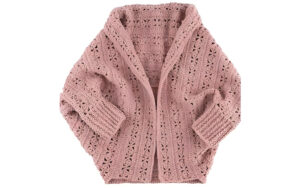
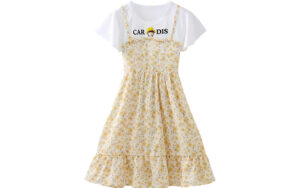
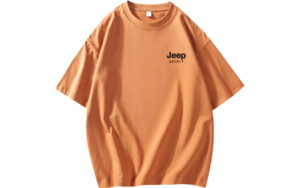
Three Industries That Rely on Automatic Garment Folding
Apparel Manufacturing Plants
High-volume garment factories producing T-shirts, polos, jeans, and casual wear deal with thousands of pieces per shift. Manual folding at the back end is typically the slowest and most labor-intensive station on the floor. Replacing that station with an automatic clothes folding packaging machine collapses a team of 8–12 people into 2–3 operators who monitor the machine and load cartons. At a daily output of 10,000 pieces or more, the labor saving alone can recover the equipment investment within months.
Print-on-Demand and Custom Apparel Fulfillment
For print-on-demand studios and custom T-shirt brands, every order needs to be folded, bagged, and ready to ship — often the same day the print run finishes. These operations frequently face demand spikes that overwhelm manual folding stations. An automatic folding and bagging line running at 600 pieces per hour lets a POD facility absorb sudden volume surges without hiring temporary workers, whose inconsistent fold quality creates return and complaint issues.
Hotel Linen and Hospitality Supply Chains
Hotels and laundry contractors supply towels, bathrobes, and bed linen to properties that expect consistent presentation. Automated folding removes the variability of hand-folding and delivers a uniform result every time, which matters both for brand consistency and for inventory management (uniformly folded items stack and count more reliably).
What a Full Automatic Folding Line Looks Like
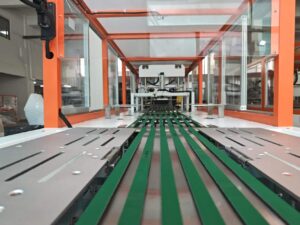
A complete UBL garment folding and packaging line is modular. Depending on the product and the factory layout, a standard configuration might include the following stations in sequence:
Step 1 — Garment Feeding
On fully automatic models, garments are loaded onto an infeed conveyor. The operator places pieces flat, and the machine aligns and feeds them into the folding zone automatically. This is the only step that still requires a human touch on most full-auto setups.
Step 2 — Folding
Mechanical folding arms perform the primary and secondary folds. The FC-252A’s dual-flip mechanism handles both thin and thick garments without requiring a changeover — the machine adjusts clamping force based on the material being processed.
Step 3 — Bagging
The folded garment passes directly into the bagging station, where a pre-opened polybag is slipped over the folded piece. The seal station closes the open end with heat sealing or a tear-tape closure, depending on the configured variant.
Step 4 — Labeling
An inline labeling machine applies a pre-printed label or prints-and-applies a variable data label (barcode, QR code, size, SKU) directly onto the sealed bag. This eliminates a downstream labeling step and keeps the line tight. Learn more about automated label application in our guide to garment labeling machines.
Step 5 — Carton Packing
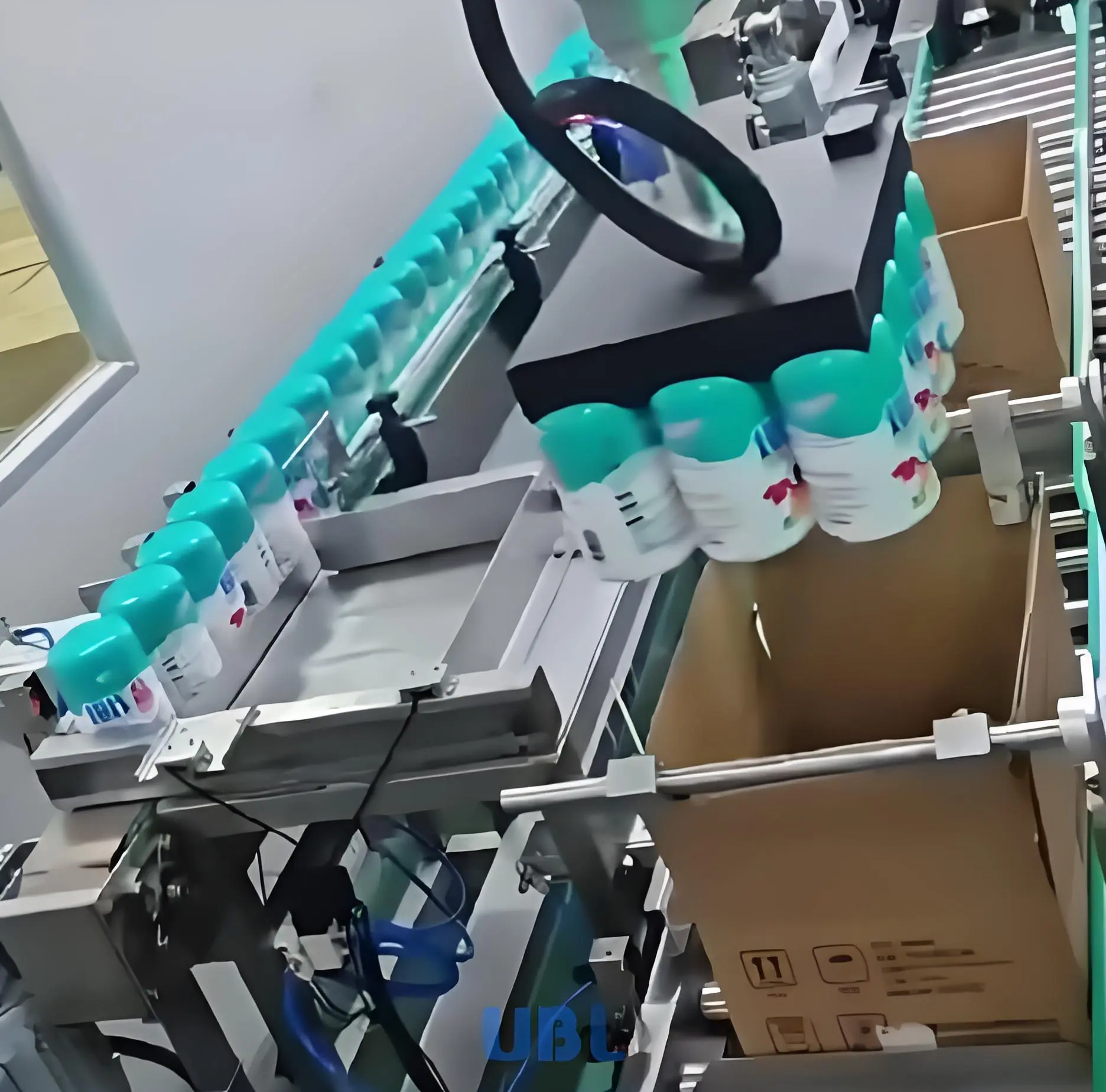
Finished bags accumulate on a take-away conveyor and are counted into cartons. On high-volume lines, an automatic carton erector opens the shipping box and an operator (or robot) loads the counted bags before the case is sealed and labeled for dispatch.
Click to view UBL garment folding machine operation cases
Semi-Automatic vs. Fully Automatic: Which Setup Fits Your Volume?
Not every factory needs a fully automatic line on day one. UBL offers both configurations to match different production scales.
| Factor | Semi-Automatic (SA Series) | Fully Automatic (FC Series) |
|---|---|---|
| Recommended daily volume | Below 3,000 pcs/day | 3,000–10,000+ pcs/day |
| Labor requirement | 1–2 operators per station | 1 operator monitors the line |
| Speed | ~700 pcs/h (with operator) | 600–700 pcs/h fully automatic |
| Floor space | Compact, single station | Larger inline footprint |
| Product contact | Human hands required for loading | Zero contact after infeed |
| Best fit | Small workshops, mixed SKUs | Mid-to-large factories, POD, linen |
The general guideline is to consider a fully automatic clothes folding packaging machine when your daily folding volume crosses 3,000 pieces. Below that threshold, the fixed equipment cost may not justify the investment; semi-automatic single-station units offer a lower entry point with meaningful throughput improvement over pure manual work. For factories running above 10,000 pieces per day, full automation is almost always the right choice — the labor saving alone covers the equipment in less than a year in most cases.
Real-World Results: A U.S. Protective Garment Supplier
One of UBL’s most cited installations is a U.S.-based protective garment manufacturer supplying isolation gowns and coveralls to hospitals and industrial clients. With annual production of 14 million pieces, their back-end folding and packaging operation had grown to over 30 workers — a significant labor cost, and a persistent hygiene risk given the end-use of the products.
They installed 7 UBL automatic clothes folding packaging machines and reconfigured their back-end line around full automation. The result: the 30-plus person folding and packaging team was replaced entirely, with only 10 workers remaining on the floor to manage outbound logistics and carton handling. More importantly, every folded and bagged garment now goes from the machine directly into a shipping box with zero human hand contact — a critical compliance point for protective apparel sold to healthcare facilities.
The speed improvement was secondary to the hygiene benefit for this client, but the throughput increase was substantial nonetheless. Seven machines running in parallel handle peak production demands that previously required overtime labor and temporary staffing — both of which introduced quality inconsistencies that generated customer complaints.
Common Questions Before Buying
Can the machine handle multiple garment sizes without a full changeover?
The FC-252A accommodates a range of garment dimensions within the same machine configuration. Adjusting for a different fold width takes approximately 10 minutes via the HMI touchscreen and manual mechanical adjustment. You do not need separate machines for every size variant — but if your product mix includes very different garment types (e.g., T-shirts and blankets), separate machines dedicated to each category will deliver better throughput and fold consistency.
What happens if the machine jams?
Jams on automatic clothes folding packaging machines are most commonly caused by misaligned feed (operator error), foreign objects in the garment, or fabric that has been damaged or over-stretched. The majority of jams resolve within 10 minutes of a stop. UBL provides remote technical support with a 4-hour response commitment, and for persistent mechanical issues, an engineer can be dispatched on-site.
How long does it take to train an operator?
Basic operation — starting the machine, loading garments, adjusting bag tension, and clearing simple jams — can be learned in approximately 30 minutes. Full operational independence, including minor parameter adjustments via the HMI, typically takes 2–3 days of hands-on experience. The control panel is available in both Chinese and English, with other languages available on request.
Is a sample trial available before purchase?
Yes. UBL’s standard pre-sales process includes a sample trial: you ship garment samples to our facility, and we run them through the machine on-site, record the output, and share the results via video. This lets you verify fold quality, bag fit, and seal integrity before committing to an order. Remote video demonstrations are also available for buyers who prefer a live walkthrough before sending samples.
Exploring More of the Folding Line
An automatic clothes folding packaging machine is the core of the line, but the surrounding equipment determines overall efficiency. If you are evaluating a complete back-end setup, these related articles cover the adjacent equipment in detail:
- UBL Folding & Packaging Machine — Product Overview and Full Machine Specifications
- T-Shirt Folding Machine: Automation Options for High-Volume Apparel Production
- Folding and Bagging Machine for Garments: Integrating Poly Bagging into Your Folding Line
- Garment Folding Machine for E-Commerce: How POD Fulfillment Centers Cut Packing Labor
- Clothes Folding Machine Buyer’s Guide: Comparing Semi-Auto vs. Full Auto for Your Factory
Ready to Automate Your Folding Line?
Whether you are running a garment factory, a print-on-demand fulfillment center, or a hotel linen supply operation, UBL’s automatic clothes folding packaging machines are configured to your specific garment type, daily volume, and floor layout. We offer both semi-automatic and fully automatic options, sample trials before purchase, and on-site installation with operator training included.
Contact us to discuss your folding line requirements or to arrange a sample trial:
Email: Helen@huanlianauto.com
Website: ublpackaging.com


7 responses