
An e-commerce apparel operation during peak season is a race between incoming orders and the number of hands available to fold, bag, label, pack, and ship. When daily volumes jump from a few hundred pieces to several thousand — or when a flash sale pushes the queue past what any manual crew can handle — the bottleneck is almost always at the same place: the person standing at a table trying to fold a T-shirt, slide it into a bag, print and attach a shipping label, and drop it into a courier pouch before the next order lands on screen. A garment folding machine for e-commerce eliminates that single-person bottleneck by automating the entire sequence from flat garment to labeled, courier-ready package.
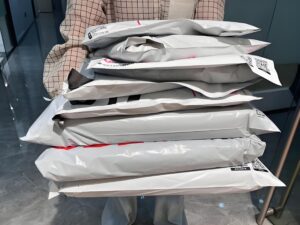
The E-Commerce Garment Packaging Workflow
Unlike traditional wholesale distribution where garments are packed in cartons of 50 or 100 identical units, every e-commerce order is a single-item (or multi-SKU) event with its own shipping address, carrier selection, and tracking number. The packaging step must produce an individually-labeled, courier-ready unit for each order line item — and it must do this fast enough that orders placed today ship before the cutoff time tonight.
Step 1 — Folding
Each garment enters the folding station flat and exits as a compact, uniformly folded piece. On UBL’s FC-152A or FC-252A, this happens in under six seconds per piece. Consistent fold dimensions matter for e-commerce because they determine how neatly the garment fits into the polybag and ultimately how it presents when the customer opens the package. A sloppy hand-folded shirt that arrives creased or misshapen generates returns; a machine-folded piece with clean edges does not.
Step 2 — Polybagging (Product Bag)
The folded garment drops directly from the fold station into a clear polybag. The bag is sealed — either by heat seal or by the bag’s self-adhesive strip depending on configuration — producing a clean, retail-ready individual pack. At this stage, the garment is protected from dust, moisture, and handling damage during downstream processing and transit.
Step 3 — Product Information Labeling
Before the garment goes into its outer shipping layer, a label is applied to the polybag carrying the product information — SKU barcode, size, color, fabric composition, care instructions, and brand identification. This label serves two purposes: it identifies the contents for warehouse picking and inventory verification, and it remains on the package so the end customer can reference product details without opening the bag. UBL’s labeling station integrates printing and application in one pass at 40–150 labels per minute, with label changeover taking roughly 5–10 minutes.
Step 4 — Courier Pouch Overbagging
The labeled polybagged garment is then inserted into a larger courier pouch or mailer bag. This outer layer carries the shipping protection that keeps the product intact through the courier network — sorting facilities, delivery vehicles, weather exposure, and final-mile handling. For high-volume e-commerce operations running thousands of pieces per day, inserting each labeled polybag into a courier pouch by hand becomes a significant labor sink at exactly the point in the workflow where speed matters most.
Step 5 — Shipping Label Application
The final step applies the courier shipping label — complete with recipient address, tracking barcode, and carrier logo — onto the outer courier pouch. This is the label the courier scans at pickup, at every sorting hub, and at delivery. Getting this step right means the order ships correctly the first time; getting it wrong means misrouted packages, customer complaints, and return-processing overhead. An automated labeling station prints and applies each shipping label in seconds, pulling order data directly from the warehouse management system.
Click here to watch the UBL e-commerce garment fulfillment line in action.
Why Manual Folding Breaks Down During Peak Season
Most small-to-midsize e-commerce apparel brands start out folding and packing by hand. It works fine at 200–500 pieces per day with one or two people. But as the business scales — or during Q4 peak, promotional events, and platform-wide sales campaigns — the manual approach hits three walls simultaneously:
Labor Availability Wall
Finding temporary packers during peak season is expensive and unreliable. Temporary workers are slower than trained staff, make more errors (wrong size in wrong bag, missing labels), and the recruitment and onboarding cycle eats into the narrow window between order surge and shipping deadline. A machine does not call in sick, take breaks at irregular intervals, or need retraining after each turnover wave.
Throughput Ceiling
A skilled hand-folder averages 5–10 pieces per minute on a good day, and that pace drops sharply toward the end of a shift as fatigue sets in. At peak volumes of 3,000+ pieces per day, a manual team of three or four people is working at capacity just to keep even. Any disruption — a missing label roll, a jammed bag supply, someone stepping away — creates a backlog that cascades into missed shipping cutoffs and delayed orders.
Error Rate Escalation
Under time pressure, error rates rise. Wrong garments in bags, mismatched sizes, missing shipping labels, illegible handwriting on address fields — each error costs money in returns, reshipping, and customer trust. Automated folding, bagging, and labeling produce consistent output at the same quality level whether it is the first piece of the morning or the five-thousandth piece of a double-shift day.
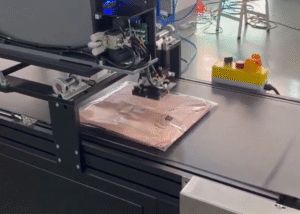
Real Case: E-Commerce Apparel Brand Upgrades to Full-Auto Fold-to-Shipping Line for Peak Season
One of UBL’s e-commerce customers — a direct-to-consumer apparel brand selling primarily through their own online store and marketplace platforms — faced a recurring problem every year during their peak sales period. Orders would surge, the manual packing team would fall behind, and the company was forced to either extend shipping deadlines (angering customers who expected next-day dispatch) or pay overtime premiums to keep the packing station running late into the night.
Their requirement was specific: they needed a line that could take a single garment and produce a fully-packaged, dual-labeled, courier-ready unit without human intervention at any intermediate step. The sequence had to be:
Fold → Polybag → Apply product information label → Insert into courier pouch → Apply courier shipping label
UBL configured a full-automatic line built around the FC-series folding platform with integrated bagging and dual-stage labeling. The line handles the complete fulfillment sequence at 600–700 pieces per hour. Each garment enters flat and exits as a finished shipping package ready for courier pickup — no manual folding, no hand-bagging, no manual label application between input and output. The only human role on the line is loading garments at the infeed and collecting finished packages at the outfeed.
During their most recent peak season, the line ran continuously through extended shifts without the throughput degradation or error spike that plagued their previous manual operation. Shipping deadlines were met consistently, overtime costs dropped because the machine maintained steady output through normal shift hours, and the customer-reported “item arrived damaged” rate fell noticeably because every garment was uniformly folded, properly sealed in its product bag, and securely enclosed in the courier pouch by machine rather than by hurried hands.
Click here to watch the UBL e-commerce garment fulfillment line in action.
FC-152A vs FC-252A: Which Model Fits Your E-Commerce Volume?
| Factor | FC-152A | FC-252A |
|---|---|---|
| Folding type | Full-auto, dual-fold (thick & thin) | Full-auto, dual-fold (thick & thin), oversized capacity |
| Speed | ~500–600 pcs/h | ~600–700 pcs/h |
| Standard config includes | Folding + bagging + sealing | Folding + bagging + sealing + labeling (standard) |
| Labeling integration | Available as add-on module | Integrated (product info + shipping label) |
| Best daily volume fit | 3,000–6,000 pcs/day (single-shift) | 5,000+ pcs/day, large-format garments, heavy peak load |
| Best for | Growing DTC brands, mid-volume marketplace sellers | High-volume e-commerce, oversized apparel, full-line fulfillment automation |
Key Considerations for E-Commerce Buyers
Integration with Your Order Management System
The shipping label station needs to receive order data — recipient name, address, carrier, tracking number — from your WMS or order management platform. UBL’s labeling system accepts standard data inputs and can be configured to work with most common e-commerce platforms and warehouse systems. Confirm data format compatibility during the sample-trial phase so the connection is smooth at installation.
Bag Size Flexibility
E-commerce catalogs typically span multiple garment categories — T-shirts, hoodies, jackets, pants — each requiring different bag dimensions. Both FC-152A and FC-252A accommodate a range of bag sizes within their compatible dimension range, and switching between sizes involves a manual adjustment (typically around 10 minutes) without requiring tool changes. If your catalog has extreme size variation (e.g., baby onesies alongside adult parkas), discuss the full size range with UBL during the configuration stage.
Peak vs. Off-Peak Planning
If your operation runs at moderate volume for eight months of the year and spikes hard for four, consider whether a full-auto line justified by peak throughput represents underutilized capital during off-peak months. Some e-commerce operators pair a full-auto base machine with semi-automatic stations that can be brought online during surge periods. Others accept that the peak-season ROI alone justifies the investment — a machine that prevents missed shipments, overtime blowouts, and customer churn during Q4 often pays for itself in a single holiday season.
Common Questions About E-Commerce Garment Folding Machines
Can one machine handle both the product label and the shipping label?
Yes. UBL’s e-commerce configuration includes a dual-stage labeling setup. The first labeling station applies the product information label (SKU, size, care instructions) to the inner polybag. The second station applies the courier shipping label (address, tracking barcode) to the outer courier pouch. Both stations pull data from your order system and operate automatically within the continuous flow of the line.
What happens if an order contains multiple items?
The folding and packaging line processes individual garments one at a time. Multi-item orders are handled at the order-consolidation stage after the line output — the packaged items are scanned, grouped by order, and placed into a shipping carton or mailer. The line itself ensures that each individual item is properly folded, labeled, and protected before it reaches consolidation.
How fast can the line switch between different products or bag sizes?
Switching between products within the compatible dimension range takes approximately 10 minutes of manual adjustment (width settings via hand-crank). Label changes (different label artwork or content) take about 5–10 minutes to swap the label roll and confirm print alignment. Neither change requires tools or technician involvement — trained operators handle both adjustments independently.
Is sample testing available for our specific garments and bags?
Yes. Send UBL your actual garments, the polybags you use (or plan to use), and samples of both your product label and shipping label format. We run the complete fold-bag-label-overbag-label cycle on video so you see exactly how your product moves through every station before you commit to an order.
Related Reading
- UBL Garment Folding Machine — Full Product Line for E-Commerce and Wholesale Applications
- Automatic Clothes Folding Packaging Machine: Full-Line Solutions for Garment Manufacturers
- T-Shirt Folding Machine: Automating T-Shirt and Polo Folding for High-Volume Production
- Folding and Bagging Machine for Garments: Why Integrated Folding-to-Bagging Beats Two Separate Steps
Ready to Upgrade Your E-Commerce Packing Line?
Whether you are preparing for your next peak season or looking to eliminate the manual folding bottleneck that limits your daily shipping capacity, UBL configures a garment folding and fulfillment line that matches your product mix, volume pattern, and order management setup. Sample trials with your actual garments and labels are standard practice — we show you the result before you buy.
Contact us to discuss your e-commerce fulfillment requirements:
Email: Helen@huanlianauto.com



One Response