
Walk onto almost any garment factory floor and you will see the same two-step dance playing out at the back end: one worker folds, another worker bags. Sometimes the same person does both — fold a piece, set it down, pick up a bag, slip it in, seal it by hand, repeat. It looks simple. It is also painfully slow, inconsistent, and increasingly expensive as labor markets tighten. A folding and bagging machine for garments collapses those two steps into one continuous motion where the folded piece never touches a human hand between the moment it leaves the infeed and the moment it emerges as a sealed, shelf-ready pack.
What Is a Folding and Bagging Machine for Garments?
A folding and bagging machine for garments is an integrated system that performs three actions in sequence — fold the garment to a precise dimension, insert it into a pre-opened polybag or film-formed pouch, and heat-seal or tear-tape close the open end — all within a single machine cycle. The output is a uniformly folded, professionally packaged product ready for labeling, carton packing, or direct shipment.
UBL offers two approaches depending on how the bag is sourced:
Pre-Made Bag Integration (FC-Series)
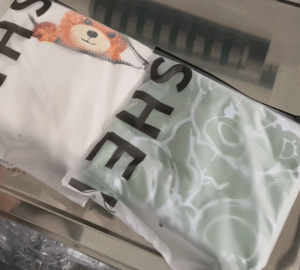
The FC-152A, FC-252A, and related models use pre-made polybags that are mechanically opened one at a time as each folded garment arrives at the bagging station. This is the most common configuration for apparel manufacturers who already have a bag specification and supplier relationship. The bag size matches the folded dimension of the garment, and the seal station closes the open end with heat sealing (tamper-evident) or tear-tape closure (retail easy-open).
Film-Forming Integration (FZ-252A)
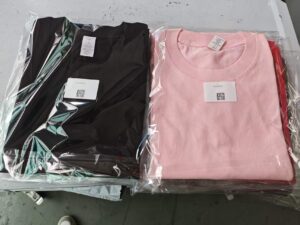
The FZ-252A takes a different approach: instead of feeding pre-made bags, it forms bags on-demand from a roll of center-folded film, folds the garment simultaneously, inserts the folded piece into the freshly formed pouch, and seals it in one motion. This eliminates bag inventory management entirely — you buy film rolls instead of stocked polybags — and allows instant bag-length adjustment via the HMI when switching between different garment sizes.
The Cost of Folding and Bagging Separately
Before understanding what an integrated machine saves, it helps to quantify what the current process costs. Here is what a typical manual folding-and-bagging station looks like:
| Step | Manual Process | Time per Piece | Typical Error Rate |
|---|---|---|---|
| Fold | Worker folds by hand on table | 6–12 seconds | 15–20% dimension variance |
| Bag insertion | Worker picks bag, opens, inserts | 4–8 seconds | 5–10% misaligned or wrinkled |
| Seal/Close | Worker applies sticker, tape, or heat gun | 2–4 seconds | 3–5% unsealed or weak seal |
| Total | Three separate manual actions | 12–24 seconds | 20–30% with visible quality issue |
An integrated folding and bagging machine compresses that entire sequence into under six seconds per piece at rated speed, with error rates below 1% when the machine is properly configured and maintained. The quality consistency alone often justifies the investment before labor savings are even calculated.
Real Case: A Printing Company Cuts Folding Team from 7 to 3
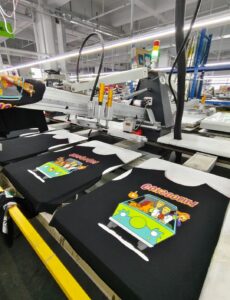
One of UBL’s apparel-sector customers operates a high-volume printing company producing custom-designed T-shirts and printed garments for brands and distributors. Their daily folding and packaging requirement averages 6,000 pieces, and the back-end operation had been running with 7 workers dedicated to folding, bagging, sealing, and applying product information labels.
They installed a single FC-152A fully automatic folding and bagging machine configured with inline labeling for product information tags. At a throughput of approximately 500 pieces per hour, the machine handles their daily volume in roughly 12 hours of operation — well within a standard shift plus moderate overtime if needed.
The result: the folding team shrank from 7 people down to 3. One operator feeds garments onto the infeed conveyor, and two others manage outbound logistics — moving sealed packs to cartons, loading cases, and handling label replenishment. The four eliminated positions represented a direct labor cost reduction that is recovering the equipment investment on an accelerated timeline. Equally important for this customer, every folded and bagged piece now exits the machine with identical dimensions, consistent bag presentation, and a properly applied product label — something their previous hand-folding operation could never guarantee regardless of how many workers they assigned.
How Inline Labeling Completes the Package
Many garment buyers require more than a plain sealed bag. Retailers want size labels, SKU barcodes, care instructions, and sometimes variable data like batch numbers or production dates. A folding and bagging machine equipped with an inline labeling station applies these automatically as each sealed bag passes through, eliminating yet another downstream manual step.
UBL’s labeling integration supports both pre-printed label application (fixed information applied from label rolls) and print-and-apply systems (variable data printed on-demand per piece). Labeling speeds of 40–150 labels per minute match the output rate of FC-Series folders without creating a bottleneck. For operations like the printing company case above — where product information labels are mandatory on every pack — this integration was a key part of the configuration that made the 7-to-3 headcount reduction possible.
Pre-Made Bags vs. Film-Forming: Which Bagging Method Fits Your Operation?
| Factor | Pre-Made Bag (FC Series) | Film-Forming (FZ-252A) |
|---|---|---|
| Consumable source | Stocked pre-made polybags | Center-folded film rolls |
| Inventory management | Must stock multiple bag sizes for different SKUs | One roll serves all sizes; length adjusted digitally |
| Bag-size changeover | Change bag supply + adjust machine (~10 min) | Adjust HMI only (instant) |
| Speed | 600–700 pcs/h | 400–600 pcs/h |
| Best fit | High-volume, stable SKU mix, established bag supplier | Variable SKUs, frequent size changes, reducing inventory complexity |
When a Standalone Folder Is Not Enough
Some factories consider buying just a folder and keeping bagging manual to reduce upfront cost. The math rarely works out favorably. A standalone folder still requires someone to receive the folded piece, open a bag manually or with a separate bag-opening device, insert the folded item, and seal it — essentially preserving all the manual steps except the fold itself. An integrated folding and bagging machine removes every one of those touchpoints, and the incremental cost over a folder-only unit is typically recovered within months through the additional labor elimination.
The printing company customer mentioned above originally evaluated a folder-only option before realizing that bagging and labeling were consuming nearly as much labor time as folding itself. Switching to an integrated FC-152A configuration with bagging and labeling built in was what made the 7-to-3 headcount reduction achievable — a folder alone would have perhaps reduced the team to 5 or 6, leaving significant manual labor on the floor.
Click here to watch the UBL garment folding machine in action.
Common Questions About Garment Folding and Bagging Machines
Can I use my existing polybag supplier?
Yes. The FC-Series accepts standard pre-made polybags within the machine’s dimensional range. Provide UBL with your bag specifications (material, thickness, dimensions) during the evaluation phase, and we confirm compatibility before you commit to anything. If your current bag falls outside the range, we can recommend alternative suppliers or adjust specifications to match available options.
Does the machine handle different bag sizes for S/M/L/XL garments?
Each garment size typically corresponds to a specific folded dimension and therefore a specific bag size. Changing bag sizes on the FC-Series takes approximately 10 minutes: switch the bag supply, adjust the fold width via HMI, and reposition the mechanical stops manually. Most facilities batch by size to minimize changeovers during a shift.
What if my garment has embellishments — buttons, zippers, patches?
Standard flat-fold machines work best with relatively flat garments. Heavy three-dimensional embellishments (large buttons, metal zippers, rigid patches) can interfere with the folding arms or create pressure points that damage the decoration. Send samples during the trial phase and UBL will test compatibility. Minor embellishments usually pass through fine; extreme cases may require a modified fold pattern or alternative handling approach.
Is sample testing available?
Standard practice. Ship your garments and your preferred bags (or film specs) to UBL, and we run the full fold-bag-seal-label cycle on video for your review. You see exactly what comes out before any purchase decision.
Related Reading
- UBL Garment Folding Machine — Full Product Line with Folding and Bagging Specifications
- Automatic Clothes Folding Packaging Machine: Full-Line Solutions for Garment Manufacturers
- T-Shirt Folding Machine: Automating T-Shirt and Polo Folding for High-Volume Production
- Garment Folding Machine for E-Commerce: How POD Fulfillment Centers Cut Packing Labor
Ready to Integrate Folding and Bagging Into One Line?
Whether you need a standard FC-Series integrated folder-bagger or a film-forming FZ-252A configuration, UBL can match a folding and bagging machine for garments to your daily volume, bag specification, and floor layout. Sample trials are included in the evaluation process, and installation covers setup, calibration, and hands-on operator training.
Contact us to discuss your folding and bagging requirements:
Email: Helen@huanlianauto.com
Website: ublpackaging.com


2 responses