
You have decided it is time to automate your back-end folding operation. The next question is not whether to buy a clothes folding machine — it is which one. Walk into any factory and you will find the same dilemma playing out: a production manager staring at two spec sheets, trying to decide between a lower-cost semi-automatic station that requires an operator at every cycle, or a fully automatic line that runs continuously but demands more floor space and capital upfront. This guide walks through that decision step by step, using real customer outcomes to show what each path actually looks like in practice.
Understanding the Two Main Categories
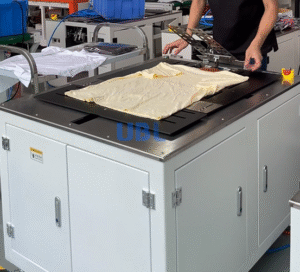
UBL’s garment folding equipment falls into two families, each designed for a distinct operational profile:
Semi-Automatic Series (SA-61A, SA-51A)
A semi-automatic clothes folding machine handles the mechanical fold and bag insertion automatically, but relies on an operator to place each garment on the infeed area and trigger the cycle. The operator is physically involved in every piece — loading, positioning, and initiating the fold. What the machine eliminates is the manual motion of folding itself: creasing, aligning, tucking, and bagging. Throughput on an SA-series station with a trained operator reaches approximately 250 pcs/h.
Fully Automatic Series (FC-152A, FC-252A, FC-252T, FC-332C, FZ-252A)
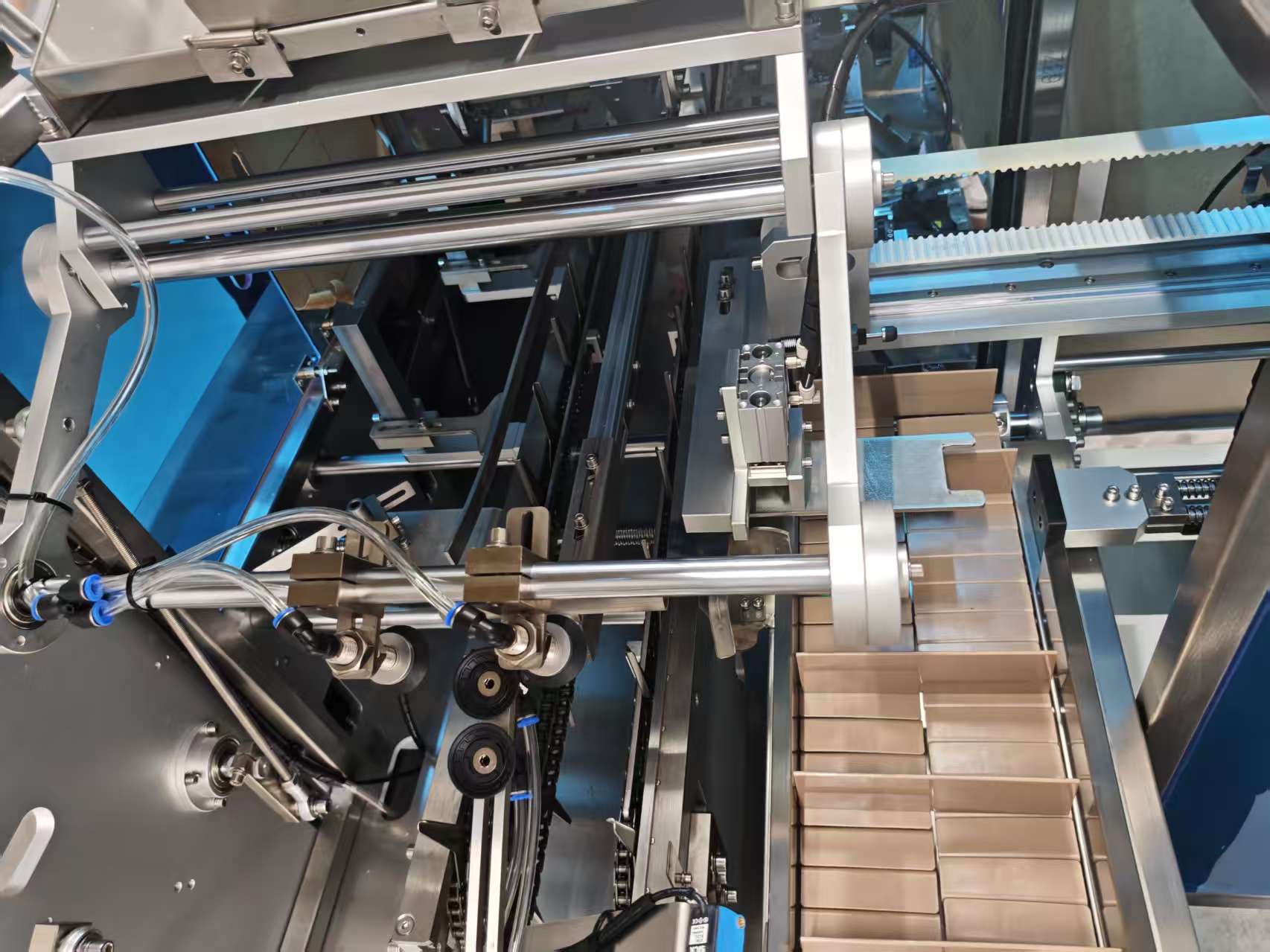
A fully automatic clothes folding machine takes over the entire cycle from infeed to sealed bag. The operator places garments flat on a conveyor (or feeds them from an upstream sewing line), and the machine aligns, folds, bags, seals, and advances the finished pack without further human intervention. Speed ranges from 600 to 700 pcs/h depending on model, but the critical difference is labor: one person can monitor a full-auto line that would require 6–8 workers on manual folding stations. The FC-Series also supports inline labeling, print-and-apply, and downstream integration with carton packing systems.
The Four Factors That Determine Your Choice
Every buying decision boils down to four variables. Work through each one honestly, and the right configuration usually becomes clear.
Factor 1 — Daily Folding Volume
Volume is the single strongest predictor of which category fits best.
| Daily Volume | Recommended Category | Why |
|---|---|---|
| Under 3,000 pcs/day | Semi-automatic (SA) or custom upgrade | Full-auto capital cost does not pay back quickly at low volumes |
| 3,000–8,000 pcs/day | Fully automatic (FC) entry-level | Labor savings begin to offset equipment cost within 12–18 months |
| 8,000+ pcs/day | Fully automatic (FC) high-throughput, possibly multiple units | Full automation delivers fastest payback; consider parallel lines for redundancy |
Factor 2 — Budget and Cash Flow
A semi-automatic station costs significantly less than a fully automatic line. If your capital budget is constrained but you still need meaningful throughput improvement, the SA series delivers real efficiency gains without the full investment. One small garment manufacturer working with limited floor space and tight budget installed two SA-series semi-automatic folding stations instead of one full-auto unit. Their headcount did not drop — but monthly output increased by 30%, and the efficiency gain came from eliminating inconsistent hand-folds and reducing rework caused by poorly folded pieces being rejected at quality inspection. The machines paid for themselves through higher billable output within the first year, even with the same number of operators.
Factor 3 — Floor Space
Fully automatic lines require a longer linear footprint because they integrate feeding, folding, bagging, labeling, and outfeed into a continuous flow. Semi-automatic stations are compact and can fit into corners or existing workstations that cannot accommodate a full inline layout. If your factory is already space-constrained, starting with SA units lets you capture automation benefits immediately while planning a future expansion or relocation that can house FC-Series equipment.
Factor 4 — Product Mix and Changeover Frequency
If your operation runs many different garment types in the same shift — say, T-shirts in the morning and towels in the afternoon — changeover time matters. Both SA and FC models adjust for different sizes via HMI and manual mechanical setup in roughly 10 minutes. However, if your mix includes fundamentally different product categories (apparel vs. linen vs. protective wear), dedicating separate machines to each category avoids constant reconfiguration and delivers better per-machine uptime.
A Third Option When Budget Lands in the Middle
Not every buyer fits neatly into “semi-auto” or “full-auto.” Some operations need more capability than a basic semi-automatic station provides but cannot justify a full FC-Series investment yet. For these situations, UBL offers customized upgrade configurations that bridge the gap.
One apparel producer faced exactly this scenario: daily volume was growing toward the threshold where semi-automatic felt too slow, but the capital for a fully automatic line was not yet available. Rather than compromise on either end, they worked with UBL on a custom semi-automatic upgrade unit equipped with integrated folding, bagging, and sealing functions — delivering a complete pack-off sequence at approximately 400 pcs/h. The upgrade gave them automated sealing and consistent bag presentation that the standard semi-auto lacked, at a price point between the SA and FC series. As their volume continued to grow, they now have a clear upgrade path to a full FC-Series line with familiar operating logic and consumable compatibility.
Click here to watch the UBL garment folding machine in action.
ROI Framework: How to Calculate Your Payback Period
Regardless of which category you choose, the calculation follows the same structure. Here is a simplified framework you can apply to your own numbers:
Step 1 — Count Current Folding Labor Cost
Number of folding workers × average hourly wage × hours per shift × shifts per day × working days per month = monthly folding labor cost. Include loaded costs (benefits, insurance, payroll tax), not just base wage.
Step 2 — Estimate Post-Automation Labor
With a semi-automatic SA station, you still need 1–2 operators per machine. With a fully automatic FC line, you need 1 monitor for the entire line. Multiply by the same rate structure as Step 1.
Step 3 — Subtract and Divide
Monthly labor saving (Step 1 minus Step 2) divided by monthly equipment cost (purchase price amortized over expected service life, typically 5–7 years for industrial folding equipment). The result is your payback period in months. Most UBL customers running 5,000+ pieces per day achieve payback in 6–14 months on fully automatic lines, and 12–20 months on semi-automatic stations where the primary benefit is output quality rather than headcount reduction.

Common Mistakes When Choosing a Clothes Folding Machine
Buying Too Small and Outgrowing It Quickly
It is tempting to choose the lowest-priced option that handles today’s volume. But if your business is growing — especially in e-commerce and POD sectors where demand can double year-over-year — an under-capacity machine becomes a bottleneck within months. If your current volume is near the upper limit of a semi-auto rating, consider investing slightly above your immediate need into an FC-series unit that gives you headroom.
Ignoring Bagging and Labeling Integration
A folder that folds beautifully but leaves you hand-bagging every piece has only solved half the problem. The real efficiency comes when folding flows directly into bagging, sealing, and labeling without human intervention between steps. Factor the full pack-off sequence into your evaluation, not just the folding mechanism alone.
Skipping the Sample Trial
Every garment behaves differently on a folding machine. Fabric weight, print type, seam bulk, and finish treatment all affect how the piece travels through the arms and bags. UBL strongly recommends sending actual production samples before committing to an order. The sample trial records the full cycle and reveals potential issues — such as a thick hem causing misalignment or a particular ink transfer smudging under clamping pressure — before the machine arrives on your floor.
Model Quick Reference
| Model | Type | Best Application | Speed |
|---|---|---|---|
| SA-61A / SA-51A | Semi-automatic | Small workshops, mixed SKUs, limited space/budget | ~700 pcs/h (with operator) |
| FC-152A | Full auto — thin garments | T-shirts, polos, lightweight knitwear | ~600 pcs/h |
| FC-252A | Full auto — dual-flip | Larger/thicker T-shirts, jeans, general apparel | ~600 pcs/h |
| FC-332C | Full auto + stacking + vacuum | Protective garments requiring compressed packaging | ~600 pcs/h |
| FZ-252A | Film-form + fold + bag | Operations needing film-based packaging integration | 400–600 pcs/h |
| Custom Upgrade | Semi-auto enhanced | Budget-conscious buyers needing bag/seal integration | ~400 pcs/h |
Related Reading
- UBL Garment Folding Machine — Complete Product Line and Technical Specifications
- Automatic Clothes Folding Packaging Machine: Full-Line Solutions for Garment Manufacturers
- T-Shirt Folding Machine: Automating T-Shirt and Polo Folding for High-Volume Production
- Garment Folding Machine Selection Guide: Matching Model to Industry and Volume
Ready to Find the Right Clothes Folding Machine for Your Factory?
Every factory’s situation is different — volume, budget, space, and product mix all influence which configuration delivers the best return. UBL offers both standard and custom configurations, sample trials with your own products, and installation with training included in every order.
Contact us to discuss your requirements or arrange a sample trial:
Email: Helen@huanlianauto.com
Website: ublpackaging.com


3 responses