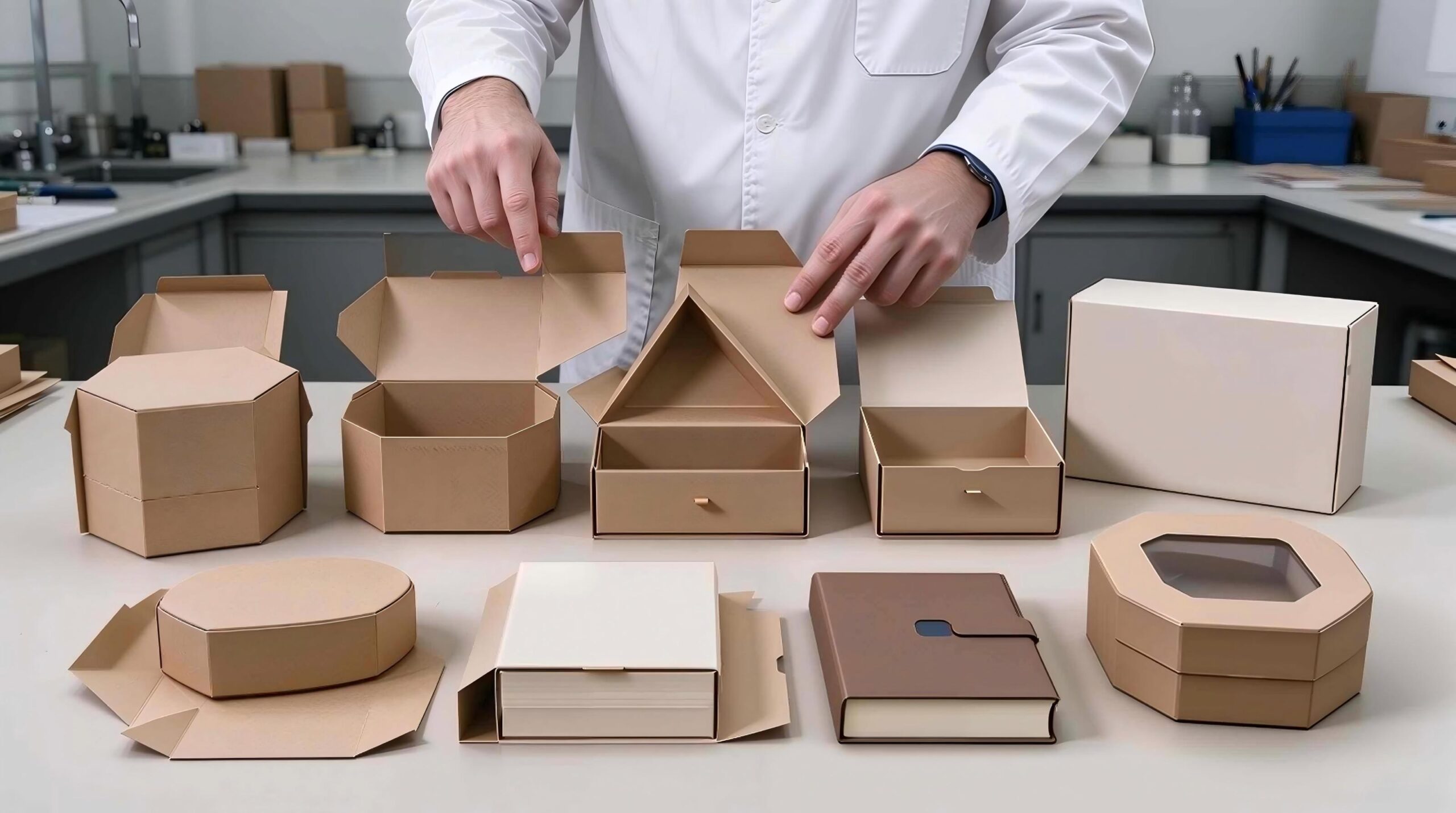
A jam and jelly producer in central Poland had a simple problem that turned expensive. The company bought a fast side load case packer to pack glass jars into shipping cases. It ran beautifully on paper. On the floor, jars kept knocking together as they were pushed horizontally into the case, and the breakage rate climbed until the line was losing money on every pallet.
The machine was not faulty. It was pointed in the wrong direction. The product went into the case from the side, when a fragile jar wants to come down from the top.
Quick answer: A top load case packer lowers product into the case from above, a side load case packer pushes it in from the side, and a wrap-around case packer folds a blank around pre-grouped product. The loading axis is the direction the product enters the shipping case, and it is the first decision in case packer selection. Match the axis to your product fragility, your packing pattern and your line speed. The axis, not the brand, decides whether the line works.
What loading axis means, and why it decides everything
Every case packer does the same three jobs: it forms a case, loads the product, and closes the case. The loading axis is how the middle job happens.
Get the axis right and the rest of the machine is a normal engineering problem. Get it wrong and no amount of tuning will save the line.
The choice is permanent. You cannot re-point a side load machine into a top load machine. The frame, the infeed and the closing section are all built around the axis.
That is why the axis belongs in the first conversation, before throughput, before price, and before anyone talks about brands.
The three loading axes in plain terms
Picture a shipping case with an open top. A top load case packer lowers the product down through that opening.
Now picture the case on its side, open toward the line. A side load case packer pushes the product in horizontally.
Now picture no pre-formed case at all. A wrap-around case packer groups the product, then folds a flat blank around it and glues the seams closed.
Three axes, three different machines, and three different sets of products they love and hate.
What a top load case packer actually does
This machine takes product from an infeed, forms it into the required group or pattern, and lowers it into a case that sits open-topped.
The gentle path is the point. Because the product travels down rather than being pushed sideways, there is far less contact and impact between units.
The pattern control is the second advantage. A top load head can place product in a precise arrangement, layer by layer, so patterns like three by four by two are straightforward.
The trade-off is speed and mechanical complexity. Lowering and placing takes longer than pushing, so top load machines generally run slower than side load or wrap-around designs.
Send us your product type, pack pattern and target cases per minute, and our engineers will tell you which loading axis fits and size the infeed to match.
Where top load wins and where it struggles
Top load wins on anything fragile, tall, irregular or pattern-critical. Glass jars, bottles, pouches and blister packs all behave better when they come down from above.
It also wins when the pack pattern changes often. A top load head can be reprogrammed to a new pattern more easily than a push mechanism can be rebuilt.
Top load struggles when the product is rigid, uniform and high volume. If you are packing identical cartons at high speed, the gentle path is wasted, and a faster axis will do the job for less.
Side load case packer: the workhorse for rigid formats
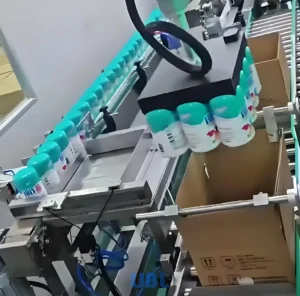
A side load case packer pushes product horizontally into a case that is presented on its side. It is the classic workhorse for rigid, rectangular, well-behaved products.
Cartons, cans, tubs and firm bags all suit a horizontal push. The product stays square, the case fills evenly, and the mechanism is simple.
Speed is the reward for that simplicity. A side load case packer generally runs faster than a comparable top load machine, which makes it the default for steady, high-volume lines.
A beverage co-packer in Vietnam standardised on side load packers across three lines for exactly this reason. The products were all rigid cartons and cans, the patterns never changed, and the horizontal push gave the highest sustained output per shift. (Synthesized composite scenario, not a specific UBL customer.)
The limit is fragility and pattern complexity. Push a glass jar or a soft pouch the wrong way and it will teach you why top load exists.
Wrap-around case packer: fastest, least flexible
A wrap-around case packer does something different. It does not load a pre-formed case at all.
Instead, the product is collated into its final group, then a flat corrugated blank is folded around it and glued. The case is built around the product.
This is the fastest of the three axes, and it uses the least board because there is no separate lid or overlap waste. For a rigid, uniform product at high volume, it is hard to beat.
The flexibility cost is steep. Wrap-around demands rigid product that can hold its own shape, and it works within a narrow window of case footprints. Change the product shape and the machine may simply not cope.
It is a high-speed specialist: choose it when the product is stable, the case is standard, and the volume never drops.
Throughput ranges: what to expect by axis
Throughput is where buyers get burned, because a number in a brochure is rarely a number on a floor. The figures below are industry experience ranges. They vary by model, product and how the line is fed, and they are not guaranteed values. A top load case packer’s real figure depends on all three, which is why the table gives ranges rather than promises.
| Loading axis | Typical industry range (cases/min) | Best product fit | Main limit |
|---|---|---|---|
| Top load | about 6 to 15 | Fragile, tall, irregular, pattern-critical | Lower speed |
| Side load | about 6 to 15 | Rigid rectangular cartons, cans, tubs | Poor with fragile or soft product |
| Wrap-around | about 50 to 100 | Rigid, uniform, high volume | Narrow format window |
How to read these ranges
Treat every range as the opening bid in a negotiation. The number that matters is the one your own product earns at the FAT. A top load machine rated at 15 cases a minute may only hold 6 with a soft pouch and a complex pattern.
The real number depends on your product, your pattern and your infeed. Confirm it on your own product at the factory acceptance test, with your operators running the machine. If the acceptance test sits inside a peak-season push, our peak-season readiness checklist covers the wider line.
If a supplier quotes a single figure with no conditions attached, ask what product and pattern it assumed. The answer is usually revealing. A single number is a claim, not a commitment.

Case packer selection by product
The fastest way to choose an axis is to start from the product rather than from the machine. Work through the table below and one column will usually stand out.
| Product type | Likely axis | Why |
|---|---|---|
| Glass jars, bottles | Top load | Gentle vertical placement avoids impact |
| Rigid cartons, cans, tubs | Side load | Horizontal push suits square, stable shapes |
| Soft pouches, bags | Top load | Pattern control without crushing |
| Uniform rigid items, high volume | Wrap-around | Speed and low board use |
Read the table as a first filter, not a verdict. A product can sit between categories, and the tie-breaker is usually the pack pattern. If those bottles go into retail cartons before casing, the cartoner side has its own rules. Our bottle cartoning guide covers that step.
For a closer look at how case packing fits the wider food line, including infeed and throughput planning, see our guide to case packing in food production.
Case packing pattern flexibility: the hidden decision
Throughput gets all the attention, but pattern flexibility quietly decides more projects than speed ever does.
If your pack pattern never changes, any axis can work, and you should optimise for speed and cost. If your patterns change by SKU, the axis you choose will either make those changes easy or impossible.
Top load handles complex and changing patterns best, because a head can be reprogrammed to place product in a new arrangement. Side load is more restricted: the push mechanism is built around a particular pattern.
Wrap-around sits at the far end. It needs the product pre-grouped in exactly the final arrangement, so pattern changes are the hardest of all.
If your roadmap includes new case counts or new arrangements, weigh pattern flexibility heavily. It is the feature you cannot retrofit later.
Robotic top load case packer: when to choose a robot
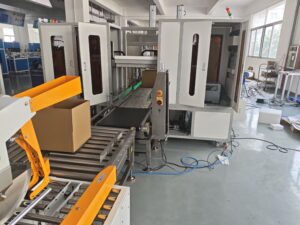
A robotic case packer replaces the fixed loading head with a robot arm. The arm picks product and places it into the case in whatever pattern you program.
This is the answer when pattern variety is high and volume is moderate. A robot can switch from one arrangement to another by loading a new recipe, often in minutes.
It is also the gentlest option. A soft-grip end effector can handle product that a fixed mechanism would bruise or crush.
A bakery in Ohio ran cookies, crackers and a fragile wafer into the same case on a shared line. Because the pack pattern changed with every product, a fixed head could not keep up. The bakery moved to a robotic top load case packer that stored a recipe per SKU, and the line absorbed the SKU mix without adding a second machine. (Synthesized composite scenario, not a specific UBL customer.) That same logic applies when one cartoning line serves many clients, which is what our guide to sizing one line for many SKUs is about.
The trade-off is speed and cost, not capability. A robot usually runs slower than a dedicated top load head, and it costs more. Choose it when flexibility and care matter more than raw throughput.
Specifying your case packer: what to lock first
When you write the specification, lock the three things that cannot be changed later, then build the rest around them.
- The loading axis, chosen from product and pattern.
- The case style and board grade, including the crush strength your distribution requires.
- The product fragility class, which sets how gentle the handling must be.
Only then discuss throughput, changeover and controls. A machine that meets a speed target but mishandles the product meets nothing at all.
Two authoritative references help here. PMMI ProSource publishes a case-packing buyer checklist covering the questions to answer before you approach a supplier. On safety, the machine-design methodology in ISO 12100 and the packaging-machine standard ANSI/PMMI B155.1 set the baseline your supplier should already meet.
For the interactions between the packer and the machines around it, our erector, packer and sealer comparison explains where each stage sits. If the case packer feeds a palletizer, the whole line has to be balanced, which is an end-of-line speed matching question.
And if your SKUs change often, the packer is only half the story. The other half is how fast you can switch formats, a question our cartoner changeover time guide answers for the whole line.
Not sure which axis your product needs? Send us a sample pack and your target case count, and our engineers will film a trial on both a top load and a side load machine and share the results.
FAQ
What is the difference between a top load and a side load case packer?
A top load case packer lowers product vertically into an open-topped case. A side load case packer pushes product horizontally into a case presented on its side. Top load is gentler and more pattern-flexible; side load is faster and better suited to rigid, rectangular products.
Which case packer is best for glass jars and bottles?
Top load is usually the right axis for glass and other fragile products, because vertical placement avoids the sideways impact that causes breakage. A robotic top load case packer adds gentle handling for irregular shapes. Side load can work only where the product is robust and the pattern is simple.
What throughput can a top load case packer reach?
Common industry experience ranges place top load machines at roughly 10 to 40 cases per minute, depending on product and pattern. Robot-assisted designs often run slower than a fixed head. Treat any figure as a range to verify on your own product at the factory acceptance test.
How does a wrap-around case packer differ from the other two?
A wrap-around case packer builds the case around pre-grouped product rather than loading a pre-formed case. It is the fastest axis and uses the least board, but it needs rigid, uniform product and a narrow case footprint window, so it is the least flexible of the three.
Does a robotic top load case packer make sense for high-SKU lines?
Often yes. A robot can switch pack patterns by loading a new recipe, which suits high-mix production and changing case counts. The trade-off is speed and cost compared with a fixed top load head. Choose a robot when flexibility and gentle handling outweigh raw throughput.