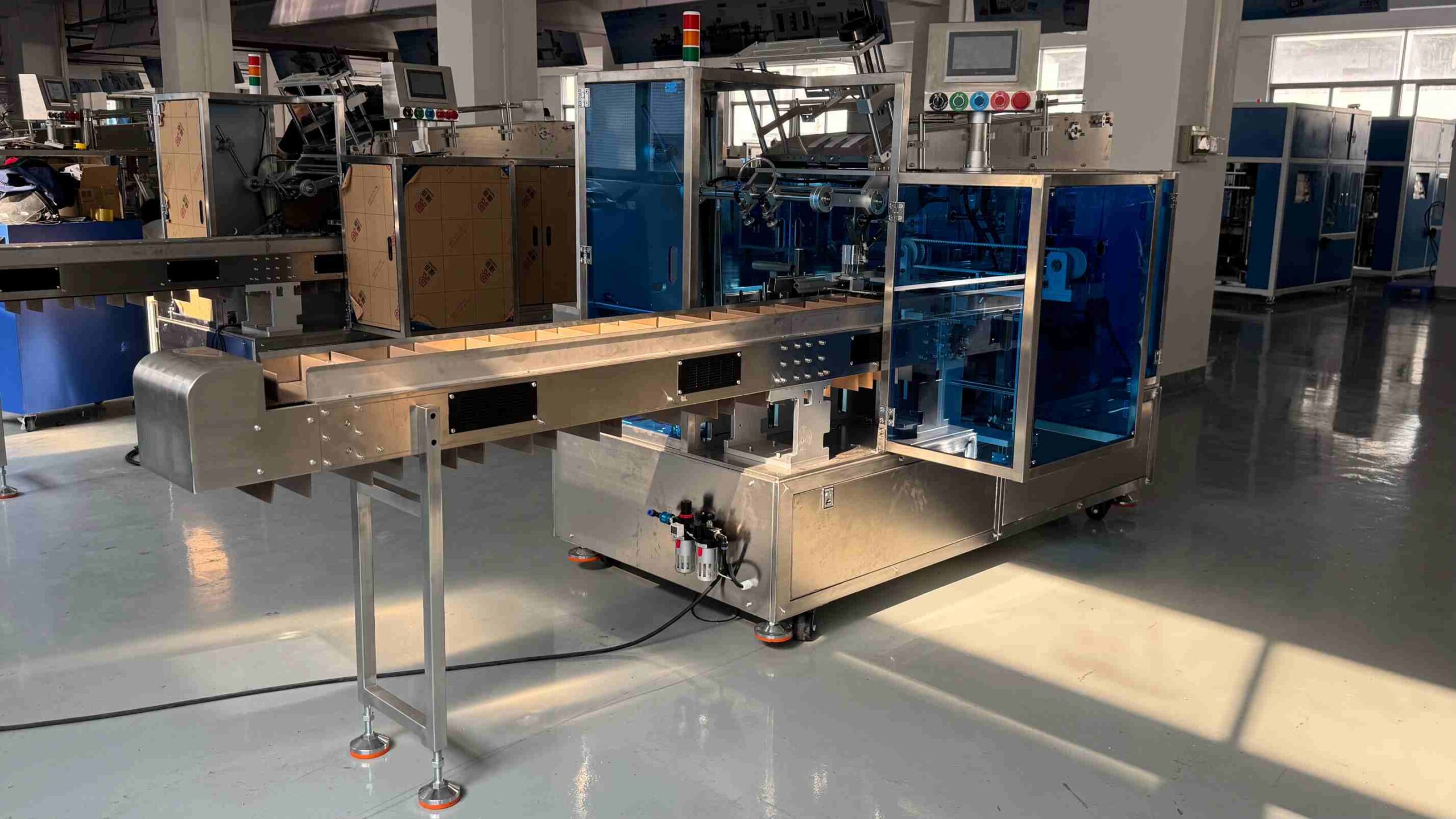
Filament moisture-proof packaging is not an accessory — it is the last line of defense between your product and a one-star Amazon review. Every manufacturer of 3D printing filament knows the anxiety. You are shipping 30,000 spools per month to an Amazon FBA warehouse in the United States. Your extruder is fine — diameter tolerance steady at ±0.03 mm, ovality under control, formulation stable across batches. Your factory floor is confident in what comes off the line. But then the reviews come in. It has been 40 days since the container left the factory. Customers are reporting wet filament, bubbling, poor layer adhesion. Your seller rating drops from 4.2 to 3.8 in one quarter. The extrusion team says “not our problem.” The shipping log says “container was sealed.” The investigation takes weeks to arrive at a simple answer: the bagging machine was the weak link. Filament moisture-proof packaging was treated as an afterthought, and the container was the wrong place to learn that lesson.
The Moisture Problem Starts at the Packaging Line, Not the Container
Why 3D Printing Filament Is Uniquely Vulnerable
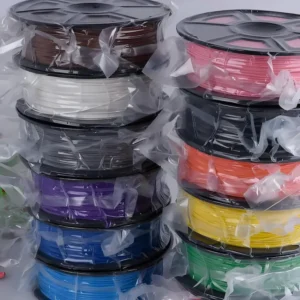
Most industrial goods that ship in containers are mechanically robust — metal fasteners, plastic components, electronic assemblies packaged with silica gel in sealed bags. 3D printing filament is a different category of risk. The materials used in filament production — PLA, ABS, nylon, PETG, PVA, and TPU — are all hygroscopic to varying degrees. PLA absorbs approximately 1.5–2.5% of its weight in moisture under high-humidity conditions. Nylon can absorb over 5%. PVA is water-soluble. Once a spool has absorbed moisture, the damage is invisible — there is no discoloration, no texture change, no smell — but the print quality is destroyed. The filament produces stringing, nozzle popping, poor layer adhesion, and brittle parts. The end user sees a failed print and leaves a one-star review. They do not see the 40-day shipping journey or the packaging failure that caused it.
Container Rain and Temperature Cycling
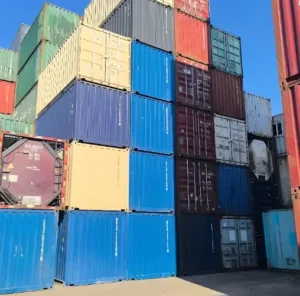
The shipping environment is more hostile than most manufacturers account for. A standard ocean container traveling from a Chinese port to a U.S. West Coast warehouse experiences temperature swings of 15–30°C between day and night cycles during transit. When warm, humid air inside the container cools overnight, condensation forms on the container ceiling and walls — a phenomenon known as container rain. This moisture drips onto cargo, seeps into cardboard outer cartons, and increases the humidity load on every sealed bag inside. If the primary packaging barrier is not performing at specification, that humidity load translates directly into moisture absorption by the filament.
Four Critical Checkpoints on the Packaging Line
Most filament manufacturers who experience moisture-related returns trace the failure back to one or more of four packaging-line checkpoints. Each one is directly controllable by the bagging machine settings, the material choices, and the quality verification process.
Checkpoint 1: Vacuum Seal Integrity
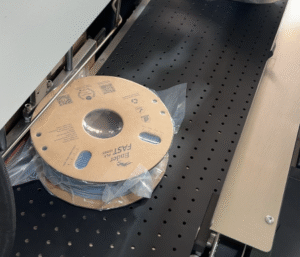
A vacuum-sealed bag is only as good as the seal. UBL’s vacuum bagging machines operate at a stable working vacuum level of -0.08 MPa, with the evacuation cycle completing in approximately 5 seconds for a typical 1 kg spool bag measuring 300 × 340 mm — the standard format for most 3D printing filament products on the market today. A seal that looks intact but has a microscopic leak path — from inconsistent heat-seal temperature, uneven jaw pressure, or contamination on the sealing surface — will lose vacuum gradually over days or weeks. By the time the spool reaches the customer, the bag may show no visible damage, but the filament inside has been breathing ambient humidity for most of the transit. The difference between a proper seal and a near-miss is measured in millibars and millimeters — and it makes the difference between a satisfied customer and a return.
Checkpoint 2: Desiccant Deployment — Manual vs. Automated
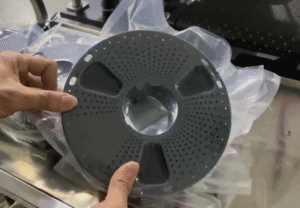
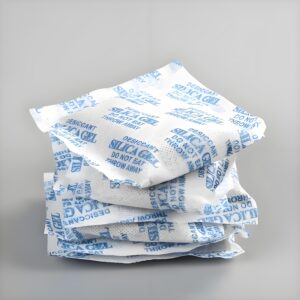
The desiccant packet inside a vacuum-sealed filament bag performs two functions: it absorbs residual moisture trapped inside the bag at the moment of sealing, and it provides a buffer against slow permeation through the bag material over time. On many packaging lines, desiccant insertion is a manual step — a worker places a silica gel packet into each bag before the spool is loaded. Manual insertion introduces two failure modes: missed insertion, where a packet is forgotten, and double insertion, where two packets are added — wasteful but not harmful — or an operator skips a bag thinking it was already done. Both failure modes are undetectable by visual inspection after vacuum sealing because the bag is opaque or metallized.
UBL’s bagging machines support an optional automatic desiccant dispensing module that eliminates both failure modes. The module uses an electric-eye sensor to verify desiccant presence at each feed point: if a desiccant packet is not detected, the machine triggers an alarm and halts the cycle, preventing an unprotected spool from proceeding to vacuum sealing. This is not a luxury add-on — for manufacturers shipping to markets with a 30–45 day transit time and stringent buyer quality expectations, it is the difference between shipping a protected product and shipping a ticking clock. The same automated logic applies wherever moisture is the enemy, and our guide to desiccant insertion for moisture-sensitive packs shows how the module carries into supplement cartoning.
Checkpoint 3: Bag Material — One Barrier Does Not Fit All
Not all vacuum bags offer the same moisture barrier performance. The choice of bag material should match the filament material being packaged and the expected transit duration. UBL’s machines are compatible with all standard flexible packaging materials, and the selection is driven by the customer’s product requirements — not by machine limitations:
| Bag Material | Moisture Barrier Level | Best For |
|---|---|---|
| PE/PE | Basic | Domestic short-transit, low-humidity markets |
| PA/PE (Nylon/Polyethylene) | Moderate | PLA, PETG — moderate transit duration, moderate humidity |
| PET / Metallized / PE | High | Nylon, ABS — long transit, high-humidity destinations |
| PET/AL/PE (Aluminum Foil Laminate) | Maximum | PVA, Nylon, specialty filaments — export-grade shipping, extended shelf life |
A manufacturer shipping PLA to a domestic distributor with a 3-day transit time can operate comfortably with PA/PE bags. A manufacturer shipping nylon-carbon-fiber composite filament to an Amazon FBA warehouse in Florida — with a 40-day ocean transit followed by potentially months of warehouse storage in a high-humidity climate — needs aluminum-foil-laminate bags and needs the bagging machine to seal them to full vacuum integrity on every cycle. The machine does not choose the material. The machine must perform regardless of which material the customer selects for their specific route-to-market.
Checkpoint 4: Quality Verification
On most filament packaging lines, quality verification of vacuum-sealed bags is performed by manual inspection — an operator visually checks each bag exiting the line for obvious seal defects, loose fit, or visible air pockets. UBL’s standard configuration supports this workflow with consistent, repeatable machine output. The key is that the machine’s sealing parameters — temperature, dwell time, jaw pressure — are set once and maintained uniformly across every cycle, so the baseline quality is machine-controlled rather than operator-dependent. When a manufacturer detects a trend in customer returns or quality complaints, the investigation starts with verifying that the machine’s sealing parameters have not drifted — and then extends upstream to bag material batch quality and desiccant freshness. The packaging line is the first variable to check because it is the one that directly controls the product’s exposure to the outside environment.
Case Study: 40% Efficiency Gain, 90% Reduction in Returns
One UBL customer — a filament manufacturer exporting primarily to North America — upgraded from a semi-automatic packaging setup to a fully automatic vacuum bagging line with integrated dust removal and automatic desiccant dispensing. Prior to the upgrade, the customer’s return rate attributable to moisture-related quality issues was significant enough to affect Amazon seller metrics and trigger FBA inventory investigations. After the upgrade:
| Metric | Before Upgrade | After Upgrade |
|---|---|---|
| Packaging line efficiency | Baseline (semi-auto) | +40% throughput increase |
| Moisture-related returns | Measurable, consistent rate | Down by approximately 90% |
| Desiccant placement | Manual — occasional misses | Automatic with electric-eye verification |
| Dust control | Not integrated | Integrated dust removal module |
| Vacuum seal consistency | Variable (operator-dependent) | Uniform at -0.08 MPa on every cycle |
The return rate reduction alone — approximately 90% — translated into a direct improvement in Amazon seller metrics, lower FBA removal order costs, and a faster path to buy-box eligibility. This is the direct ROI of effective filament moisture-proof packaging: fewer returns, lower logistics costs, and a brand that buyers trust to deliver usable product. The throughput increase of 40% meant the packaging line could absorb volume growth without adding headcount. The machine investment was recovered well within the first year through the combination of reduced returns and higher packaging throughput. The customer’s post-installation assessment was direct: the machine paid for itself even before factoring in the efficiency gain.
📹 Watch the UBL automatic vacuum bagging line in operation: see the complete cycle — spool loading, desiccant dispensing, vacuum sealing, and output — at production speed. [Customer production line video — link here]
Why the Bagging Machine Is the Quietest Variable — and the Loudest When It Fails
On a filament production line, the extrusion system, the winding station, and the diameter measurement equipment all get attention. They are visible. Their failures are immediate — a diameter deviation shows up on the laser micrometer readout in real time. The bagging machine at the end of the line is quieter. Its failures are delayed — a weak seal or a missing desiccant packet does not announce itself until the customer opens the package 40 or 50 days later. Compared to the extrusion and winding stations, filament moisture-proof packaging is the least visible variable on the line — and the one with the longest tail of consequences. By that time, hundreds or thousands of additional spools may have been packaged with the same undetected problem. The cost of a packaging-line failure is not the cost of reworking one bag. It is the cost of a batch recall, an Amazon account health warning, or a distributor relationship damaged by a pattern of avoidable returns.
This is why the four checkpoints — vacuum integrity, desiccant placement, bag material selection, and quality verification — are not optional considerations. They are the difference between a packaging line that looks functional and one that actually protects the product from the moment it leaves the factory until the moment it enters the customer’s printer.
What to Ask When Evaluating a Moisture-Proof Packaging Line for Filament
- What is the stable working vacuum level the machine can achieve and maintain across continuous operation?
- Is desiccant insertion manual or automated — and if automated, does the machine verify each placement?
- Does the machine support multiple bag materials (PA/PE, PET/AL/PE, PE/PE) without requiring hardware changes?
- What is the seal temperature control range and consistency across an 8-hour production shift?
- How does the machine handle dust-prone filament materials (PLA silk, carbon-fiber composites) that can contaminate seal surfaces?
- What is the after-sales response guarantee if a sealing parameter drifts and quality consistency drops mid-production?
Protect the Product Before It Leaves the Factory
The moisture that damages filament inside a shipping container was invited in at the packaging station. A bagging machine that seals with full vacuum integrity, deploys desiccant with verification, and maintains consistent parameters across thousands of cycles is not an incremental improvement over a manual setup — it is a fundamentally different category of protection. For filament manufacturers shipping internationally to markets with buyer expectations shaped by Amazon reviews and distributor quality audits, that difference is measured not in percentage points of efficiency but in the return rate, the seller rating, and the long-term health of the brand.
UBL offers a full trial process: send your filament spool specifications and target transit conditions, and UBL will configure a moisture-proof packaging test run with video documentation of the output. Standard configurations dispatch the next business day after contract signing. To discuss your specific packaging requirements, contact UBL at Helen@huanlianauto.com .