
Manual filament packing has a hard ceiling. At one person per station, even a disciplined team can only move so fast—and after two hours of repetitive sealing, speed drops as fatigue sets in. For 3D printing manufacturers trying to scale, the ceiling arrives quickly. An automatic filament packaging line removes that ceiling entirely.
This article walks through the real efficiency gap between manual and automatic packing, what staffing looks like at different automation levels, and how one filament manufacturer made the switch after discovering UBL’s equipment on YouTube.
For a technical overview of the full line architecture, start with our guide to 3D printing filament packaging lines.
The Manual Packing Baseline
Before calculating the ROI of automation, it helps to put accurate numbers on what manual packing actually delivers.
Pure Manual (No Equipment)
An operator manually inserting spools into bags, dropping in a desiccant sachet, and sealing the bag by hand manages roughly 5–10 spools per minute. Hand sealing is physically demanding and inherently inconsistent—seal quality varies between operators and degrades over a shift. There is no vacuum capability in a purely manual process.
Manual Bagging + Standalone Vacuum Machine
Adding a standalone vacuum sealer improves throughput to roughly 20 spools per minute for a skilled operator working at pace. However:
- Speed drops significantly after approximately two hours as operator fatigue accumulates
- Each additional throughput target requires purchasing additional vacuum machines and hiring additional operators
- Seal consistency remains operator-dependent
- The process cannot easily be integrated into an upstream production line
This model scales by adding bodies and machines in parallel—a cost structure that compounds quickly as volume grows.
What Automatic Packaging Delivers
Machine Speed
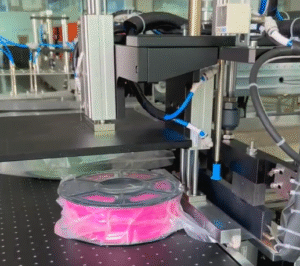
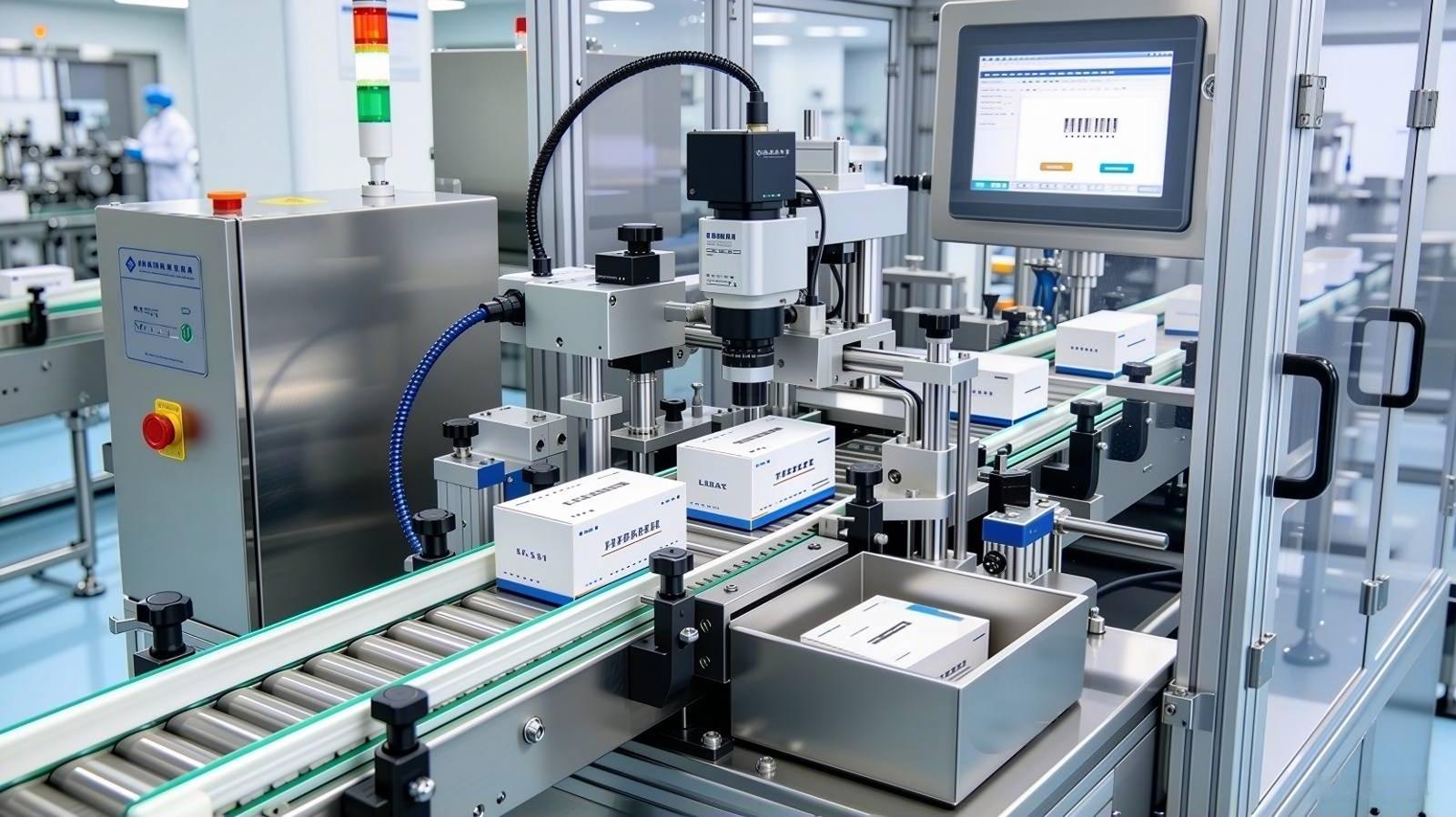
A UBL automatic filament bagging and vacuum sealing line runs at 30–40 spools per minute under standard configuration—three to eight times the throughput of a manual operator working at peak pace, before fatigue is factored in.
Operating Hours
A machine does not fatigue. Where a human operator realistically sustains peak pace for eight to ten hours before rest requirements limit output, a production line can run 15–18 hours per day with only periodic monitoring. At 30 spools per minute over a 15-hour run, that equates to approximately 27,000 spools per day from a single line—well above the manual ceiling of any same-sized team.
Consistency
Every sealed package exits the line at the same vacuum level (-0.08 MPa), the same seal width, and the same desiccant quantity. Manual processes cannot maintain this consistency at scale. See the filament vacuum packaging machine guide for vacuum specification details.
Staffing at Different Automation Levels
Automation does not mean zero labor—it means labor is redirected from repetitive physical work to monitoring and exception handling. Here is what staffing typically looks like at each level:
| Automation Level | Staff Required | What They Do |
|---|---|---|
| Manual only | 3–5 per station | Bagging, desiccant insertion, sealing, transfer—all manual |
| Semi-automatic (bagging machine + vacuum sealer) | 2 | One operator feeds spools; one transfers finished packages or packs into cartons |
| Fully automatic standalone line | 1–2 | One operator manages infeed; one handles discharge and carton packing |
| Fully automatic, integrated with production line and carton packing | 0–1 | One monitor/inspector; no repetitive manual steps in the product path |
The fully integrated scenario—where the line connects directly from filament extrusion output on one end to sealed, labeled, cartoned product on the other—is the highest-automation configuration. A single operator checks for machine faults; the line handles all product movement.
Real Case: From Three Operators to One
One 3D printing filament manufacturer came to UBL after trying to scale their existing manual process. Their original setup: two operators manually bagging spools, one operator running a standalone vacuum sealer. Output was limited, and the only way to increase throughput was to buy more vacuum machines and hire more people.
They found UBL through a product demonstration video on YouTube — [Watch the UBL filament packaging line demonstration] — and reached out after seeing that the same product could be processed at a dramatically higher rate.
What changed after switching to a UBL automatic line:
- Headcount: From 3 operators (2 bagging + 1 vacuum) → 1 operator managing the infeed
- Speed: 70% increase in packaging throughput
- Time to operation: From contract to running line in 2 months
The speed gain came not just from machine rate, but from eliminating the bottleneck of hand-sealing and the fatigue-driven slowdown in the afternoon shift. The line runs consistently at the same pace from the first hour to the last.
For details on how the bagging station operates in this kind of setup, see the filament bagging machine article.
When Does Automation Make Financial Sense?
The crossover point depends on your output volume and local labor costs, but UBL’s general guideline is:
| Daily Output Target | Recommended Configuration |
|---|---|
| Under 20,000 spools/day | Semi-automatic bagging module — strong ROI without full-line investment |
| 20,000–50,000 spools/day | Semi-auto with staged upgrades; evaluate full-auto ROI based on labor cost |
| 50,000+ spools/day | Fully automatic line — labor elimination at scale justifies the investment |
For the fully automatic configuration to deliver its designed throughput, the line needs to run. At 30 spools per minute, a 15-hour operating day produces approximately 27,000 spools. To reach 50,000 spools per day, either a faster line configuration, longer operating hours, or a second line is required. UBL evaluates your specific volume target and proposes a configuration—including layout and station count—before you commit to a specification.
The Upgrade Path: You Don’t Have to Start at Full Automation
Most manufacturers don’t go from fully manual to fully automatic in a single step. The practical upgrade path typically looks like this:
- Stage 1: Replace hand sealing with a semi-automatic bagging machine. Operators still handle product placement; the machine handles bag opening, product infeed, and sealing. Speed roughly doubles; seal consistency improves dramatically.
- Stage 2: Add an automatic desiccant dispenser. Eliminates manual sachet insertion from the operator’s workflow.
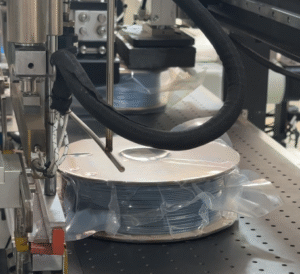
- Stage 3: Connect to an inline vacuum sealing station. The sealed bag passes directly to the vacuum chamber—no manual transfer between stations.
- Stage 4: Add a labeling machine downstream. Batch number, material spec, and QR code applied automatically after sealing.
- Stage 5: Connect a cartoning machine for automatic box packing at the end of the line.
Because UBL designs each station as a modular unit, the machines bought in Stage 1 integrate cleanly with the equipment added in Stage 3, 4, and 5. The modular layout also means the line can adapt to your floor plan—turning corners or folding back on itself where a straight run isn’t possible.
For a full view of all the stations in a complete line, see the filament packaging line overview.
Getting Started
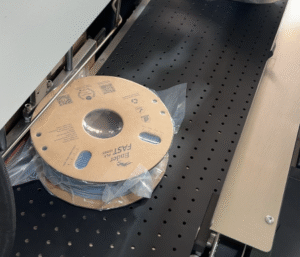
The fastest way to evaluate whether automation is right for your operation is to see your own product running through the machine. UBL supports sample testing—send us your spools with your packaging requirements, and we’ll run them through the line and document speed, seal quality, and vacuum performance.
We also offer remote video demonstrations and customer case references if you want to see comparable operations before committing to a factory visit.
Contact UBL with your current daily output, spool dimensions, and packaging format to receive a configuration recommendation and layout proposal: | ublpackaging.com
Summary
The gap between manual filament packing and automatic line packaging is not marginal—it’s a 3× to 8× throughput difference, sustained over a 15–18 hour operating day without the fatigue decline that limits human operators. The decision to automate comes down to daily volume: under 20,000 spools, a semi-automatic module delivers strong ROI; above 50,000, a full line is the economical choice.
The upgrade doesn’t have to happen all at once. Every station UBL builds is modular and connectable—your starting point today can scale into a full line as your volume justifies the next step.


4 responses
The shift from manual to automated filament packaging really highlights how quickly human-paced production can become a bottleneck, especially as demand grows. It’s fascinating to see how automation not only boosts speed but also maintains consistency—something that’s hard to achieve with repetitive manual tasks. This article does a great job of showing the real-world impact of scaling up efficiently.
The point about manual packing hitting a productivity ceiling due to fatigue really stands out—it’s something a lot of manufacturers underestimate until it starts affecting output. I’d be curious to see more detail on the transition phase, especially how teams adapt when shifting from manual roles to overseeing automated systems. It seems like the real value isn’t just speed, but consistency and scalability over time.
The point about fatigue creating a hard ceiling on manual output really resonates, especially for scaling 3D printing manufacturers. It clearly highlights how transitioning to a fully automated line isn’t just about speed, but about removing the physical limitations that inevitably slow human teams down as the day progresses.