
Not every 3D printing filament manufacturer needs a fully automated packaging line—and not every growing operation can afford to stay on manual packing. Choosing the right spool packaging machine depends on three practical factors: your daily output volume, your available floor space, and your capital budget. This guide maps those factors to specific equipment configurations so you can make a clear decision before you request a quote.
For an overview of how a complete packaging line is structured, see our guide on 3D printing filament packaging lines.
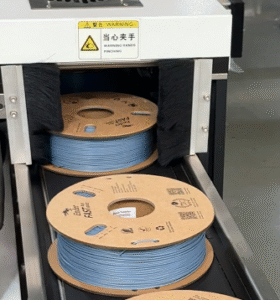
What “Spool Packaging Machine” Actually Covers
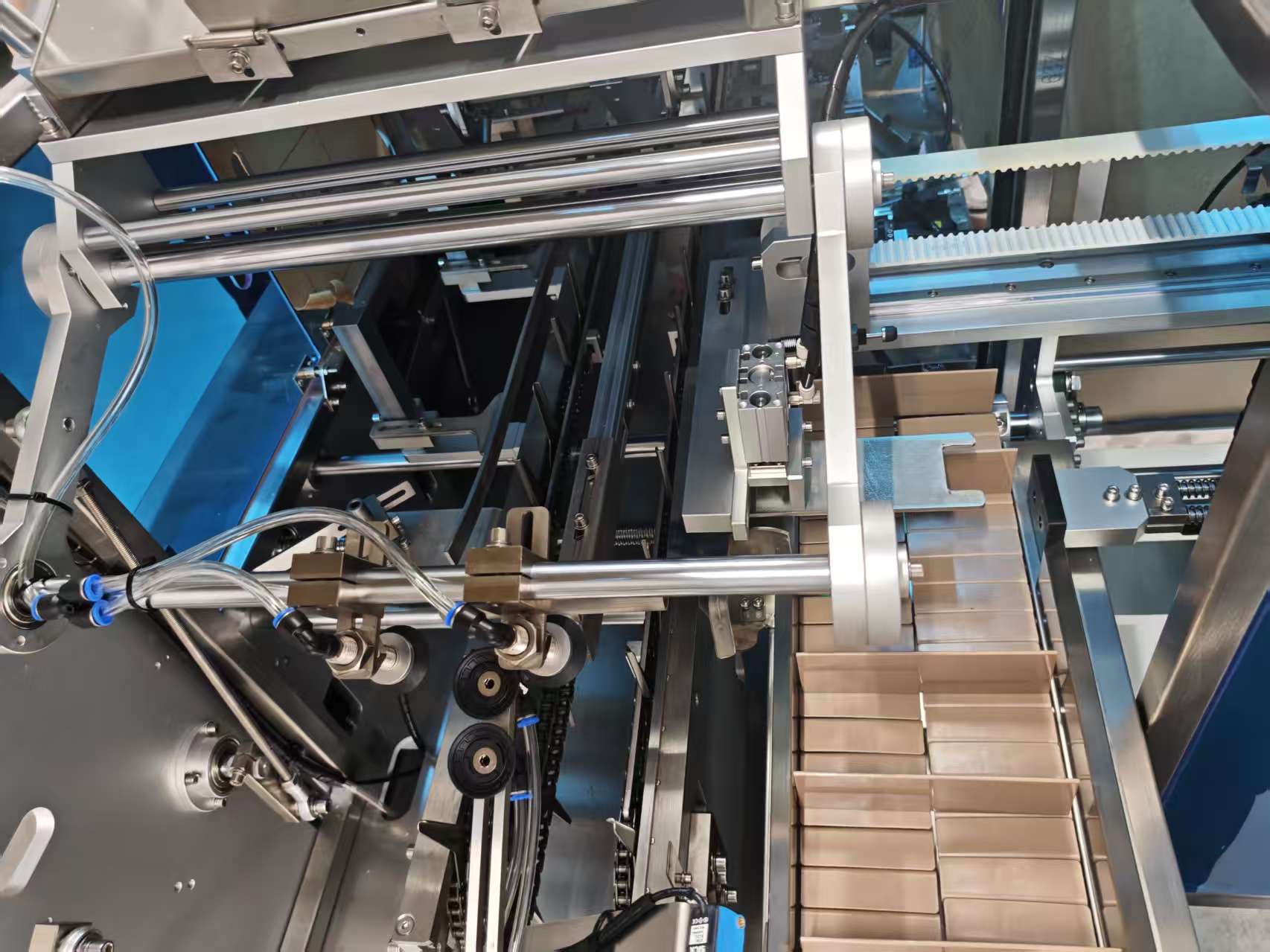
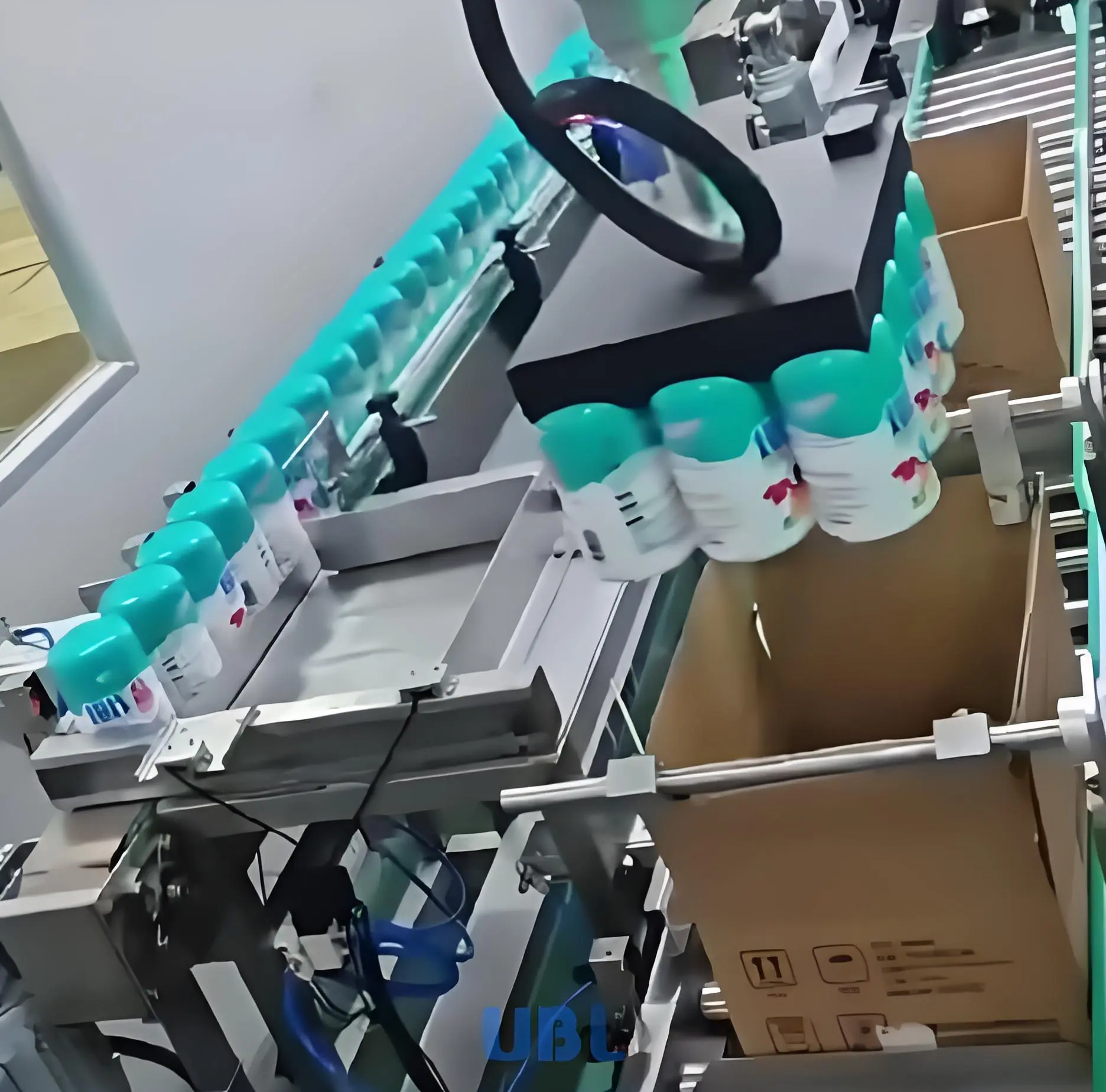
The term spool packaging machine typically refers to a bagging machine configured for cylindrical spool products. “Bagging machine” is the generic equipment category—the product prefix changes based on what you’re running through it. A spool bagging machine handles the core steps:
- Opening a bag (from roll film or premade pouches)
- Inserting the spool into the bag
- Optionally inserting a desiccant sachet
- Sealing the bag shut
The machine can operate as a standalone unit or as one station in a complete automated packaging line that continues downstream to vacuum sealing, labeling, and box packing.
The Core Decision: Semi-Automatic vs Fully Automatic
Most manufacturers land in one of two configurations. The right choice is determined by volume, space, and investment capacity—not by preference.
Semi-Automatic Spool Bagging
In a semi-automatic setup, the machine handles the mechanical work (bag opening, sealing, cutting) while the operator places each spool into the bag mouth and manages the discharge station. A desiccant can be dropped manually before sealing.
Recommended when:
- Daily packaging volume is under 20,000 spools
- Floor space is limited or irregularly shaped
- Capital budget is constrained—semi-automatic lines are significantly more affordable
- Flexibility is a priority—human operators adapt instantly to format changes
Semi-automatic packaging is a legitimate long-term solution for small to mid-size filament producers, not just an entry-level stepping stone. Many manufacturers find that a semi-automatic bagging module with machine-driven sealing delivers the right balance between labor savings and investment.
Fully Automatic Spool Packaging Line
A fully automatic line removes the operator from the product path entirely. Spools are fed in at one end; sealed packages come out the other. Human operators manage loading, monitoring, and exception handling—not the package-by-package work.
Recommended when:
- Daily packaging volume is 50,000 spools or above
- Labor costs are a significant operational burden
- Consistent output quality at speed is a contractual requirement
- Floor space is adequate for a modular line layout
Full automation is sized for high-volume operations. The investment is justified by labor elimination at scale, not by incremental productivity gains.
The Gap Between 20,000 and 50,000
Manufacturers in the 20,000–50,000 daily spool range sit in a judgment zone. The right answer depends on labor cost in your market, your growth trajectory, and your floor plan. A semi-automatic line can be upgraded incrementally—adding an automatic desiccant dispenser, connecting to a downstream vacuum sealing station, or integrating a labeler—without replacing the whole line. This modular upgrade path is often the more cost-effective route for mid-volume operations.
Key Technical Specifications to Evaluate
Maximum Spool Weight
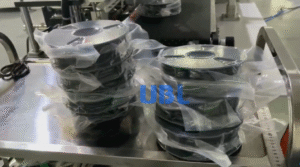
The machine’s mechanical design determines how heavy a spool it can handle reliably. UBL spool bagging machines are engineered to handle spools up to 3 kg—covering the full range of consumer and prosumer filament formats, from 200g desktop spools to 2.85kg production spools.
If your product line includes 5 kg or larger industrial spools, confirm weight capacity before specifying equipment. Overloading a bagging machine’s pusher mechanism is a common cause of premature wear.
Compatible Bag Dimensions
Standard spool packaging machines accommodate a range of bag sizes. UBL’s reference compatibility range for filament spools:
| Dimension | Compatible Range |
|---|---|
| Length (L) | 250 – 350 mm |
| Width (W) | 110 – 220 mm |
| Height / Gusset (H) | 40 – 90 mm |
These are reference values for standard filament spool formats. Machines are custom-specified based on your actual spool dimensions—contact UBL with your product dimensions for a confirmed compatibility assessment.
Format Changeover Time
When switching between spool sizes—say, from a 1 kg to a 2 kg format—the bagging machine requires mechanical adjustment. On UBL machines, format changeover takes approximately 15 minutes, involving adjustments to the bag guide width and pusher depth. No specialized tools are required, but the operator needs familiarity with the adjustment procedure.
If you run multiple spool formats frequently, factor changeover time into your line efficiency calculations. A line running two formats per shift will lose 30 minutes of productive time to changeovers—which may affect your net hourly output target.
Bag Material Compatibility
Spool bagging machines accommodate multiple bag materials. The most common for 3D printing filament:
- PE composite film – Standard moisture barrier, cost-effective for domestic shipping
- High-temperature PE – Higher sealing temperature tolerance, stronger seal integrity
- BOPP film – High transparency for retail display, good moisture resistance
Material selection interacts with your sealing temperature and speed settings. See our detailed breakdown in the filament vacuum packaging machine guide.
Roll Film vs Premade Pouch: Which Suits Your Operation?
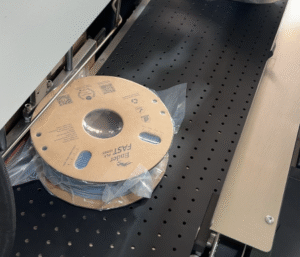
Spool bagging machines run in two bag-supply configurations:
| Factor | Roll Film (Form-Fill-Seal) | Premade Pouch |
|---|---|---|
| Bag cost per unit | Lower | Higher |
| Print quality / branding | Moderate (inline printing possible) | High (pre-printed bags) |
| Bag supply | Sourced as film roll | Customer supplies finished bags |
| Format flexibility | Adjustable on-machine | Fixed to premade dimensions |
| Common use case | High-volume, cost-optimized runs | Branded retail packaging |
Roll film is the more common configuration in filament manufacturing because it reduces per-unit cost at scale and eliminates dependency on an external bag supplier’s lead time. For customers with established brand packaging already in production, premade pouch configurations are fully supported—contact us with bag specifications.
Integrating the Bagging Machine into a Complete Line
A spool bagging machine rarely operates in isolation. The most common downstream connections:
- Vacuum sealing station – The sealed spool passes directly to a vacuum chamber that draws down to -0.08 MPa before final heat-sealing.
- Labeling machine – Applies printed labels with batch number, material spec, and QR code after vacuum sealing
- Cartoning machine – Inserts sealed, labeled spools into retail or shipping cartons for final dispatch
UBL designs each station as a modular unit, which means the bagging machine can run standalone today and connect to upstream and downstream equipment as your volume grows. The modular layout also means the line can turn corners or fold back on itself to fit non-linear floor plans—a significant advantage in factories where straight-line runs aren’t possible.
For a full view of how these stations connect end-to-end, see the 3D printing filament packaging line overview.
Capacity Planning: Matching Machine Configuration to Output
Before specifying equipment, map your current and projected output against the configuration thresholds:
| Daily Output | Recommended Configuration | Notes |
|---|---|---|
| Under 20,000 spools/day | Semi-automatic bagging module | Operator manages product placement; machine handles bag opening, sealing, cutting |
| 20,000 – 50,000 spools/day | Semi-auto with automation upgrades | Add automatic desiccant dispenser, downstream vacuum sealer; evaluate full-auto ROI |
| 50,000+ spools/day | Fully automatic packaging line | Operator-free product path; full line from infeed to cartoning |
Line speed is determined by the slowest station in the sequence—the bottleneck machine sets the ceiling for the entire line. When specifying a complete line, UBL evaluates each station’s throughput to ensure the configuration as a whole meets your daily output target without creating upstream queues or downstream idle time.
Questions to Ask Before Specifying a Spool Packaging Machine
- What is your maximum spool weight? Weight determines mechanical requirements for the pusher and conveyor systems
- What spool formats do you run, and how often do you switch? High-frequency changeovers favor simpler adjustment mechanisms
- What is your peak daily packaging volume? This is the single most important variable in the semi-auto vs full-auto decision
- Do you need vacuum sealing integrated in-line, or as a separate station? In-line integration changes the physical footprint and conveyor layout
- What bag material are you currently using, or planning to use? This affects sealing specification and machine compatibility
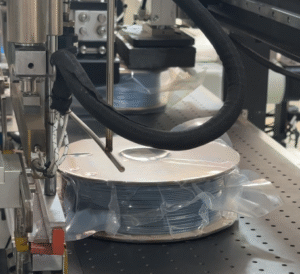
UBL supports pre-sale sample testing—send us your spools and we’ll run them through the machine and document the results before you commit to a specification. Contact our team to arrange a sample test or request a line layout proposal.
Summary
The right spool packaging machine is the one that matches your output, your floor plan, and your investment timeline—not the most automated option on the market. For operations under 20,000 spools per day, a semi-automatic bagging module with downstream sealing integration is typically the most cost-effective starting point. For high-volume operations above 50,000 spools daily, a fully automatic line delivers the labor elimination and throughput consistency that justify the capital investment.
UBL builds both configurations as modular systems, meaning your starting point can grow with you. Explore the full line architecture in our filament packaging line guide, or contact us with your production parameters for a tailored recommendation.
Contact UBL Packaging for a technical consultation or sample test: helen@huanlianauto.com | ublpackaging.com


6 responses
It’s interesting how you point out that automation isn’t always necessary. I think many small-scale 3D printing businesses might overlook how much space and budget impact their packaging decisions.
This breakdown of the key factors—output volume, floor space, and budget—really helps clarify how to approach spool packaging machine selection. It’s easy to get overwhelmed by options, but focusing on these practical aspects makes the decision much more manageable. Thanks for the clear guidance on aligning equipment choices with operational needs.
This breakdown of the key factors—output volume, floor space, and budget—really helps clarify how to approach spool packaging automation without overcomplicating the decision. It’s easy to get caught up in feature lists, but knowing how to align those specs with actual operational needs is what makes the right machine selection sustainable in the long run.
This guide effectively highlights the critical balance between daily output, floor space, and budget when selecting spool packaging equipment. It’s a refreshing reminder that not every operation needs a fully automated line, as matching the solution to specific growth stages is often more cost-effective. The focus on mapping these practical factors to equipment configurations provides a clear roadmap for making informed investment decisions.
The article’s focus on balancing daily output, floor space, and budget is spot-on, as it really helps clarify whether a full automated line is necessary or if a semi-auto solution would be more practical. I appreciate how you highlighted that not every filament manufacturer needs the same setup, since many overlook how their specific volume thresholds dictate the equipment choice. This structured approach to matching equipment configurations with actual operational constraints is exactly what buyers need to avoid overspending before even requesting a quote.
This breakdown of balancing daily output, floor space, and budget is incredibly practical, especially for smaller operations who might feel overwhelmed by fully automated options. It’s refreshing to see the distinction that not every filament manufacturer needs the most expensive high-speed line, as a tailored approach often yields better long-term results than over-investing upfront.