Most food manufacturers who invest in automated cartoning equipment have a clear benchmark in mind: reduce labor, increase throughput, or eliminate a specific packaging bottleneck. The manufacturer in this cookie cartoning case study had all three, with the added complexity of a glue-sealed carton requirement that made manual packaging slower, messier, and more expensive than simple box-folding operations. What made this deployment notable was how the discovery happened: the factory owner saw a glue seal cartoning machine packaging food products on Instagram, recognized it could solve his factory’s most persistent problem, and moved from first contact to production-line deployment with a labor reduction from eight workers to two, all within one month.
Before Automation: Eight Workers and the Glue-Sealing Problem
The Product and the Packaging Challenge
A mid-sized cookie and biscuit manufacturer in Southeast Asia produces individually wrapped cookie packets for retail and wholesale distribution. Each packet enters the packaging line ready for its secondary packaging step: being loaded into a glue-sealed carton box for retail shelf presentation. The box type uses hot-melt adhesive to create a tamper-evident seal that cannot be opened and re-closed without visible damage. This format is standard in the food industry because it prevents product tampering, reduces pilferage risk, and eliminates disputes about product quantity upon arrival. Tuck-end boxes, which can be opened and re-closed without leaving evidence, do not address these concerns.
For the cookie manufacturer, the glue-seal requirement was non-negotiable. The factory supplied major retail chains where carton integrity was part of the purchasing agreement. But the glue-seal requirement also made manual packaging significantly harder than it would have been with a simple tuck-end box.
The Labor Breakdown Before Automation
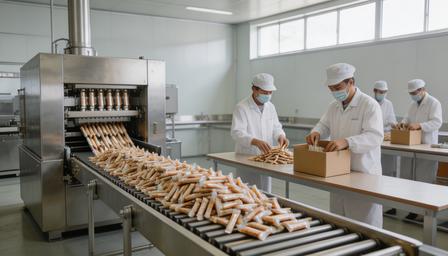
Before automation, the secondary packaging station operated with eight workers assigned to a single task chain. Two workers manually opened flat carton blanks and folded the bottom flaps. Three workers placed individually wrapped cookie packets into each open box, carefully arranging them to reach the correct count per carton without damaging the product. Two workers handled the most difficult task: manually applying hot-melt glue to the end flaps, pressing them closed, and holding each carton until the adhesive set. A final worker transferred completed cartons onto the conveyor feeding the next processing step.
The manual glue-sealing station was the persistent source of quality issues on the packaging line. Workers who applied too little glue produced cartons whose flaps peeled open during transport. Workers who applied too much glue created a messy appearance on the finished carton. Workers who did not hold the flap closed long enough produced a weak bond that failed during downstream handling. Every shift produced cartons that had to be reworked, which meant peeling open the flap, scraping off the dried adhesive, applying new glue, and re-sealing. This rework process consumed productive time and created a secondary quality risk.
The glue-sealing problem was not a training issue. It was a mechanical limitation of manual work. Human hands cannot apply adhesive at the same bead geometry, pressure, and setting time on every cycle. A glue seal cartoning machine can.
The Discovery: An Instagram Video That Changed the Production Floor
Finding the Right Machine for Glue-Sealed Cartons
The factory owner had been actively looking for automation solutions for the secondary packaging station for several months. The specific requirement was narrow: the machine needed to handle glue-sealed cartons without requiring any change to the existing box dimensions, needed to automate the full open-load-seal sequence, and needed to produce tamper-evident seals consistently at production speed.
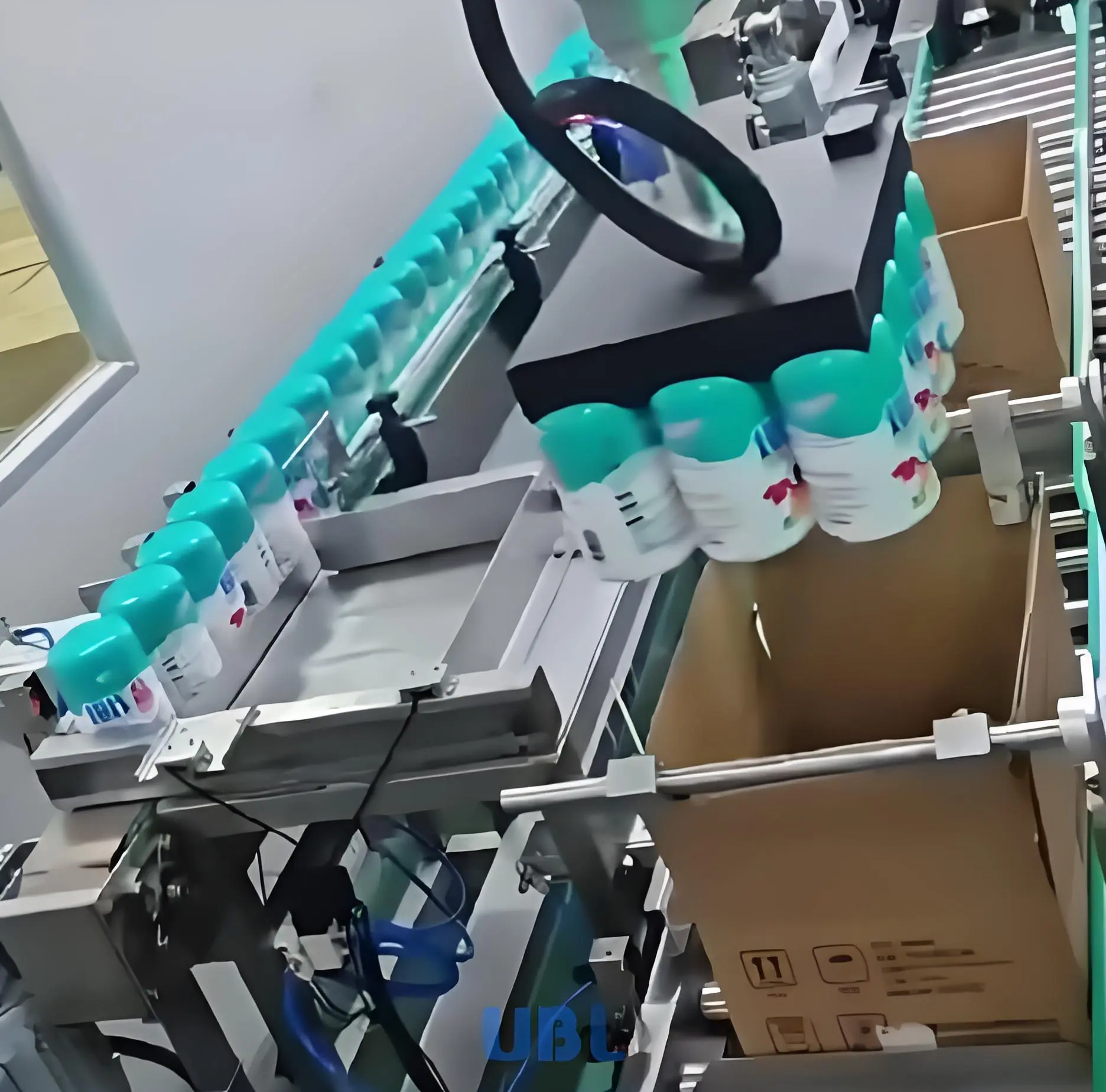
While browsing Instagram, the owner came across a video from UBL Packaging showing a glue seal cartoning machine automatically opening carton blanks, loading wrapped food product into the formed boxes, applying hot-melt adhesive to the end flaps, and sealing each carton in a continuous mechanical cycle. The video showed exactly the process the manual line was performing, but without the glue inconsistency, the rework, or the eight-worker labor cost. He contacted UBL the same day.

The Sample Trial: Seeing Results Without Sharing Product Details
The cookie manufacturer was concerned about product confidentiality. Sending actual product samples to a machine supplier meant revealing package formats, product dimensions, and production details to an external party. UBL’s team proposed an alternative: the customer sent the carton blank dimensions, the product dimensions, and the required count per box. UBL sourced similar-sized box blanks from its own supply and configured the glue seal cartoning machine with infeed and closing parameters matching the customer’s specifications.
The test run was recorded on video and sent to the customer. The video showed the machine opening each blank, forming the box, advancing simulated product through the infeed, applying the hot-melt adhesive bead, and sealing the carton, all at production speed. The customer could see the carton closing quality, the adhesive application pattern, and the cycle time without revealing any proprietary product information. Within three days of the video review, the customer confirmed the order.
Click to watch the machine running video
After Automation: One Machine, Two Workers, Zero Manual Gluing
The New Labor Configuration
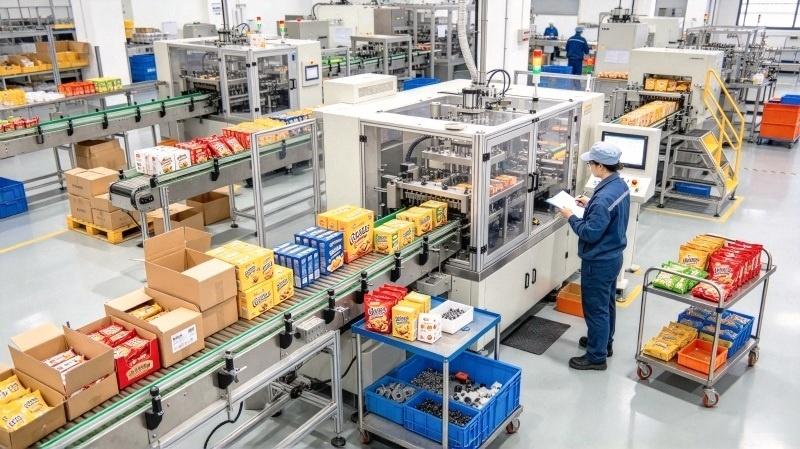
One month after the initial contact, the UBL glue seal cartoning machine was installed and commissioned at the cookie factory. The secondary packaging station was reconfigured from an eight-worker manual line to a two-worker machine-assisted workflow. One worker is positioned at the infeed, placing individually wrapped cookie packets onto the machine’s product infeed conveyor. The second worker is positioned at the output end, transferring sealed cartons from the machine discharge onto the conveyor leading to the downstream case-packing and palletizing stage.
The tasks that previously consumed six workers, manual folding of flat blanks, manual loading of product, manual glue application, and manual flap closing, are now performed by the glue seal cartoning machine in a continuous mechanical cycle. The machine opens each blank, forms the box, loads the correct count of cookie packets, applies the hot-melt adhesive bead at the programmed temperature and pattern, presses the flaps closed, holds them for the correct setting time, and discharges the sealed carton, all without operator intervention.
Throughput: Consistent Output, Zero Rework
The machine output was consistent from the first production shift. The manual line output had varied throughout the day, faster in the first hours, slower as fatigue accumulated, and interrupted by rework cycles when glue application issues were detected at the downstream inspection point. The glue seal cartoning machine delivered the same output at 9:00 AM as it did at 4:30 PM. The carton defect rate from adhesive issues dropped to near zero. The rework station that had been part of the manual line was removed entirely because there was nothing to rework.
How the Glue-Seal Cartoning Machine Works
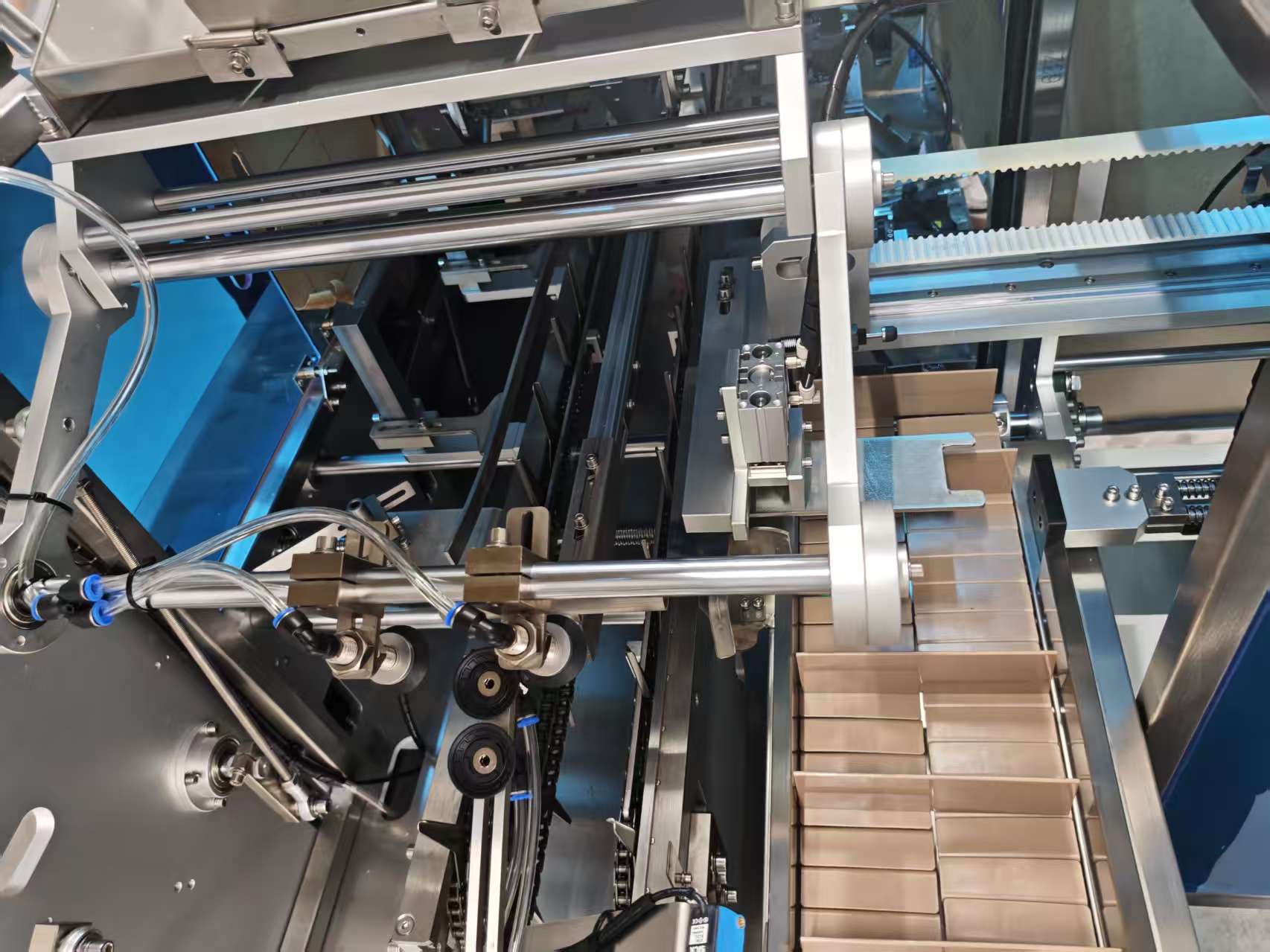
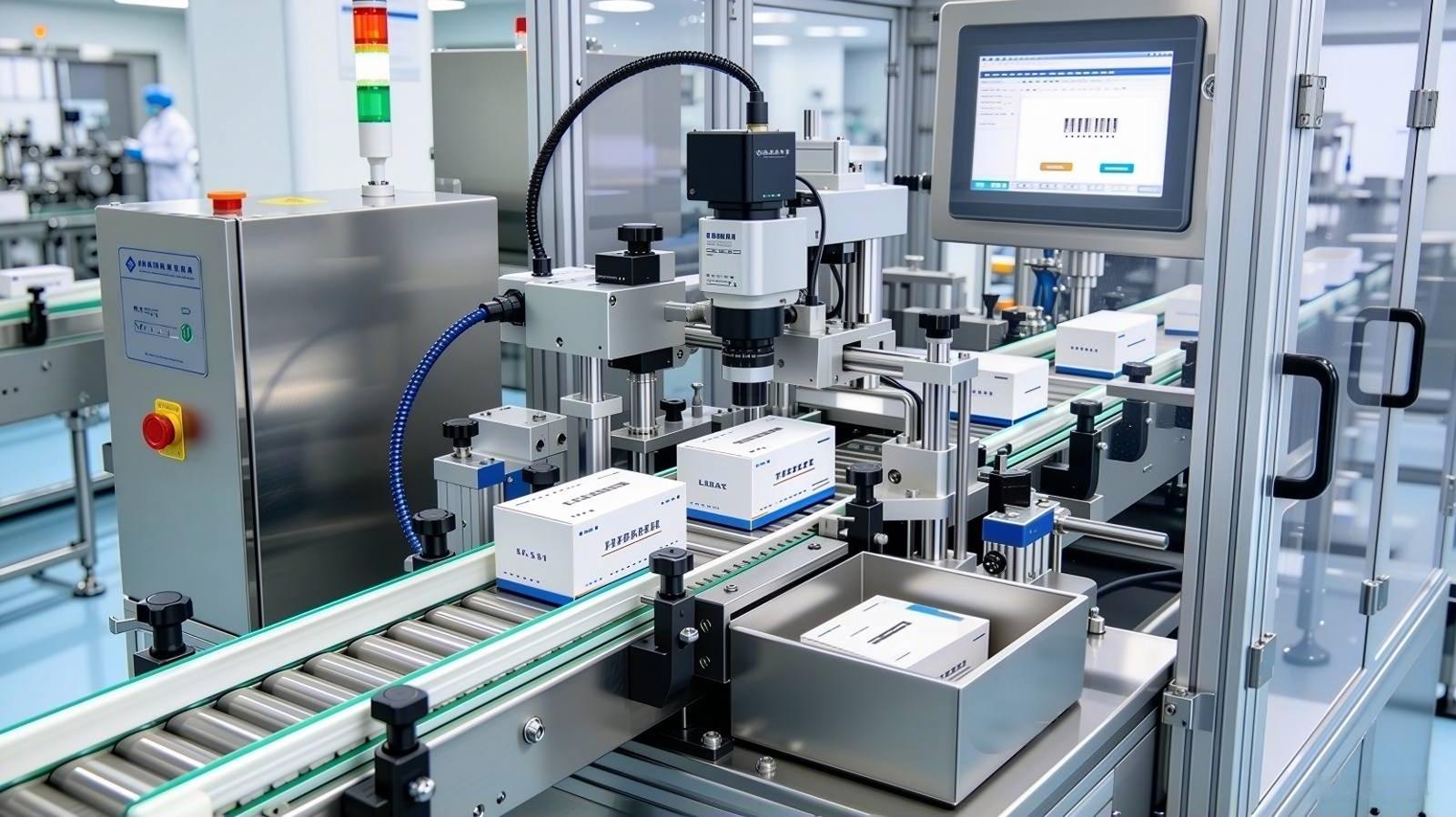
A UBL glue seal cartoning machine performs the complete secondary packaging sequence in a continuous mechanical cycle. A flat carton blank is picked from the magazine by vacuum cups and transferred to the forming station, where mechanical folders erect the blank into a three-dimensional box. The formed box moves to the loading station, where the product is pushed into the open box by a servo-driven pusher mechanism. The filled box advances to the sealing station, where a hot-melt adhesive applicator applies a precisely controlled bead of glue to the end flaps. The flaps are pressed closed and held for the programmed setting time, after which the sealed carton is discharged to the outfeed conveyor.
The hot-melt adhesive system is the component that distinguishes a glue-seal cartoning machine from a tuck-end machine. UBL machines use international-brand hot-melt applicators that maintain consistent adhesive temperature and bead geometry across the full production shift. The adhesive temperature, bead pattern, and setting time are programmed through the machine’s HMI and can be adjusted for different carton sizes and adhesive formulations without mechanical modification. For a broader overview of UBL machines, see the UBL cartoning machine product series which covers glue-seal, tuck-end, and snap-lock bottom configurations.
Why Manual Glue Application Is the Weak Link in Food Packaging Lines
Manual glue application in food packaging is one of those tasks that looks simple until it has to be done correctly at production volumes. The worker uses a glue gun or brush to apply hot-melt adhesive to the carton flap, presses the flap closed, and holds it for the required setting time. At the volumes required to serve retail and e-commerce channels, thousands of cartons per shift, manual glue application becomes both the bottleneck and the quality risk simultaneously.
The problems with manual glue application are inherent to the process. Adhesive temperature varies as the glue pot cools between applications. Bead pattern varies with the worker’s hand motion and speed. Setting time varies with the worker’s fatigue level. These variables produce cartons whose seal quality is inconsistent across a shift and across different workers. The inspection station downstream of the packaging line catches the worst cases, but borderline cases pass through and fail during distribution.
A glue seal cartoning machine eliminates all of these variables. The same applicator applies the same bead pattern at the same temperature and pressure on every cycle. The same mechanical closure presses each flap with the same force for the same duration. The result is a carton whose seal quality is identical from the first box of the shift to the last, regardless of how many hours the machine has been running or which operator is monitoring the infeed.
ROI: Six Workers Saved, Twelve-Month Payback
The most straightforward component of the ROI calculation is the direct labor saving: six workers removed from the secondary packaging station. The machine requires two workers instead of the previous eight. The two remaining workers are positioned at infeed and outfeed, roles that require less training, less physical effort, and less specialized skill than the manual folding, gluing, and closing tasks they replaced.
At the regional labor cost level for the factory’s market, the annual saving from six packaging positions exceeded the machine’s purchase price within approximately twelve months. The payback was shorter than initial projections because the elimination of glue-related rework added savings that had not been fully counted in the pre-purchase estimate.
Beyond direct labor, three indirect costs were eliminated. Product rework from failed glue bonds, which had required a dedicated rework station, dropped to zero. Carton waste from glue-damaged blanks decreased because the machine applied adhesive in a controlled pattern with no overspray or excess. Worker-related cost variables, absenteeism, training new workers on the glue application technique, and quality variation between workers on different shifts, were substantially removed from the packaging station.

Why Glue-Seal Cartoning Matters for Food Manufacturers
The glue-sealed carton format is the preferred choice for food manufacturers selling through retail chains and e-commerce platforms for three reasons that go beyond packaging aesthetics. First, tamper evidence. A glue-sealed carton cannot be opened and re-closed without visible damage because the adhesive bond tears the carton surface when pried apart. For food manufacturers shipping to retail and e-commerce customers, this tamper-evident property reduces disputes about product quantity and condition upon arrival.
Second, structural integrity during distribution. A glue-sealed carton maintains its closed state through the vibration, stacking pressure, and temperature changes of long-distance transport. Tuck-end boxes can pop open under these conditions. Glue-sealed boxes remain closed throughout the distribution cycle. Third, retail buyer compliance. Major retail chains increasingly specify glue-sealed or tamper-evident carton formats in their packaging requirements for food products.
UBL glue seal cartoning machines support speeds of 1,500 to 2,400 cartons per hour using international-brand hot-melt applicators, meeting the throughput requirements of retail-bound food production. For a detailed comparison of carton formats, see the tuck-end vs snap-lock bottom carton format guide which covers the structural differences and which product types each format suits.
What Makes This Deployment Repeatable Across Food Categories
The cookie manufacturer’s success with this glue seal cartoning machine benefits from an operational pattern that applies broadly across food categories. The product was already sealed in primary packaging before entering the cartoning station. The cartoning machine performed secondary packaging, handling a sealed, uniform product unit rather than an exposed food surface. This means any food manufacturer with a product already packaged in a wrapper, pouch, or sealed tray before cartoning can deploy the same machine configuration with no food-safety validation barrier.
The box type, glue-sealed carton, is one of the standard formats that UBL machines handle natively, alongside tuck-end and snap-lock bottom cartons. A manufacturer evaluating cartoning automation can proceed with confidence if their existing box is a standard format. In most cases, the existing box design does not need to change. The machine adapts to the box format, not the other way around.
Where the packaging line includes a carton folding machine upstream of the cartoning station, the two machines are synchronized to maintain consistent carton flow. UBL’s carton folding machines handle snap-lock bottom boxes at 40 to 60 boxes per minute and tuck-end boxes at 40 to 60 boxes per minute, feeding directly into the cartoning machine’s blank magazine without intermediate manual handling.
Common Questions About Glue-Seal Cartoning Machines
What types of hot-melt adhesive does the machine support?
The glue seal cartoning machine supports standard food-grade hot-melt adhesives used in secondary packaging. The adhesive temperature range and bead pattern are programmable through the HMI. If you use a specific adhesive formulation, send a sample with your carton blanks during the trial process and UBL will verify compatibility.
Does the machine require compressed air?
Yes. The hot-melt adhesive applicator requires a compressed air supply. UBL’s installation team confirms that your facility’s compressed air system meets the requirement during the pre-purchase technical review.
Can the machine switch between glue-seal and tuck-end cartons?
A single UBL glue seal cartoning machine is configured for one closing format at the time of manufacture. If your facility produces products that require both formats, configure the machine for the format that covers the majority of your volume.
What are the minimum and maximum carton sizes?
The dimensions vary by machine model. UBL’s team confirms dimensional compatibility during the pre-purchase technical review based on your carton sample. The sample trial process verifies that your specific carton dimensions feed, form, and seal correctly on the machine.
How long does installation and training take?
Installation and commissioning are typically completed within one to two days. Operator training takes approximately two hours. A one-year warranty covering parts and service is included with every machine purchase.
How to Start
UBL supports sample trial runs before purchase. Send your product dimensions, carton blank specifications, and output requirements to the UBL team. The engineering team configures a test cycle on the relevant glue seal cartoning machine and provides video documentation of the output, including carton closing quality, adhesive application consistency, cycle speed, and any format adjustments required. The trial is provided at no cost and does not require a purchase commitment.
Standard glue-seal cartoning machine configurations are available for next-business-day dispatch after contract signing. Custom configurations for non-standard carton dimensions or specific hot-melt adhesive requirements are typically available within three months of design confirmation. Installation and commissioning are included in the purchase price. On-site operator training takes approximately two hours.
For a broader perspective on selecting the right machine for your product, see the food packaging cartoning machine selection guide which covers how to match machine type to product category and what to confirm before purchasing.
To discuss your product format, carton specification, and glue-seal requirements, contact the UBL team at helen@huanlianauto.com or visit ublpackaging.com.
Carton Integrity in the Food Supply Chain
Food products moving through retail and e-commerce supply chains are subject to handling conditions that test carton integrity at every stage. Cartons are stacked on pallets, transported by truck across varying distances and climates, sorted in distribution centers by automated equipment, and placed on retail shelves by staff who may not handle them gently. A glue-sealed carton that was closed properly at the factory will remain closed through all of these handling stages. A carton whose glue bond is weak will fail, and the failure will be visible: a popped flap, a spilled product, a damaged retail display.
For the cookie manufacturer in this case study, the switch from manual glue application to automated glue seal cartoning eliminated the variability that had been producing intermittent seal failures in the supply chain. The machine consistent adhesive application and mechanical flap closing produced cartons whose integrity was uniform across every production batch. The retail buyer who had raised a quality complaint about carton seal quality three months before the automation project began did not raise another complaint after the machine was installed. The improvement in supply chain performance was immediate and measurable.
Food Safety and Regulatory Compliance
Food manufacturers operating under SQF, BRC, or FSSC 22000 audit frameworks have specific requirements for equipment and materials used in food production areas. The hot-melt adhesive used in a glue seal cartoning machine must be food-grade and must not transfer to the product or the carton interior during the sealing process. UBL glue-seal cartoning machines use international-brand hot-melt applicators that maintain consistent adhesive temperature and prevent adhesive contamination of the product area. The adhesive is applied only to the carton flap surface, which is outside the product containment zone of the sealed carton.
The machine stainless-steel frame and food-contact-adjacent surfaces meet the sanitary design requirements of food-grade production environments. The machine is designed for access during cleaning procedures, and the adhesive system includes drip trays and shields that prevent adhesive residue from accumulating on machine surfaces. For facilities with specific allergen segregation or cleaning protocol requirements, UBL provides a detailed equipment specification that confirms compliance with the relevant food safety standards.
Changeover and SKU Flexibility
The cookie manufacturer produces multiple SKUs with different carton dimensions and product counts per box. Changeover between SKUs on the manual line required reconfiguring the glue application setup, adjusting the folding guides, and retraining workers on the new count requirements, typically 30 to 45 minutes per changeover. On the glue seal cartoning machine, changeover is completed in under ten minutes for dimension adjustments within the same box style. The operator adjusts the guide width using handwheels on the forming and closing modules, with target dimensions displayed on the HMI screen. The adhesive application parameters, bead pattern, temperature, and setting time, are recalled automatically when the corresponding SKU is selected.
This quick changeover capability is particularly valuable for a manufacturer producing 10 or more SKUs on a single line. A facility with three changeovers per week saves over 100 hours of lost production time annually by reducing changeover duration from 45 minutes to 10 minutes. For facilities that also produce tuck-end cartons for certain SKUs, the changeover between glue-seal and tuck-end formats requires planned module reconfiguration. UBL recommends configuring the machine for the format covering the majority of production volume.
The Timeline: From Discovery to Production in One Month
The cookie manufacturer story is notable for how quickly the transition from discovery to production deployment happened. The factory owner saw the UBL glue seal cartoning machine video on Instagram on a Monday afternoon. He contacted UBL the same day and had a product requirements discussion by midweek. UBL configured a test run using similar box blanks and sent the video documentation within one week of the initial contact. The customer reviewed the video, confirmed the machine was compatible with his box format and product dimensions, and placed the order within three days of the video review. The machine was manufactured and shipped within two weeks. Installation and commissioning were completed on a Friday, and the machine was running production on the following Monday.
The total elapsed time from initial Instagram discovery to production-line deployment: less than five weeks. For the cookie manufacturer, this timeline meant that the labor savings and quality improvements began within the same quarter as the decision to automate, with no extended transition period or production disruption.
Evaluating Your Glue-Seal Cartoning Requirements
Three factors determine whether a glue seal cartoning machine is the right fit for a food manufacturing facility. First, carton format: the machine is designed for glue-sealed cartons specifically. If your box uses a tuck-end or snap-lock bottom format, a different machine configuration is appropriate. Second, product infeed format: the product must arrive at the cartoning station in sealed primary packaging, such as a wrapper, pouch, or tray. Products that are loose or bulk-fed require a different infeed configuration. Third, output volume: the machine is most cost-effective at volumes exceeding 500 cartons per shift, where the labor savings from removing manual workers offset the machine investment.
UBL reviews these three factors during every pre-purchase evaluation. The standard process includes a product and carton specification review, a sample trial with video documentation, and a layout plan that confirms the machine fits the available floor space and integrates with existing upstream and downstream equipment. The evaluation is provided at no cost and does not require a purchase commitment.
Training and Ongoing Support
The glue seal cartoning machine installation included a two-hour on-site operator training session covering HMI operation, infeed procedure, adhesive system maintenance, and troubleshooting for common issues. The cookie manufacturer operators were running the machine independently within two production shifts. Routine maintenance, adhesive system cleaning, belt tension inspection, and blank magazine adjustment, follows the standard schedule taught during the training session. UBL supports the machine with a one-year warranty covering parts and service, plus four-hour remote response support for issues that cannot be resolved through on-site troubleshooting.
Summary: From Instagram to Glue-Seal Automation
The cookie manufacturer case study demonstrates a pattern that is becoming more common in food packaging: a manufacturer whose box format requires glue-sealed cartons reaches a volume where manual glue application becomes economically unsustainable. The manual glue-sealing step requires multiple dedicated workers, produces a measurable rework rate, and generates quality variation that would be invisible if the cartons were tuck-end boxes. The glue seal cartoning machine addresses all of these problems simultaneously, reducing the station from eight workers to two while eliminating the glue-related quality issues that defined the manual operation.
The deployment timeline, from Instagram discovery to production-line installation in one month, reflects three conditions available to any food manufacturer evaluating glue-seal cartoning automation. The machine matches the existing box format. The product is in sealed primary packaging. The sample trial provides compatibility evidence before purchase. These conditions make the decision to automate measurable and low-risk, and the ROI calculation provides the financial justification. For food manufacturers currently applying hot-melt adhesive manually, the operational pattern is the same. The machine replaces all of those manual steps with a single continuous mechanical cycle, reducing glue-related quality variation and eliminating the rework that manual application inevitably produces.
Why This Case Study Matters for Your Facility
If your food manufacturing facility currently uses manual glue application for carton sealing, the operation pattern is predictable: multiple workers folding boxes and applying adhesive by hand, with the glue-sealing step producing the most quality complaints and the most rework hours. The glue seal cartoning machine described in this case study replaces all of those manual steps with a single continuous mechanical cycle, reducing the station from eight workers to two. The same conditions apply: your product must arrive at the cartoning station in sealed primary packaging, your carton format must be a standard glue-sealed box, and you must have access to a machine configured to your dimensions and output requirements. The sample trial process confirms all three conditions before any purchase commitment is required.