A bagging capacity comparison is worth running only when the four options are measured at the same station and against the same output, because each option moves a different thing and plants tend to pick the one that looks biggest on a quotation rather than the one that changes the constraint.
This is written for the person who has to answer the question in the production meeting. The line is short of sealed spools. What do we do about it. The answer on the desk is usually a machine proposal, because a machine has a rate on it. The rate is not the question.
There are four moves available at a bagging station, and they are not four versions of the same move. Running the station faster moves the machine. Adding a shift moves the hours. Putting in a buffer moves the waiting. Sending the step to another plant moves the work itself. Each relieves a different constraint.
Another article on this site looks at the same problem from the far end of the line, on how to tell whether upstream expansion matters. This one stays at one station.
What Is Actually Being Compared
The station, not the line
The bagging station takes a spool, puts it into a bag, pulls the air out, makes a seal, and hands the sealed spool on. Its output is a sealed spool that has passed whatever check the plant applied. Everything above depends on how that output is defined. Counted where spools enter the bagger, a line that bags freely and finds faults later looks productive and delivers nothing.
So the comparison needs a definition of output all four options can be measured against, written from the plant’s own records rather than a machine specification. How the station works is covered in how a filament bagging machine works, and the equipment is in the bagging machine range.
Four options, four different resources
| Option | What it moves | What it changes first | Where it stops helping |
|---|---|---|---|
| Run the bagger faster | The rate the station works at | The rate a spool is bagged and sealed | When the stations either side cannot absorb the extra |
| Add a shift | The hours the plant is open | The hours the line can run | When the loss was in setup and waiting, not running time |
| Buffer between stations | Where the waiting happens | The queue at one station | When the constraint sits upstream of the buffer or inside the step |
| Send the step outside | The place the work happens | Which plant does the bagging | When transit, custody and the quality agreement cost more than the capacity |

That spool on the perforated conveyor bed, with the film already opened loose around it, is where the station gets measured against. The bag is not sealed yet, so a count taken here and one taken at the last check can tell different stories about the same shift.
Running the Bagging Station Faster
What the rate on the specification describes
The rate printed on a bagging machine specification describes the machine running one format, one bag film, one material, with everything prepared before the run starts. It is a number produced under conditions a production day does not offer. On shift the same machine runs below it, and the gap is the time spent feeding and splicing film, changing to a different bag size, waiting for a seal to cool enough to handle, and waiting for somebody to clear a fault.
Where the extra rate goes
Three things consume the difference between the rated rate and the running rate: changeover, material handling and attention. An operator dealing with a misaligned spool, a film that will not feed or a suspect seal stops the cycle whether the machine is fast or slow. A plant running the bagger faster should first find how much of that gap is setup and waiting, and how much is the work itself, because only the second part moves when the machine moves faster.
That is the measurement the bottleneck work asks for, applied at one station instead of across the line. It also answers what no quotation can: whether the rated rate was ever reached on this plant’s own product, with its own film and changeover pattern. See how to measure what a change did to the line.
Adding Shifts Rather Than Speed
What an extra shift changes on paper
Adding a shift is the simplest option to write down and often the easiest to arrange, because it needs no new equipment and no new supplier. The same machine covers more hours, more people are on site, and the supervision question arrives with it, because a night shift needs somebody who can make a judgement call a day shift would have taken to a supervisor.
What an extra shift changes on the floor
The floor version is where this option gets its reputation. The loss that prompted the question is often not running time but idle time: the line waiting for material, for a quality check, for the cartoner to clear, for a changeover to be finished. Extra hours carry the same idle time, plus the accumulated small problems of the shifts before them, and the record of what happened gets thinner rather than longer, which is how a night shift turns into the shift nobody wants to work.
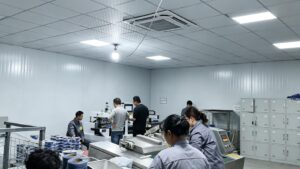
This is the arrangement a lot of filament lines start from: a bagger feeding operators who load the sealed packs into cartons by hand at the next station. The picture shows a machine and people working at different rates, and the hours spent on that hand work are what the comparison is arguing about.
Buffering Between Stations
What the accumulation buffer absorbs
A buffer between the bagger and the next station is a place where sealed spools wait. What it absorbs is the short mismatch between two stations: a cartoner clearing a carton, an operator fetching a box, a downstream station pausing between cycles. For those gaps the buffer lets the bagger keep running, and it is a quick way to find out whether the bagger is the constraint at all, because a bagger that keeps running while a buffer fills has shown where the line is short.
| Situation on the line | What the buffer absorbs | What still arrives wrong |
|---|---|---|
| The bagger waits for the cartoner to clear | The short gap between two stations | A cartoner stopped for a long stop still stops the bagger |
| An operator attends a print or label fault | The fault time, while the queue has room | A fault that repeats on every unit still reaches the customer |
| A changeover waits for material | The wait for material to arrive | Material that does not match the next SKU still stops the changeover |
| The downstream station stops | A limited amount of downtime | Downtime longer than the queue holds |
| Quality inspection moves off the line | The inspection time | An inspection that finds a fault still finds it |
What the buffer does not change
The buffer does not make the downstream station faster. It moves the waiting. Finished spools now sit in a queue in front of the cartoner instead of in the bagger, where one station counts them as output and the next one does not. It also takes floor space that has to be swept and kept clear, and the spools in it are exposed to whatever the room does to them, the same question as any exposure between sealing and boxing.
Sending the Step Outside
What travels with the work
Outsourcing the bagging step moves the operation to another plant. The spools travel there, get bagged, and come back. What travels with the work is the product, the packaging material, the acceptance criteria and the records. Two plants that have not worked together still have to agree on what an event means, and GS1 publishes the vocabulary for that exchange in the EPCIS standard. What has to be written down is the agreement any step crossing a boundary needs, described in the labeling system interface.
What stays behind
What stays behind is usually the reason you outsourced, and that is the part to watch. If the volume is seasonal, the arrangement is straightforward. If a specific skill sits with one operator, it has to be described well enough for a second plant to buy it and to inspect it. Two plants making the same bag disagree about how long a seal is held and what a wrinkled bag means, and those disagreements arrive as quality questions rather than capacity questions.

The picture is the version most plants are trying to move away from: people in cleanroom coats handling packed product by hand at a workbench while the conveyor carries the next item past. It is skilled work, done properly, and it is the step that stops when people are not there.
Putting the Four Side by Side
| Option | What has to be true first | What to measure | What the plant usually finds |
|---|---|---|---|
| Run the bagger faster | The stations either side can take the extra rate | Good sealed spools leaving the bagger | The gain is smaller than the rated rate, because changeover shares the clock |
| Add a shift | The extra hours are covered by trained, supervised people | Good output per paid hour across the shift | The loss was in setup and waiting, so extra hours carry idle time |
| Buffer between stations | There is floor space for the queue | The size of the queue in front of the bagger | The queue grows on one side and the constraint sits further upstream |
| Send the step outside | The step can be described well enough to be inspected and agreed | Good spools delivered per agreed period, checked on arrival | Transit and custody add steps the plant had removed |
The number that decides it
A bagging capacity comparison run against a machine specification compares two different things. Whichever option a plant leans towards, the deciding measurement is the rate at which good sealed spools leave the last check, taken from the plant’s own records over the same period. Run the four against that number and the argument gets shorter, because a plant short of sealed spools can see whether the shortage was in the bagger, the hours, the waiting, or the step itself.

These spools coming off the machine are the output the comparison has to count, and the count only means something taken where the plant has accepted the pack.
How to Run the Comparison on Your Own Line
Before the meeting, write down four things from the plant’s own records: the rate of good sealed spools leaving the last check, the time the line spends in changeover, the time it spends waiting for work that is not its own, and the hours the line is scheduled to run. The last one makes the shift option comparable at all, and the middle two separate a station that is genuinely busy from a station standing still. Without those four, a bagging capacity comparison is a discussion rather than a decision.
Then put the four options against those four numbers. If the line is losing most of its time to waiting, the buffer and shift options address a real loss and the machine rate does not. If it is losing time to changeover and material handling, the station is busy, and a second station in parallel may be the answer, a different decision from running the same station harder. If the people are the constraint, the comparison becomes one of who does the step, and that is where keeping a step manual on purpose is worth reading first.
[Tell us what your line is short of at the bagging step and what your own records say the loss is made of, and we will tell you which of the four options those numbers point at before anything is ordered.]
Email: helen@huanlianauto.com
FAQ
Which option usually wins on a filament packaging line?
None of them in general. The one that wins matches where the loss actually is, and the loss moves around. A line short because it lacks hours in the day responds to a shift. A line short because the bagger stands still waiting for the cartoner responds to a buffer. A line short because the station is saturated responds to speed or to a second station. The plant’s own shift records say which case you are in.
How do I measure bagging capacity without trusting the machine’s rated rate?
Count the sealed spools that pass the last check, not the spools that enter the bagger, and keep the two figures apart. Take the count from the plant’s own records over the same period for each option compared, and split it into running time, changeover time and waiting time. The rated rate on the specification is a laboratory figure for one prepared format. It does not know about your film, your changeover pattern or your operators.
Does an accumulation buffer between the bagger and the cartoner help?
It helps against a short mismatch between two stations, and it is a quick way to find out whether the bagger is the constraint at all: a bagger that keeps running while a buffer fills has shown you where the line is short. It does not make the downstream station faster, and it moves the waiting rather than removing it. The spools in the queue are output for one station and work in progress for the next.
When is sending the bagging step outside the sensible choice?
When the volume is seasonal enough that a permanent machine is not justified, when the step cannot be staffed at the volume required, or when the plant already uses an outside partner. In each case the work has to be describable: the bag specification, the seal, the check and the records. Two plants making the same bag disagree about how long a seal is held and what a wrinkled bag means, so the acceptance terms decide whether it works.
What should be written down before choosing?
Four numbers from the plant’s own records: the rate of good sealed spools leaving the last check, the time the line spends in changeover, the time it spends waiting for work that is not its own, and the hours the line is scheduled to run. Add a definition of output all four options can be measured against, and a note of what happens to a spool that fails the check under each option.