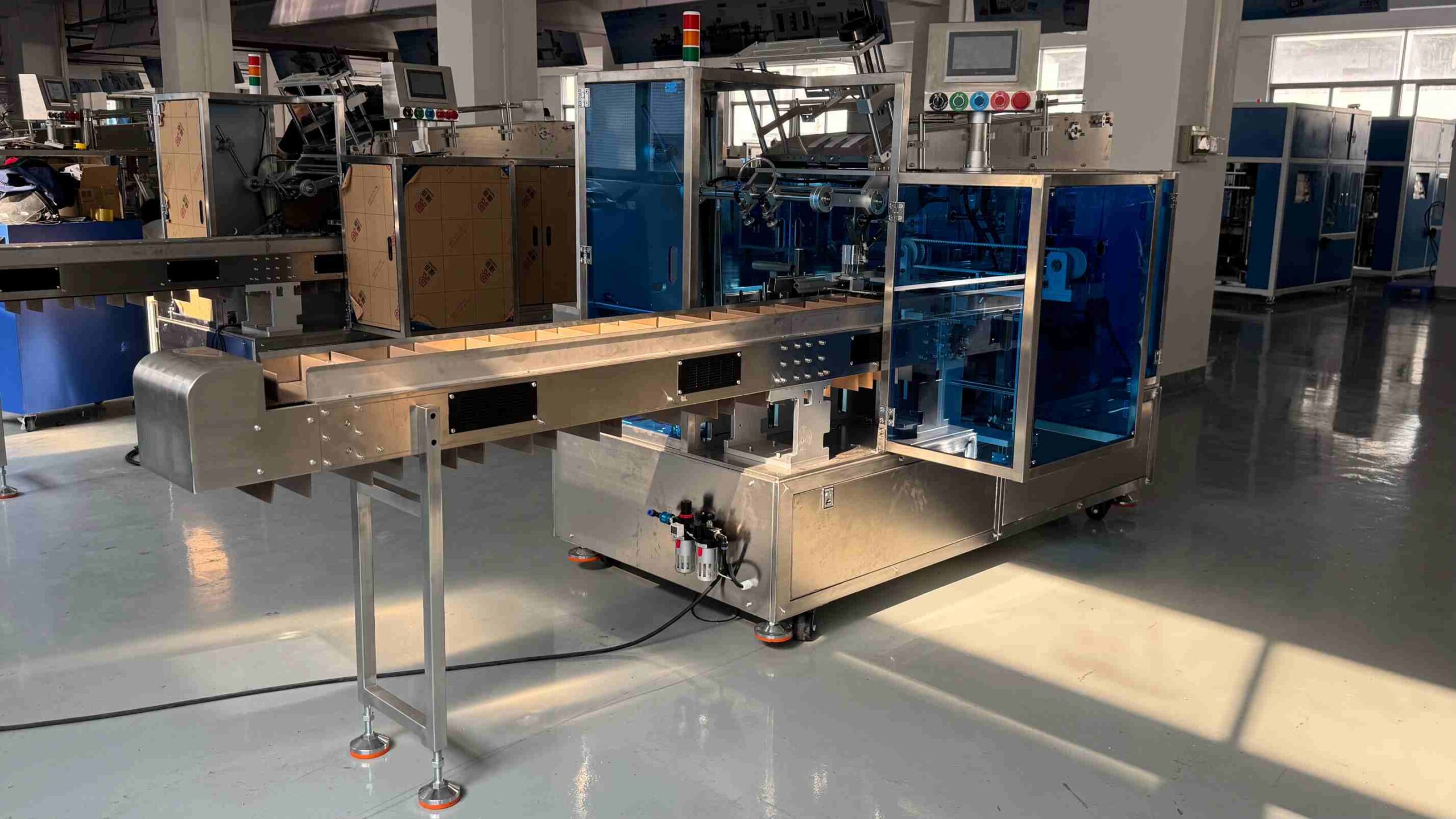
Your folding carton just became a compliance document. Since 12 August 2026, every carton, case and tray you place on the EU market must be backed by a Declaration of Conformity and a technical file — and the people who have to support it sit on your production floor, not in the artwork studio. That shift is bigger than paperwork. PPWR’s requirements now reach directly into machine decisions: how cartons are sealed, which board can run at speed, how much empty space a shipping case may contain, and what gets coded onto every pack for EPR reporting.
This article is for plant and engineering managers running cartoning and case-packing lines for food, FMCG and e-commerce products sold into the EU. You get a plain-language map of what has applied since 12 August 2026, what becomes a hard market gate on 1 January 2030, and an audit list you can hand your team this week.
Note: the plant and manager examples in this article are composites drawn from real line conversations, not specific named clients.
Key takeaways
– Since 12 August 2026, Regulation (EU) 2025/40 (PPWR) generally applies in all 27 member states: heavy metals (Pb, Cd, Hg, Cr VI) in packaging are capped at 100 mg/kg, and food-contact packaging must stay under PFAS limits.
– Sealing is now a recyclability specification: hot-melt, cold glue, tape and plastic windows are assessed component-by-component when a fibre carton is graded for recycling.
– The 1 January 2030 gate is the real line deadline: packaging below recyclability grade C (≥70%) leaves the EU market, and grouped/transport/e-commerce packaging must hold empty space to ≤50%.
– EPR reporting and variable-data coding turn your inkjet and print-and-apply stations into traceability infrastructure.
– Machine flexibility (format right-sizing, new recycled boards, fast changeover) is the hidden variable that keeps a cartoning line EU-ready without a last-minute capital scramble in 2029.
What the new packaging rules mean on your line right now
Regulation (EU) 2025/40 (the PPWR, or Packaging and Packaging Waste Regulation) entered into force on 11 February 2025 and applies across the Union since 12 August 2026. It replaces the old Packaging and Packaging Waste Directive (94/62/EC). Because PPWR is a regulation, not a directive, it applies directly in every member state with no national transposition. That means one rulebook and one set of deadlines from Amsterdam to Warsaw, with no softer national version to wait for. Dates and figures follow the European Commission’s packaging waste overview.
For anyone placing packaged goods on the EU market (manufacturers, importers, distributors, retailers, online sellers and their packaging suppliers), three obligations are already live:
- Restricted substances. The combined concentration of lead, cadmium, mercury and hexavalent chromium in packaging or any component may not exceed 100 mg/kg. For food-contact packaging, PFAS are restricted from the same date: 25 ppb for an individual substance, 250 ppb for the sum of targeted substances, and 50 ppm for total fluorine including polymeric PFAS.
- Recyclability in principle. Packaging must be designed for material recycling. The detailed design-for-recycling (DfR) criteria that assign an actual grade are still being finalised by the Commission, but the direction is fixed and the thresholds are already written into the law.
- Documentation and EPR. A technical file and an EU Declaration of Conformity are expected for the packaging you place on the market. If you are the “producer” (the operator that first makes packaged goods available in a member state), you register per country, report volumes, and pay fees that rise as recyclability falls.
A German confectionery plant — call it “Südback” — ran into this in late August. Their engineering manager pulled the spec for a 90 g praline box and found a plastic window, an inner foil liner and a low-temperature hot-melt that never fully disperses in the repulper. Under the old rules the carton sailed through every audit.
Under PPWR, the packaging buyer asked for a conformity file covering each component — and nobody on the line could say where the adhesive specification lived. Nothing was banned overnight, but the request exposed a real gap: “recyclable” had been an artwork claim, not an engineering specification.
The compliance clock: 2026 → 2030 → 2035 → 2038
| When | What applies | What it means for your line |
|---|---|---|
| 11 Feb 2025 | Regulation (EU) 2025/40 enters into force | Framework set; transition begins |
| 12 Aug 2026 | General application: heavy metals ≤100 mg/kg; PFAS limits for food contact; conformity assessment, DoC, technical file; EPR registration | Screen inks, coatings, adhesives and windows; document every component; start batch-level data capture |
| By 2028 | Commission adopts DfR grading criteria and empty-space calculation method; harmonised sorting labels apply from Aug 2028 | Watch delegated acts; don’t print draft EU pictograms yet; stress-test cartons against expected criteria |
| 1 Jan 2030 | Recyclability grade C (≥70%) minimum; recycled content in plastics; empty-space ratio ≤50% for grouped, transport and e-commerce packaging; packaging minimised to functional weight and volume | Re-spec boards and closures; right-size the case portfolio; prove new recycled boards run at speed |
| 2035 | “Recycled-at-scale”: packaging must actually be collected and recycled at EU volume | Confirm your material class is genuinely recycled in practice |
| 1 Jan 2038 | Only grades A (≥95%) and B (≥80%) accepted; grade C exits | Design for a high grade now to avoid a second redesign |
Read the dates this way: 2030 is the hard gate, and the run-up is now. Several technical details (the grading method, the empty-space formula) are still being set through delegated acts, and final criteria may shift specific numbers. Every signal still points one way: more recyclable, more homogeneous, less empty space, better documented.
How the new rules reach your cartoning and case-packing floor
It is tempting to file PPWR under “packaging engineering problem.” Trace the chain and it falls apart: a brand owner defines a carton or case spec that must meet the packaging waste regulation, then that spec has to survive contact with a real machine. The cartoner that erects, fills and seals, and the case packer that groups cartons for shipment, either execute the compliant design cleanly at speed or quietly undermine it through jam-prone board, mis-applied adhesive, oversized cases or unreadable codes.
The regulation governs the packaging, not the machine. But the machine is where those rules actually get executed, every shift. That is why the six impact points below belong in front of operations and procurement, not only the sustainability office.
1. Sealing method is now specification data: hot-melt vs cold glue vs tape
Most continuous cartoners seal with hot-melt; most case packers glue flaps or close with tape. Under PPWR’s grading logic, every component of a fibre-based pack is assessed for how it behaves in sorting and repulping, and adhesives sit on the named list of grade-lowering culprits.
- Hot-melt that does not release cleanly during paper recycling drags a carton’s score down; non-dispersible and pressure-sensitive hot melts are flagged in DfR analysis.
- Tape is different from glue: heavy, reinforced tapes survive repulping and contaminate the fibre stream; lighter, water-soluble or easily removable tapes are friendlier. And tape also covers graphics you may need for codes and sorting labels.
- Cold glue and water-soluble adhesives disperse well in repulping and are the most recycling-friendly choice where machine and product allow it.
The practical consequence: when your supplier asks which sealing method you run, that is no longer trivia; it is a line item in the technical file. Run a continuous cartoner at up to 120 cartons per minute and adhesive chemistry changes carry real process implications: pot temperature, open time, compression length, nozzle wear. Validate any change on the machine, not only in the lab. For a primer on retail carton formats and how they’re sealed, our cartoning guide covers the machine-side basics.
2. Paperboard is changing under your cartoner
The material heading into your hopper is not the material you commissioned the line for. Two PPWR drivers are converging: a mono-material preference (a homogeneous, single-material carton scores higher than one laminated to plastic or foil) and recycled fibre and lighter calipers (the binding recycled-content percentages in Article 7 target plastic from 2030, but brand commitments, EPR eco-modulation and retailer scorecards push paper the same way).
What does that mean at 100+ cartons per minute? Recycled fibre board is typically less stiff, more moisture-sensitive and dustier than virgin board. Lighter calipers cut cost and waste but reduce crush resistance through transfer and compression sections. Scoring, creasing and forming tolerances tighten.
A servo-driven, programmable cartoner with gentle transfer handles that variation far better than a mechanically cam-driven machine tuned to one board. Downstream, a case erector that runs a wider stiffness range without jamming saves you the rejects, re-runs and lost OEE on every pallet.
If a line manager says “we can’t change board, the machine won’t run it,” treat that as a specification conversation, not a verdict. Ask the builder for board parameters (caliper range, coefficient of friction, moisture tolerance, scoring profile) and make a running trial part of equipment selection. A day of board testing tells you whether a new recycled stock holds speed or jams the infeed.
3. Right-sizing shrinks the case count: the ≤50% empty-space rule is a packing problem
From 1 January 2030, grouped, transport and e-commerce packaging must have an empty-space ratio of no more than 50% — and the definition is unforgiving: air cushions, bubble wrap, foam, paper fill and polystyrene all count as empty space. Sales packaging must also be minimised, with double walls and false bottoms restricted.
That lands squarely on case packing. The habit of carrying one or two “universal” shipping cases and padding the gap is finished for EU-bound goods. The compliant operation runs a family of right-sized cases: more formats, more frequent changeovers, less void fill, and primary packs that must survive transit in a tighter fit.
A Polish food co-packer illustrates the squeeze. Their e-commerce channel shipped dry pasta in one universal 60 × 40 × 40 cm case with paper cushioning; measured against the coming methodology, void content ran over 60%. To get under the cap they introduced four case sizes matched to order profiles. Good for compliance, hard for operations: their old case packer took roughly 40 minutes per format change.
The realistic answer was a servo-adjustable case packer with recipe-driven changeover measured in minutes, not hours. Right-sizing is a machine-flexibility project as much as a packaging project. As formats multiply and buffers tighten, end-of-line buffer and line-speed engineering become decisive for absorbing changeover time without starving the cartoner. For case-side mechanics, see the shipping-case formats covered in our food case packing guide.
4. EPR reporting turns variable-data coding into a traceability backbone
PPWR does not create one EU-wide EPR register. It harmonises the rules, then still requires producers to register in each member state where they place packaged goods, report volumes by type and material, and pay eco-modulated fees. Non-EU producers must appoint an authorised representative, and online platforms must verify sellers’ registration.
Here is the production-floor catch: an EPR declaration is only as good as the data behind it, and that data is only as good as what the line records. If your cartoning and case-packing lines cannot tell you, per batch, which board ran, at what grammage, with which adhesive and closure, and what went into each case, someone will reconstruct that information from memory at year-end.
This is where variable-data coding earns its keep. Inline inkjet and laser coders can print, on every pack and case, the batch number, material identifiers and GS1 Digital Link QR codes. The same stations can also print the sorting pictograms harmonised labelling will require from August 2028. Add vision inspection that verifies each code, and the line produces the traceability file as a by-product of normal running.
An operations manager at a Dutch FMCG e-commerce site put it neatly (a composite voice, not a named client): EPR reporting used to be a quarterly archaeology project; once case coding carried the bake-off date, board GSM and adhesive code in variable-data QR codes, the report became a database query.
5. Restricted substances reach into inks, coatings and adhesives
The 100 mg/kg heavy-metal cap and the PFAS food-contact limits are not only about the board. They apply to each packaging component: inks, varnishes, barrier coatings, adhesives, labels and any plastic window or film. For food-contact cartons the PFAS question is acute, because PFAS were widely used in grease-resistant paper coatings.
Practical checks for a cartoning line:
- Request substance declarations from ink, coating and adhesive suppliers; keep them in the technical file.
- Verify inks meet the heavy-metal limits (most food-grade, low-migration inks already do).
- Confirm no PFAS-based grease barrier sits between product and board, especially for bakery, confectionery and frozen formats.
- Re-test whenever you change chemistry; a “minor” varnish or adhesive swap can change the picture, and some compliant inks dry or rub differently on a new board surface.
6. The 2030 and 2038 grading ladder: buy machines that can run the next board
Recyclability is scored A (≥95% recyclable by weight), B (≥80%), C (≥70%); below C, packaging is treated as non-recyclable. The gates: 2030 requires grade C or better; 2035 adds recycled-at-scale; 2038 drops grade C entirely, leaving only A and B. A carton that squeaks into C in 2030 will have to be redesigned by 2038, so the cheapest time to build for a high grade is before you buy or refurbish the line.
For fibre packaging the graders look at the whole construction: substrate, coatings, inks, lamination, windows, adhesives, labels, closures. Paper-based does not automatically mean compliant; a plastic-laminated or heavily coated carton can fall below grade C. On the fibre side, CEPI, the European paper industry association, publishes the recyclability test method that most paper and board recyclability labs work from, so it is a useful benchmark for judging a new carton construction before you commit.
So any cartoner or case packer bought today should run a range of boards, including the lower-stiffness recycled stocks and lighter calipers tomorrow’s cartons will use. Look for servo-driven forming with programmable motion, a wide tolerance window for caliper and stiffness, quick recipe-driven changeover for a growing format family, and built-in or easily integrated coding and vision stations. Buying a machine that only runs today’s board is how companies pay for the same line twice by 2030. That is what future-proofing means under the PPWR packaging regulation requirements.
If you are shortlisting a cartoner or case packer now, look at servo-driven cartoning machines built for board flexibility and run your future board stock on one before you sign.
A printable line audit checklist for PPWR readiness
Print this and hand it to the line team. Each item maps to a requirement that already applies or lands by 2030.
- Material spec on file: an up-to-date spec (substrate, grammage, coatings) for every carton and case run for EU-bound product.
- Component inventory: every ink, varnish, adhesive, tape, window and label, with its substance declaration.
- Heavy-metal evidence: data or declarations showing combined Pb/Cd/Hg/Cr VI stays ≤100 mg/kg per component.
- PFAS check for food contact: confirmation that no PFAS-based grease barrier or treatment is used.
- Seal method documented: the hot-melt / cold-glue / tape choice recorded and justified in the technical file.
- Board trial record: trials on recycled or mono-material board with speed, jam rate and seal integrity logged.
- Empty-space measurement: current void ratio of your grouped, transport and e-commerce packaging (fillers count).
- Case-size strategy: a right-sizing roadmap for SKU-specific cases, not one padded universal case.
- Changeover time: how long a case-size change takes today, and whether the line can absorb more frequent changes.
- Coding and traceability: batch-level data on board, weight and material per EU-bound shipment, verified by vision.
Unchecked boxes are your project for this quarter. Items tied to the 12 August substance rules (2, 3, 4) and the ones that take months to fix (6, 8, 9) deserve the earliest start.
RFQ questions to ask before you buy or upgrade a cartoner or case packer
Procurement teams usually ask about speed and price. Under PPWR, add these questions to every RFQ:
- Board flexibility: “What range of board calipers and stiffness does this machine run reliably at rated speed?” Demand a documented window and a live trial with your new recycled board, not your current one.
- Dust and moisture: “How does it handle dust, moisture variation and lower-stiffness recycled fibre?” You want specifics on transfer, scoring and compression sections.
- Changeover: “What is the true tool-less format-change time, including erecting-head and seal changes?” Right-sizing multiplies your formats, so changeover time becomes throughput. Servo-driven, HMI-recipe machines typically change over in roughly 10 minutes; verify it in a witnessed test.
- Sealing options: “Which sealing methods (hot-melt, cold glue, tape) can it run, and what does switching cost?” Your recyclability strategy may change your seal method; the machine should not force the choice.
- Coding and inspection: “Can it integrate inline variable-data coding (inkjet or laser, GS1 QR) and vision verification at full speed?” EPR traceability and the 2028 sorting labels depend on it.
- Documentation: “Will you provide machine documentation that supports our technical file, including board and format parameters, changeover procedures and validation records?”
If you would rather put these questions to an equipment builder who works with EU food and FMCG lines every week, our engineers at UBL Packaging will walk through them against your real set of formats. UBL builds high-speed continuous cartoners (up to 120 cartons/min), case packers, carton erectors and end-of-line machines from our factory in Dongguan, China, and runs board and format trials every week. Start the conversation here.
Do it now, finish before 2030: a phased action plan
PPWR is staged, so your response should be staged too.
This quarter. Run the audit checklist; collect substance declarations and start the technical file per format; confirm PFAS-free food-contact cartons and heavy-metal evidence; stand up batch-level data capture for EPR.
Within 12 months. Commission board trials for your next recycled or mono-material spec on existing or shortlisted machines; model your grouped, transport and e-commerce packaging against the ≤50% empty-space rule and build the right-sized case portfolio; budget equipment changes around flexibility: fast changeover, coding and vision, and a board window broad enough for the 2028–2030 specification shifts.
Before the 2030 gate. Verify every EU-bound format meets at least grade C, and prefer designs that reach A or B so you are not forced into a second redesign by 2038; confirm any plastic components hit 2030 recycled-content minimums; lock the harmonised sorting labels into artwork once the Commission finalises them.
The companies that treat PPWR as a line-engineering programme, not a compliance memo, are the ones that hit 2030 without a panic redesign and a rushed equipment purchase.
Final word: your carton is the product now
Since 12 August 2026 the carton is a documented product. By 1 January 2030 it must also be a demonstrably recyclable, right-sized, data-carrying product. The machines that erect, fill, seal, pack and code it are the instruments of that compliance, which is why line managers and procurement teams now own this problem.
The good news: most of the fixes are the same upgrades that improve OEE anyway (more flexible changeovers, less material waste, cleaner codes, fewer jams). Compliance and productivity are pulling in the same direction for once.
Next step: put your current formats in front of an equipment engineer before you commit to a 2027 board change or a 2028 machine purchase. UBL’s engineers run board and format trials every week with customers selling into the EU. Send us your cartons, your cases and your target markets, and we will check the machine side of your PPWR plan with you. Contact UBL Packaging for a cartoning and case-packing line consultation
FAQ
When does the EU PPWR apply?
The PPWR, Regulation (EU) 2025/40, entered into force on 11 February 2025 and has applied in all 27 EU member states since 12 August 2026. The harder gates come later: at least recyclability grade C from 1 January 2030, and only grades A and B from 1 January 2038.
What are the PPWR packaging regulation requirements for cartons and cases?
Cartons and cases must keep combined heavy metals (Pb, Cd, Hg, Cr VI) at or below 100 mg/kg, meet PFAS limits for food-contact packaging, and be designed for recycling. Each format also needs a technical file and an EU Declaration of Conformity. From 1 January 2030, grouped, transport and e-commerce packaging must hold empty space to 50% or less.
Does PPWR apply to cartoning and case-packing machines directly?
No, not directly. PPWR regulates the packaging placed on the EU market, not the machines that make it. But the machine is where compliance is won or lost: a cartoner or case packer that jams on recycled board, mis-applies adhesive, or runs oversized cases can push a compliant pack out of spec. Machine flexibility is therefore part of PPWR planning.
What counts as “empty space” under the 50% rule?
Empty space is the unfilled volume inside grouped, transport or e-commerce packaging. Air cushions, bubble wrap, foam, paper fill and polystyrene all count, so padding a universal case rarely helps. From 1 January 2030 the ratio must be no more than 50%, which pushes most lines toward a family of right-sized cases and more frequent changeovers.
How does PPWR affect EPR reporting and coding?
PPWR harmonises extended producer responsibility rules but still requires producers to register in each member state where they place packaged goods, report volumes by material, and pay eco-modulated fees. Non-EU producers must appoint an authorised representative. Because reporting depends on accurate batch data, variable-data coding with GS1 QR codes on each pack and case is becoming standard.