
Most manufacturers who invest in automated cartoning equipment have a clear benchmark in mind: reduce labor, increase throughput, or eliminate a specific bottleneck. The manufacturer in this automatic cartoning machine case study had all three — with the added complexity of handling a premium food product where packaging quality directly affects brand perception. What made this deployment notable was not the machine’s speed or the box type. It was the speed at which the transition happened: from discovery on YouTube to production-line deployment with a measured, unambiguous labor reduction from eight workers to two.
Before Automation: Eight Workers, One Repetitive Task
The Product and the Packaging Challenge
A durian fruit processor in Southeast Asia produces individually sealed trays of durian flesh — a frozen product that must maintain visual appeal, structural integrity, and tamper-evident packaging throughout cold-chain distribution. Each sealed tray enters the packaging line ready for its secondary packaging step: sliding into an outer carton box for retail shelf presentation. The box type is a double tuck-end box — both ends close by tucking flaps into the box body, no glue, no tape, no adhesive required. This box type is straightforward in concept: fold the body, tuck both ends, and the box is sealed. In practice, at production volumes, it becomes a sustained repetitive operation that consumes hours of labor every shift. Making it even more challenging, the varying sizes and shapes of the frozen fruit pieces required careful handling to prevent damage during the cartoning process.
The Labor Breakdown Before Automation
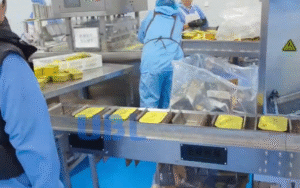
Before automation, the secondary packaging station operated with eight workers assigned to a single task chain. Three workers were dedicated to manually folding the flat carton blanks into formed boxes — a task that required consistent hand pressure and attention to crease alignment to ensure the tuck-end flaps would close properly downstream. Two workers loaded each sealed durian tray into the formed boxes. Two more workers manually closed and tucked both end flaps on each filled box. A final worker transferred the completed boxes onto the conveyor belt feeding the next processing step. On paper, this was a balanced line. In reality, any variation at a single station — a slow folder, a misaligned tuck, a dropped tray — created a cascade delay across the entire chain, causing productivity to fluctuate unpredictably.
The Discovery: A YouTube Video That Changed the Production Floor
Finding the Right Machine for a Specific Box
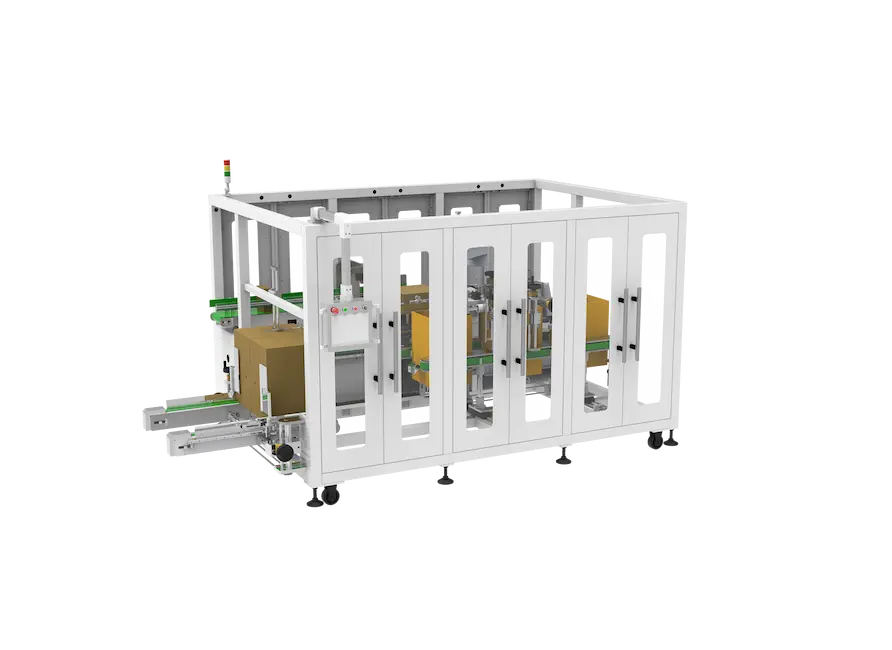
The operations manager at the durian processor was actively looking for automation solutions for the secondary packaging station. The specific requirement was narrow: the machine needed to handle a double tuck-end box without any modification to the existing box dimensions, needed to operate at high speed, and needed to integrate into the existing cold-chain production line without requiring extensive floor redesign. A search on YouTube led to a high-speed cartoning machine from UBL Packaging — and in a moment of what the operations team later described as immediate recognition, the machine matched their box configuration precisely. The tuck-end closing mechanism was exactly the mechanism the manual line depended on human workers to perform. The decision timeline compressed: the machine was compatible with the box, compatible with the product format, and compatible with the production environment.
Why Compatibility Was Never in Question
Three factors converged to make this deployment faster than a typical packaging machinery evaluation process. First, the box was a standard double tuck-end format — exactly the box type that UBL’s high-speed cartoning machines are designed to handle without requiring box design changes. Second, the product was already individually sealed in its primary packaging — meaning the cartoning machine was performing secondary packaging with zero direct food contact, eliminating any food-safety validation or regulatory recertification requirement. Third, the machine’s 70-box-per-minute throughput meant that one cartoner could match or exceed the output of the eight-worker manual line without requiring parallel machines or complex feed-splitting arrangements.
After Automation: Six Workers Redeployed, One Machine Running
The New Labor Configuration
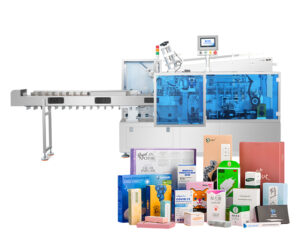
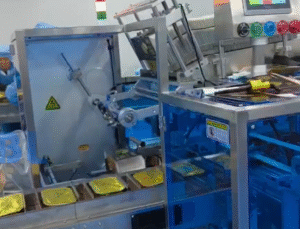
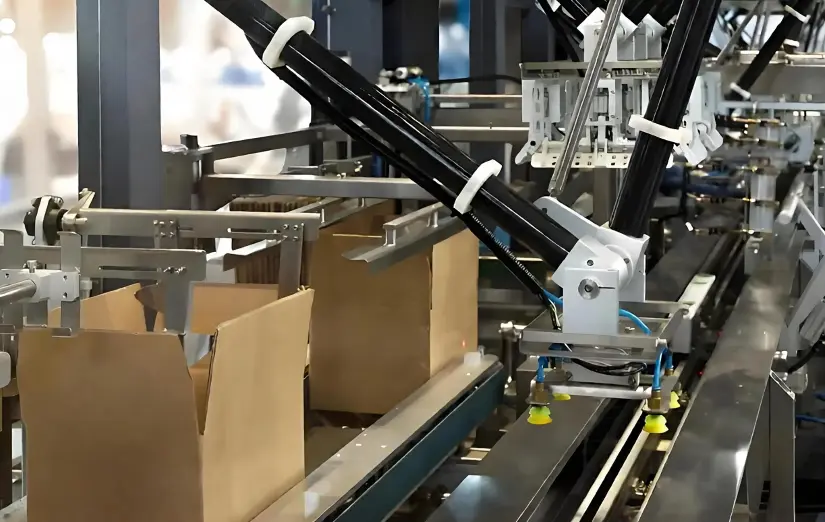
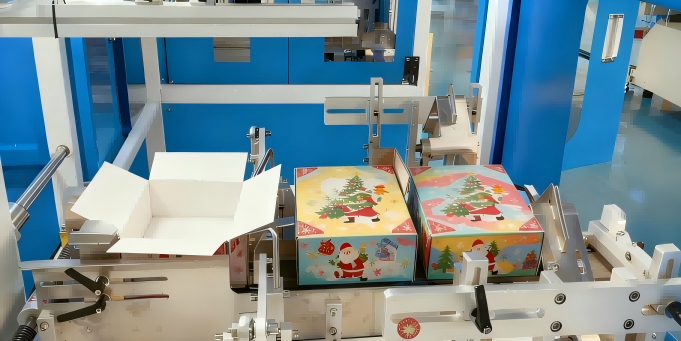
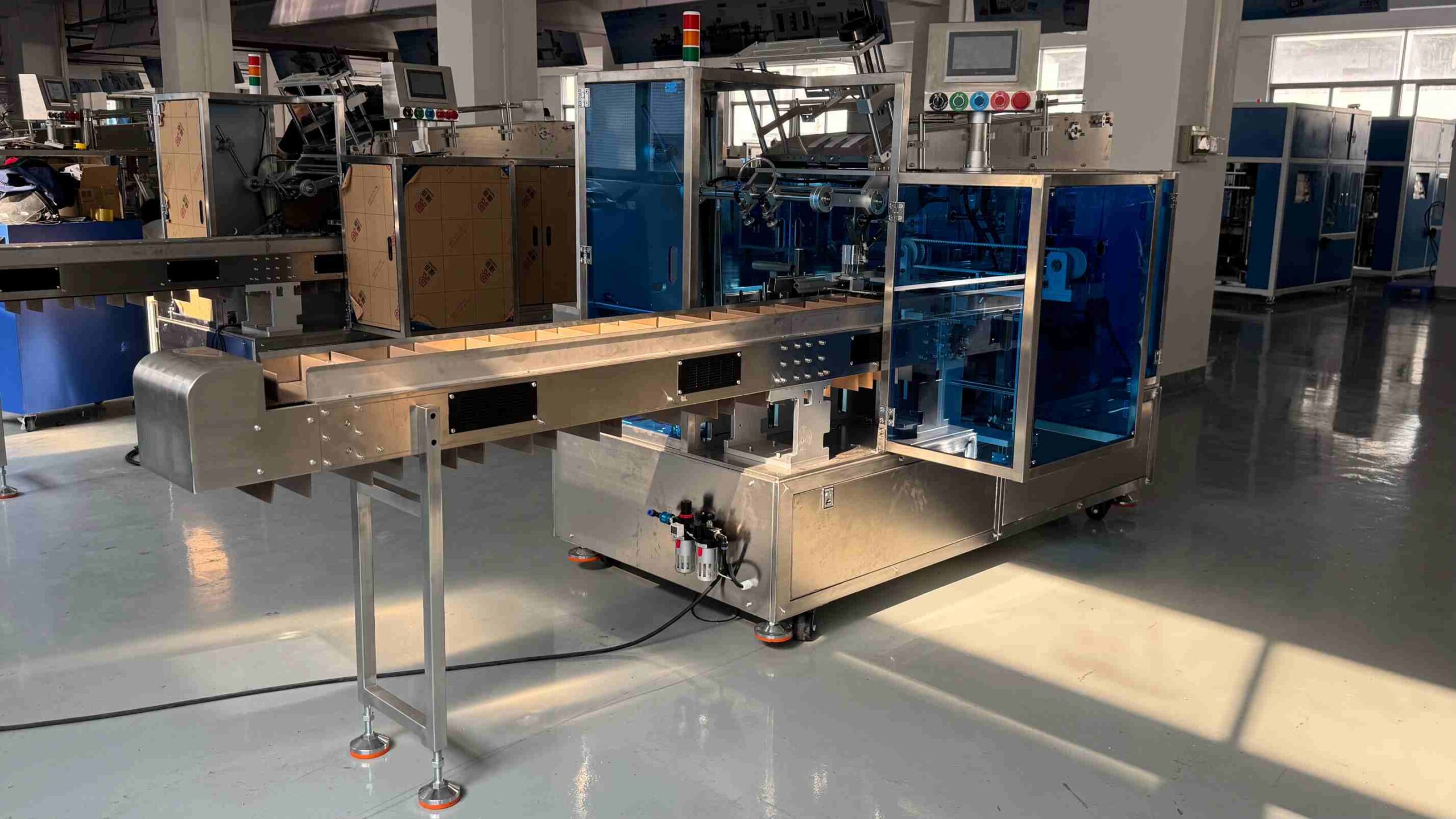
After the UBL high-speed cartoning machine was installed and commissioned, the secondary packaging station was reconfigured from an eight-worker manual line to a two-worker machine-assisted workflow. One worker is positioned at the front end of the machine, placing sealed durian trays onto the cartoning machine’s product infeed. The second worker is positioned at the output end, transferring completed boxes from the machine discharge onto the conveyor belt leading to the next processing station. The tasks that previously consumed six workers — manual folding of flat blanks, manual loading of product into formed boxes, and manual closing of tuck-end flaps — are now performed by the machine.
This is not a partial-automation scenario where the machine assists workers rather than replacing them. The UBL cartoner performs all three core actions — box forming, product insertion, and tuck-end closing — autonomously and continuously. The two remaining workers are there for infeed and outfeed, not for direct packaging operations. The labor reduction is a direct result of a machine whose mechanical architecture matches the specific actions that were previously performed by human hands.
Throughput: Not Slower — and Often Faster
A common concern when replacing a manual packaging line with a single machine is that throughput will decrease — that the machine will create a bottleneck rather than remove one. In this deployment, the opposite occurred. The machine operated at 70 boxes per minute, which exceeded the manual line’s average sustained throughput. The manual line’s output varied throughout the shift — faster in the first hours, slower as fatigue accumulated, and punctuated by interruptions from misalignment and rework. The machine delivered consistent output across the shift, unaffected by fatigue, shift changes, or the small variations in operator technique that accumulate on a manual line. The production manager reported that peak-shift output on the automated line was comparable to or higher than the manual line’s best days — and that average output across a full production week was higher because of the elimination of slowdown periods.
The ROI Equation: Six Workers, One Year, and an Obvious Decision
Direct Labor Cost Reduction
The most straightforward component of the ROI calculation is the direct labor saving: six workers removed from the secondary packaging station. The exact labor cost savings depend on local wage rates and employment costs, which vary significantly by market. What is consistent across markets is the magnitude: a six-person reduction on a single packaging line represents a structural cost saving that compounds monthly. Even in relatively low-wage manufacturing markets, the annual labor cost of six full-time packaging workers exceeds the purchase price of a UBL cartoning machine within approximately one year — sometimes significantly less, depending on shift patterns and overtime requirements.
Indirect Savings That Compound Over Time
Beyond direct labor, the automated line eliminated several indirect costs that accumulate on manual packaging stations. Product rework from misaligned box folding — boxes that needed to be unfolded and re-folded because the creases were misaligned during manual forming — dropped to near zero. Product damage from handling during the manual insertion step decreased because the machine’s product pusher operates at consistent speed and pressure. Worker-related cost variables — absenteeism, training new workers on the folding and tucking technique, quality variation between workers on different shifts — were substantially removed from the packaging station. These second-order savings are harder to quantify on a per-unit basis but become visible in the overall packaging station operating cost over a quarter or a year.
What Makes This Deployment Repeatable Across Food Categories
The Secondary Packaging Advantage
The durian processor’s success with this automatic cartoning machine case study benefits from an operational pattern that applies broadly across food categories: the product is already sealed in hygienic primary packaging before it enters the cartoning station. This means the cartoning machine is performing secondary packaging — handling a sealed, uniform product unit rather than an exposed food surface. The result is that any food manufacturer with a product that is already packaged in a tray, pouch, or sealed bag before cartoning can deploy the same machine configuration with no food-safety validation barrier. The machine’s role is mechanical — fold the box, insert the sealed product, close the box — and the food-safety responsibility remains upstream.
Box-Type Compatibility That Covers the Majority of Food Retail Packaging
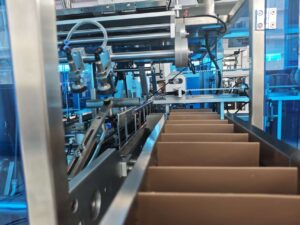
The double tuck-end box format used by the durian processor is widely used across frozen food, snack, confectionery, bakery, and ready-meal packaging applications. It is one of the standard formats that UBL’s cartoning machines handle natively, alongside snap-lock bottom boxes, glue-seal cartons, and mailer trays. A manufacturer evaluating cartoning automation can proceed with confidence if their existing box is a standard format — and in many cases, the existing box design does not need to change. The machine adapts to the box format, not the other way around.
Risk and Reward: What to Consider Before Automating Secondary Cartoning
Downstream Bottleneck Risk
When a cartoning machine increases output from a packaging station, the downstream processes — labeling, case packing, palletizing — may become the new bottleneck if they were sized for the manual line’s throughput. This is not a machine failure; it is a line-balancing consideration. The best deployments identify the post-cartoning constraint during the planning phase and either right-size the machine speed to match downstream capacity or add downstream capacity in parallel. The goal is not maximum machine speed; it is sustainable line speed.
Box Supply Quality Matters
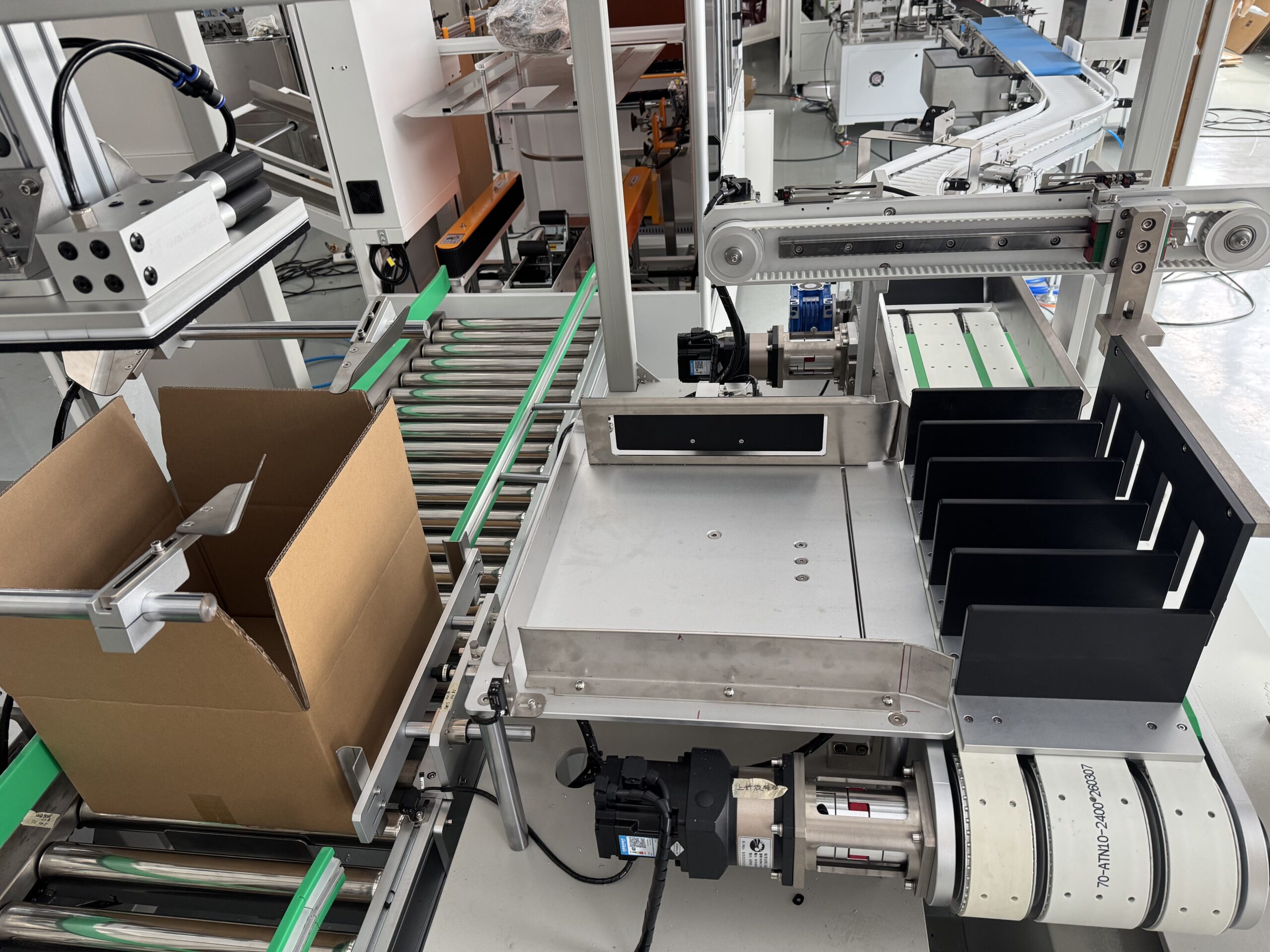
A cartoning machine feeds flat blanks from a magazine and forms them into boxes through precise mechanical movements. If the carton blanks are poorly cut, inconsistently creased, or have variable dimensions due to supplier quality issues, the machine’s performance will reflect those input tolerances. The manual process is forgiving of carton variation because a human worker compensates instinctively. The machine is consistent but not adaptive — it expects the blanks to fall within specification. The practical consideration is simple: if the box supplier is inconsistent, address that first or work with UBL during the pre-deployment evaluation to verify that the existing blanks feed and form reliably on the machine.
Maintenance and Skill Requirements
No production machine runs indefinitely without maintenance, and the cartoning machine is no exception. UBL’s standard training program — two hours for basic operation, with operators reaching comfortable independent operation within two to three days — includes instruction on routine maintenance and quick troubleshooting. Common issues, such as a misfed blank or a jammed box, are typically resolved in under ten minutes using the machine’s HMI-guided diagnostics. UBL also provides four-hour remote response support for issues that cannot be resolved through on-site troubleshooting. The maintenance burden on a well-installed cartoning machine is low — but it is not zero, and the deployment plan should include at least one trained operator per shift.
The First Step: Verify That Your Box Works
The durian processor’s evaluation process was straightforward: a box sample and product sample were sent to UBL for a test run, and the machine’s compatibility was confirmed before any purchasing commitment was made. This same process is available to any manufacturer evaluating cartoning automation. UBL supports sample trial runs — send your product and box format, and the team runs a live machine test with video documentation. There is no need to guess whether the machine will handle your box; the trial provides direct evidence.
For secondary packaging lines where labor cost, throughput consistency, and packaging quality are active operational concerns, this automatic cartoning machine case study demonstrates a clear pattern: a single high-speed cartoner can take over the manual tasks of folding, loading, and closing — and the economics of reducing six workers from a packaging station typically deliver a payback measured in months, not years. The video of the machine running at production speed is linked above. To discuss your specific box format, product requirements, and potential machine configuration, contact UBL at helen@huanlianauto.com


One Response