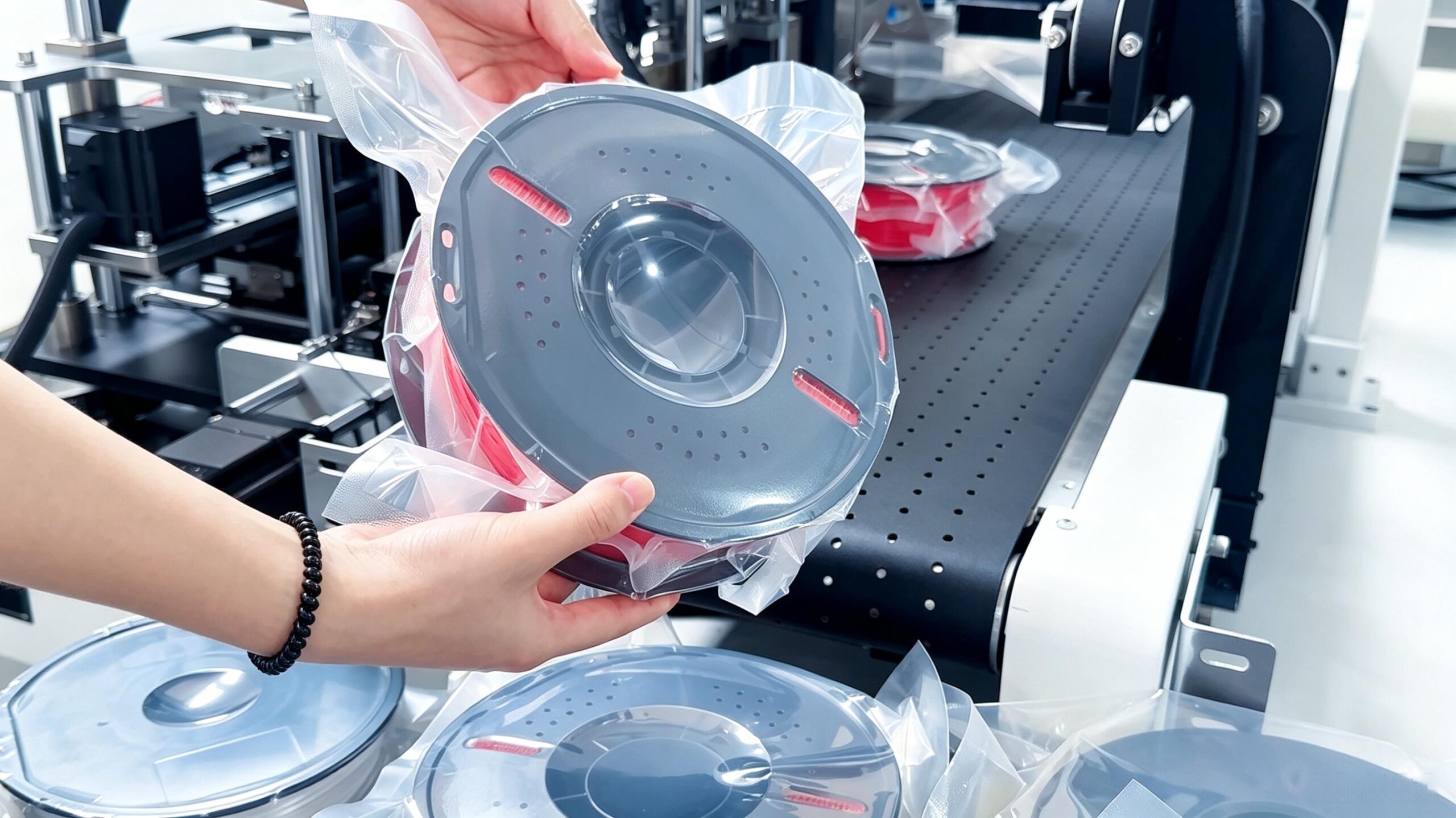
A filament moisture complaint arrives with more certainty than evidence. The customer says the spool was wet. The bag was sealed. The gauge read normal. From the plant side that looks contradictory: a bag that left the sealer intact should protect what is inside.
A filament moisture complaint investigation starts with four branches behind that sentence. They produce the same symptom in the customer’s hand, and only three measurements tell them apart. The order you work them in decides whether the next order ships or the next complaint.
A Sealed Spool Can Still Come Back Damp
Four causes sit behind one complaint
Name the four before you touch a bag. They all arrive as the same customer sentence.
Drying and exposure before bagging: the filament dried, then stood somewhere humid before the sealer saw it. Barrier film performance: the film is not the barrier everyone assumed. Seal integrity: a wrinkle, contamination, a pinhole. And the inspection method itself, handing back a clean all-clear on a bag nobody looked at.
The first gets argued about most, and we have said it before: vacuum sealing preserves the condition of the filament it seals, it does not dry filament that is already wet. what vacuum sealing does and does not do sets that boundary out. A filament moisture complaint investigation starts on the far side.
Most filament moisture troubleshooting advice stops at the symptom. The customer question is always the same: why filament is still wet after vacuum sealing.
What the vacuum gauge does and does not tell you
A gauge reading at the sealer describes one moment. A bag can reach the working vacuum level and still lose it in the carton. A lower, serviceable vacuum can hold perfectly well.
We have made that argument before too — treat the vacuum level as one input, not the verdict — and the standing hold catches the slow leak before it ships. A filament moisture complaint needs something else: which of the four causes produced the wet filament, and the records to prove it.
Record Before You Test
The six records that make a complaint investigable
Most plants cannot answer a complaint because the evidence was never kept. Six records decide whether a filament moisture complaint can be investigated at all. Pull them first.
| Record | What it rules out | What it cannot tell you |
|---|---|---|
| Filament type and grade | The wrong material was called | What this spool carried on the day |
| Moisture content measurement before packaging — Karl Fischer titration filament moisture, or your own metric | Wet filament went in | What came through the film |
| Conditioning time filament before packaging — and the drying time and exposure before bagging | Moisture reabsorbed on the floor | The humidity it stood in |
| Bag film structure and reel number | The film was not the barrier assumed | Whether this bag sealed |
| Sealing method and that shift’s parameters | The seam was weak, settings differed | What the seam did on the road |
| Inspection records for the batch | Nobody looked, or one bag only | What the other bags did |
Vacuum-sealed filament spools. The bag hugs the spool and the sealed edge is the line every complaint starts from.
A record that was never kept is itself a finding: the process has no memory, and that is cheaper to fix than the complaint.
What a missing record already tells you
A batch with no drying time record and no inspection record cannot be split into a drying failure and a seal failure, however carefully you measure afterwards. You end up with an answer that is true and useless: the film was fine, the seam was fine, the filament was wet, and nobody can say which step let it happen.
Not a reason to stop. A reason to close the complaint with a process change, and to write the records down next time.
Three Measurements, Matched to Three Causes
Three measurements, one question each. Run them on the complaint batch, not on a fresh run, and write the conditions down beside the result.
Heat-seal strength: will the seam hold?
Will this seam carry handling, stacking and the trip? Peel or strength test on the actual film at the actual sealer settings, with the heat seal strength test packaging conditions stated: film, seam direction, conditioning. A burst test sealed bag answers a related question: can the package survive handling? No universal pass mark exists; the value belongs to your film and your machine. Strength and integrity differ — see our leak testing post.
Package integrity: is this bag leaking?
Is this specific bag sound? Dye penetration or a bubble and pressure test on the retained bag, sampled across the batch, not one bag off the line. The seal leak test dye penetration method reads the bag you already hold; bubble test package leak detection needs less kit. ASTM F1929 and ASTM F88 are the frameworks: method and vocabulary, not a pass mark.
The decision it drives: reject this bag, or escalate to the batch. The standing pre-shipment screen, the one-day spool hold, should have been running when these bags left the plant.
Barrier performance: is the film a barrier for this route?
Can this film hold the line through this route, in this season? The method is a WVTR barrier film test, read against the supplier’s declared value and your own transit conditions. A film’s transmission rate is a material property; the question you ask is a route property.
No universal figure exists; the number comes from your own data and film. If a supplier will not tell you what their film does under your conditions, that is an answer too.
| Measurement | The question it answers | The method | The decision it drives |
|---|---|---|---|
| Heat-seal strength | Will the seam carry handling and stacking? | Peel or strength test on the actual film | Change the seal process, or the film |
| Package integrity | Is this bag sound, and its neighbours? | Dye penetration or bubble test, sampled across the batch | Reject the bag, or escalate to the batch |
| Barrier performance | Can this film hold this route and season? | Transmission rate against the declared value | Change the film, the route, or the packaging |
Read the Results Against the Four Causes
Now put the three results next to the complaint. Each rules causes out as well as it points at one, and the cheap discrimination goes first. This is where a filament moisture root cause stops being a guess.
The mapping: result → cause
| What you measured | What it rules out | The cause that remains |
|---|---|---|
| Seam strength below what handling needs | A barrier problem | Seal integrity: parameters, contamination, a wrinkle |
| Seam strength good, retained bags fail the leak test | A drying problem | Seal integrity: a channel opened after sealing |
| Seam and bags hold, film unsuited to the route | A seal fault | Barrier film performance: moisture came through the film — the two residual moisture sources inside a sealed bag explains it |
| Pre-packaging record shows filament already wet | Nothing downstream | Drying and exposure before bagging: drying step, conditioning time |
| Everything holds, records never kept | Nothing. That is the problem | The inspection method. The bag you checked was never the bag that failed |

Desiccant is one layer of protection. The film is the other, and only a measurement tells you which one failed.
A composite case, drawn from a pattern rather than one customer: the complaints all came from one run, those bags ran a different film reel, and the drying room log was never found.
When the measurements all pass, look at the method
There is a fourth cause family, and it is the one people skip. If the seam holds, the bags hold and the film is right for the route, the remaining explanation is usually that the wrong thing was checked.
Only the seam was inspected, not the film. The check happened at sealing, not after the hold. One bag was tested and treated as the batch. Or a bag was opened and resealed for the inspection, telling you nothing about the bag the customer opened. The convenient answer names a component. The honest one names the step that failed.
One spool held up to check the seal. The film behind it, and the rest of the batch, stay unchecked.
What a New Bagging Line Can and Cannot Fix
What automation genuinely removes
Equipment is good at one thing. It removes variation. Seal parameters held the same from cycle to cycle instead of from shift to shift. Desiccant placed and checked every time rather than remembered every time. Every bag inspected on the same rule rather than on whoever’s attention that week. These are real gains — what the four checkpoints your bagging line must get right describes.
On a line where bags were missed or seals drifted between operators, how the bagging station reduces missed bags changes the numbers.
What no machine can repair
Filament that was already wet before it entered the bag. It was wet when the sealer saw it, and no bag, vacuum or hold brings back moisture the filament already held.
A film that is not a barrier for the route, whatever the gauge reads. Automation is a control on the packaging process. Not a drying step, not a barrier upgrade.
Compare the four options only after the cause is confirmed
Drying improvement, film optimisation, seal process, automation, in that order of what the diagnosis supports. Buying the line first and hunting the cause afterwards is a familiar way to end up with a faster process and the same complaints.
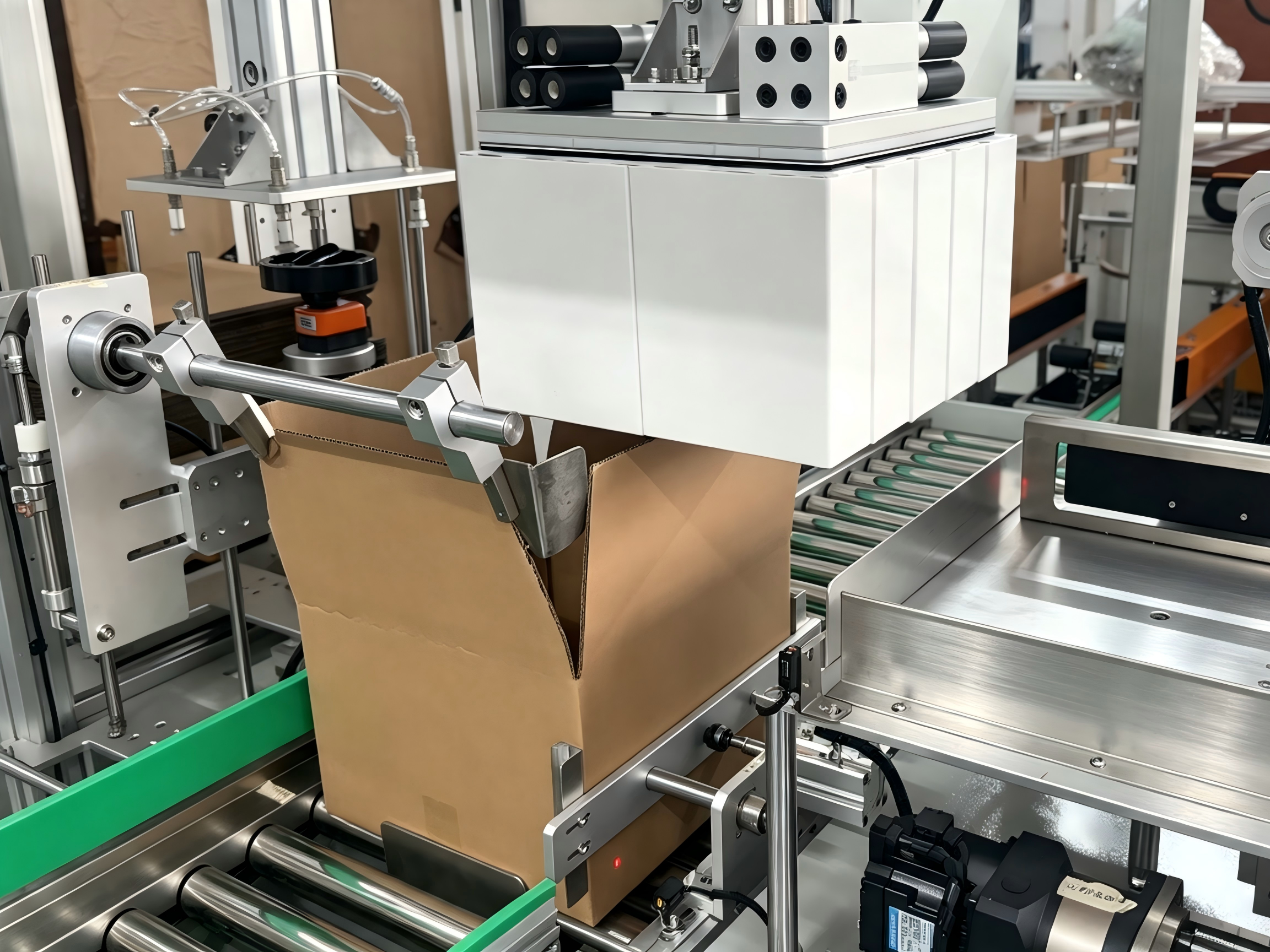
The sealing station holds its parameters. What happened to the filament before it arrived here is outside the machine.
Turn the Finding Into a Corrective Action
From confirmed cause to corrective action
Root cause analysis filament moisture failure is not a form you fill in at the end. It is a sequence: records, measurements, decision.
A drying finding is corrected upstream: change the drying, shorten the conditioning time before bagging, or move the waiting area out of the humid corner. A barrier finding is corrected in the film or the route. A seal finding at the sealer, and in handling.
Then verify it the same way. Re-run the same measurement, on the same batch, under the same conditions, and keep the result against the batch record. A corrective action that is not re-measured is a hope.
Close the filament moisture complaint on the finding, not on a replacement spool.
What to ask a packaging supplier, and what to keep yourself
If you buy filament, or sell it, the evidence matters twice.
From a supplier: what moisture measurement do they take before packaging, with what method, how long filament stands between drying and bagging, what film they run, what they record. Ask for the record, not the assurance.
Keep your own side as well: an incoming moisture check filament sample drawn from the batch, the seal test you ran on your own line, the date the bags were sealed, who checked them, and the complaint handling corrective action filament record in the file.
No process makes moisture absorption zero. A supplier who promises otherwise is telling you something about their process, not about your filament.
A filament moisture complaint is not a bag problem until the records say so. Pull the six, run the three on the complaint batch, read the results against the four causes. Drying, barrier or seal — the answer picks the corrective action, and tells you whether new equipment belongs in it. Write the finding down, so the next complaint costs an afternoon.
FAQ
Can a vacuum-sealed spool still arrive wet?
Yes. Vacuum sealing preserves the condition of the filament it seals, it does not dry filament that is already wet. Moisture can enter before bagging, through the film, through a seal fault, or the problem can be in how the bag was inspected.
What should I record first when a customer says the filament was wet?
Filament type, moisture content before packaging (or your own quality metric), the waiting time between end of drying and bagging, bag film structure, sealing method, and inspection records. A record never kept is itself a finding.
Which three measurements separate the causes?
Heat-seal strength answers whether the seam holds. Package integrity answers whether this bag is leaking. Film barrier performance answers whether the film is a barrier for this route and season. Each needs a matching measurement method and conditions.
Does a new bagging line fix filament that was already wet?
No. A bagging station holds seal parameters constant, places desiccant by rule rather than by memory, and inspects every bag the same way. It cannot dry filament that was already wet, and it cannot turn a low-barrier film into a high-barrier one.
What do I do when all three measurements pass?
Look at the inspection method. Often only the seam was checked and not the film, or the check happened at sealing and not after transit, or one bag out of the batch was tested. A clean result on the wrong question is still a clean result on nothing.
[Send us the spool and the bag from the complaint batch. We will seal it, hold it, and show you what the measurements say.]
Email: helen@huanlianauto.com