
A factory owner called us last week with a question that comes up more than any other: “I know I need to automate my box folding. But there are so many machine types, and everyone tells me something different. How do I pick the right one without overspending on features I don’t need—or buying too small and outgrowing it in six months?”
It’s a fair question. A carton folding machine—or carton erector—isn’t one-size-fits-all. The right machine depends on your box structure, your daily volume, your product weight, your budget, and where you want your operation to be in two or three years. This guide walks you through each decision point in order, so by the end you’ll know exactly which configuration fits—and you won’t have wasted time looking at machines that don’t.
Step 1: Identify Your Box Type First
The single most important rule of carton folding machine selection: **the machine follows the box**. You don’t pick a machine first and then design around it. You start with the box you already use (or are about to use), and the correct machine category follows from that decision.
The Four Main Box Types and Their Machines
| Box Type | Structure | Typical Use Cases | Machine Category |
|---|---|---|---|
| Snap Lock Bottom (Auto-Lock / 1-2-3) |
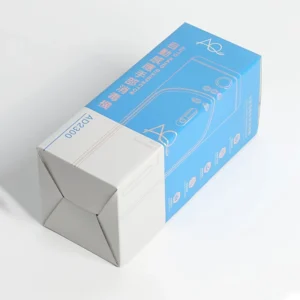
Interlocking base flaps, no glue at assembly | Electronics (chargers, shavers), cosmetics, food, home goods, hardware multipacks. Best for products 500g–3kg+ | Snap Lock Bottom Carton Erector |
| Tuck End Box (STE / RTE) |
Fold-in tabs friction-fit into slots | Light cosmetics, pharma, FMCG, retail display packaging. Best for products under 400–500g | Tuck End Carton Erector |
| Mailer Box (Shipping Box / Corrugated Mailer) |
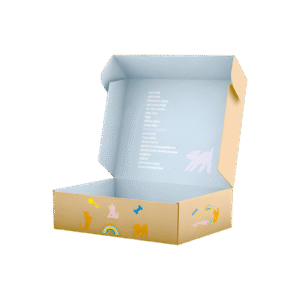
One-piece corrugated, self-interlocking or crash-lock base | E-commerce shipping, subscription boxes, direct-to-consumer fulfillment, gift sets | Mailer Box Folding Machine |
| Rigid Box (Lid & Base / Two-Piece) |
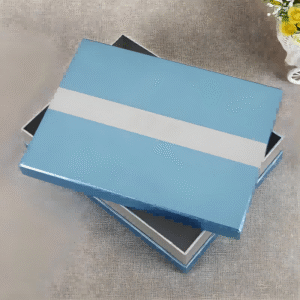
Dense paperboard trays, separate lid and base | Premium cosmetics, fragrances, fruit gift sets, jewelry, high-end electronics accessories, fashion | Rigid Box Folding Machine |
If you’re still deciding between box types, this comparison of tuck end vs. snap lock bottom boxes breaks down the structural differences, weight limits, and cost tradeoffs. If you already know your box type, skip ahead—the machine choice is now straightforward.

Go to YouTube to watch the UBL carton forming machine in action.
Step 2: Match Your Daily Production Volume
Once you know the box type, volume determines the speed tier you need:
| Daily Volume | Snap Lock / Tuck End | Mailer Box | Rigid Box |
|---|---|---|---|
| < 10,000/day | Standard model (1,500 pcs/h) — single shift sufficient | Standard model (1,800 pcs/h) — single shift sufficient | HL-ZP30 standard — may not need full shift |
| 15,000–2,000/day | Mid-speed model (1,800–2,000 pcs/h) — 1–2 shifts | Mid-speed model (2,000–2,200 pcs/h) — 1–2 shifts | HL-ZP30 full shift + possible second unit |
| > 40,000/day | High-speed model (2,200–2,400 pcs/h) — multi-shift or dual-machine setup | High-speed model (2,400+ pcs/h) — multi-shift or dual-machine | Multiple HL-ZP30 units or custom line layout |
A common mistake is sizing for today’s volume only. If your business has been growing 20–30% year-over-year, size for where you expect to be in 18–24 months, not where you are today. An undersized machine becomes a bottleneck just as quickly as manual folding does.
Step 3: Consider Your Product Weight and Handling Requirements
Box type isn’t just about aesthetics—it’s structural. The wrong box for your product’s weight leads to bottom failures, returns, and damaged goods during shipping.
Weight-Based Quick Reference
- Under 300g — Tuck end (STE/RTE) is sufficient and most economical. Snap lock bottom works fine but costs slightly more per blank.
- 300g – 500g — Border zone. Tuck end works for careful handling environments. Snap lock bottom adds safety margin if products ship through logistics networks.
- 500g – 2kg — Snap lock bottom recommended. The interlocking base distributes load across four panels; tuck end tabs risk popping open under this weight range.
- Over 2kg — Snap lock bottom or reinforced rigid box. For shipping applications, consider double-wall corrugated mailers with crash-lock bases.
If your SKU mix spans multiple weight ranges, you likely need two different box types—and therefore two different erectors. Plan for both from the start rather than retrofitting later.
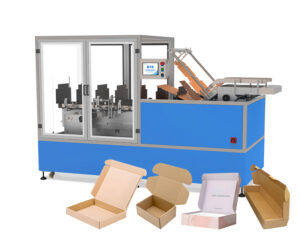
Step 4: Semi-Automatic vs. Fully Automatic Line
“Fully automatic” sounds like the goal, but it isn’t always the right starting point. Many UBL customers get better ROI by automating in phases:
Phase 1: Semi-Auto Folding (The Most Common Starting Point)
- What you buy: One carton erector at the head of your existing packing line
- What changes: Machine folds boxes and pushes them to conveyor; workers do everything else (loading, sealing, labeling) as before
- Labor savings: Eliminates all folding workers immediately; frees 3–6 people for value-added tasks
- Payback period: Typically 4–12 months depending on local labor costs and volume
- Best for: Operations under 10,000 boxes/day, limited floor space, or companies testing automation for the first time
Phase 2: Add Downstream Automation
- What you add: Product loading station (cartoning machine), auto-labeling, weighing, shrink-wrapping
- What changes: After the erector forms boxes, the rest of the line runs with minimal human intervention
- Labor savings: Additional reduction in loading/sealing workers; higher throughput consistency
- Best for: Established operations with stable volume, clear ROI on Phase 1, and management ready to invest further
Phase 3: Full Line Integration
- What it looks like: Erector → Cartoner → Labeler → Weigh-checker → Shrink-wrapper → Case-packer → Palletizer
- Labor requirement: 1–2 operators monitoring the entire line vs. 10–15 people on a fully manual line
- Best for: High-volume manufacturers (15,000+ units/day), multi-shift operations, or companies building new facilities from scratch
You don’t have to jump straight to Phase 3. Phase 1 delivers 60–70% of the labor savings at a fraction of the total investment. UBL supports customers at every phase—we’ve installed single erectors for startups and complete lines for established manufacturers. The approach depends entirely on your current situation and growth plan.
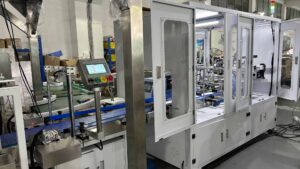
Step 5: Check These Technical Specs Before Buying
Regardless of box type, these specifications determine whether a machine actually works for your specific situation:
| Specification | Why It Matters | UBL Standard |
|---|---|---|
| Size range (L × W × H) | Covers all your SKUs? If you run 5 sizes but the machine handles 4, you still need a second solution for the oddball SKU | Adjustable within wide range per model; confirm against your spec sheet |
| Board thickness / flute type | Wrong spec = jams, misfeeds, or damage to blanks. E-flute, B-flute, and dense board each require appropriate settings | E-flute, B-flute, single-wall up to ~5mm; rigid board up to 3mm |
| Changeover time | Critical if you change sizes multiple times per day. Every minute of downtime is lost output | ~10 minutes between sizes of same box type |
| Throughput (pcs/hour or pcs/min) | Must exceed your peak demand with margin. Don’t size for average—size for peak | Varies by box type: 25–40/min (snap lock), up to 60/min (tuck end), 1800–2400/h (mailer), 20–30/min (rigid) |
| Folding precision | Misaligned folds = downstream problems. ±0.1mm is the threshold for reliable operation | ±0.1mm positioning accuracy (servo-driven) |
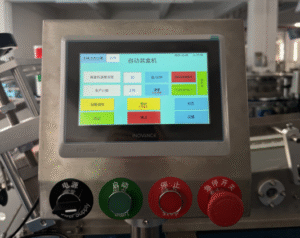
| Control interface | Touchscreen, recipe storage, bilingual support = faster training and fewer operator errors | Bilingual touchscreen (Chinese/English), recipe memory, diagnostics built-in |
| Footprint | Fits in your available space? Measure before ordering. Include room for blank magazine loading and outfeed accumulation | Compact modular design; dimensions provided per model in quote |
Step 6: The Sample Test (Don’t Skip This)
This is the step that converts “probably works” into “definitely works.” Here’s what we recommend every buyer do before committing:
- Send us 50–100 flat blanks of your actual box (the exact material, die-cut, and print you currently use).
- We load them onto the matching machine model and record a video of the full folding cycle—from blank pickup to formed box output.
- We send you the video plus a brief report: throughput observed, any adjustments needed, and confirmation that your material runs cleanly.
No sales pitch replaces seeing your own box being folded automatically. That video removes uncertainty about whether the technology works for your specific product. Most UBL customers tell us the sample test was what finally convinced them to proceed.

Decision Summary: Which Machine Do You Need?
| Your Situation | Recommended Path | Start With |
|---|---|---|
| I make snap lock bottom boxes for electronics/home goods, < 10k/day | Snap lock bottom erector → semi-auto line | Snap lock bottom guide |
| I use tuck end boxes for cosmetics/pharma, light products | Tuck end erector → semi-auto line | Tuck end comparison |
| I ship e-commerce orders in corrugated mailers | Mailer box erector → pack-and-ship line | Mailer box guide |
| I produce premium rigid boxes (cosmetics/gifts/fruit) | Rigid box forming machine → premium line | Rigid box guide |
| I’m not sure which box type I should use | Read the box-type comparison first, then choose the machine | Tuck end vs. snap lock bottom |
| I need a complete automated line from blank to sealed pack | Full-line consultation with layout proposal | Email helen@huanlianauto.com with details |
Next Steps
If you’ve read through this guide, here’s what to do next:
- Confirm your box type — Look at your current blank. Is it snap lock bottom, tuck end, mailer, or rigid? If unsure, send us a photo and we’ll identify it.
- Note your daily volume — Current average and peak-day maximum. Be realistic about peaks—they determine the minimum speed you can accept.
- Send us your sample — Blank samples go to our factory for live testing. We return video results within days, not weeks.
- Discuss integration — If you have an existing line or are planning a new facility, share photos or floor plans. We’ll propose the optimal placement for your erector and any downstream stations you’re considering.
Summary
Choosing the right carton folding machine comes down to six steps: identify your box type, match volume to speed tier, verify weight compatibility, decide between semi-auto and full automation phases, check technical specifications against your requirements, and always test with your actual blank sample. The most expensive mistake is buying the wrong machine for your box—or the right machine undersized for your growth trajectory.
UBL manufactures dedicated erectors for snap lock bottom, tuck end, mailer, and rigid box configurations. Each article linked above covers its box type and machine in detail. When you’re ready, send us your sample blank and we’ll show you exactly how it runs on our equipment.


3 responses