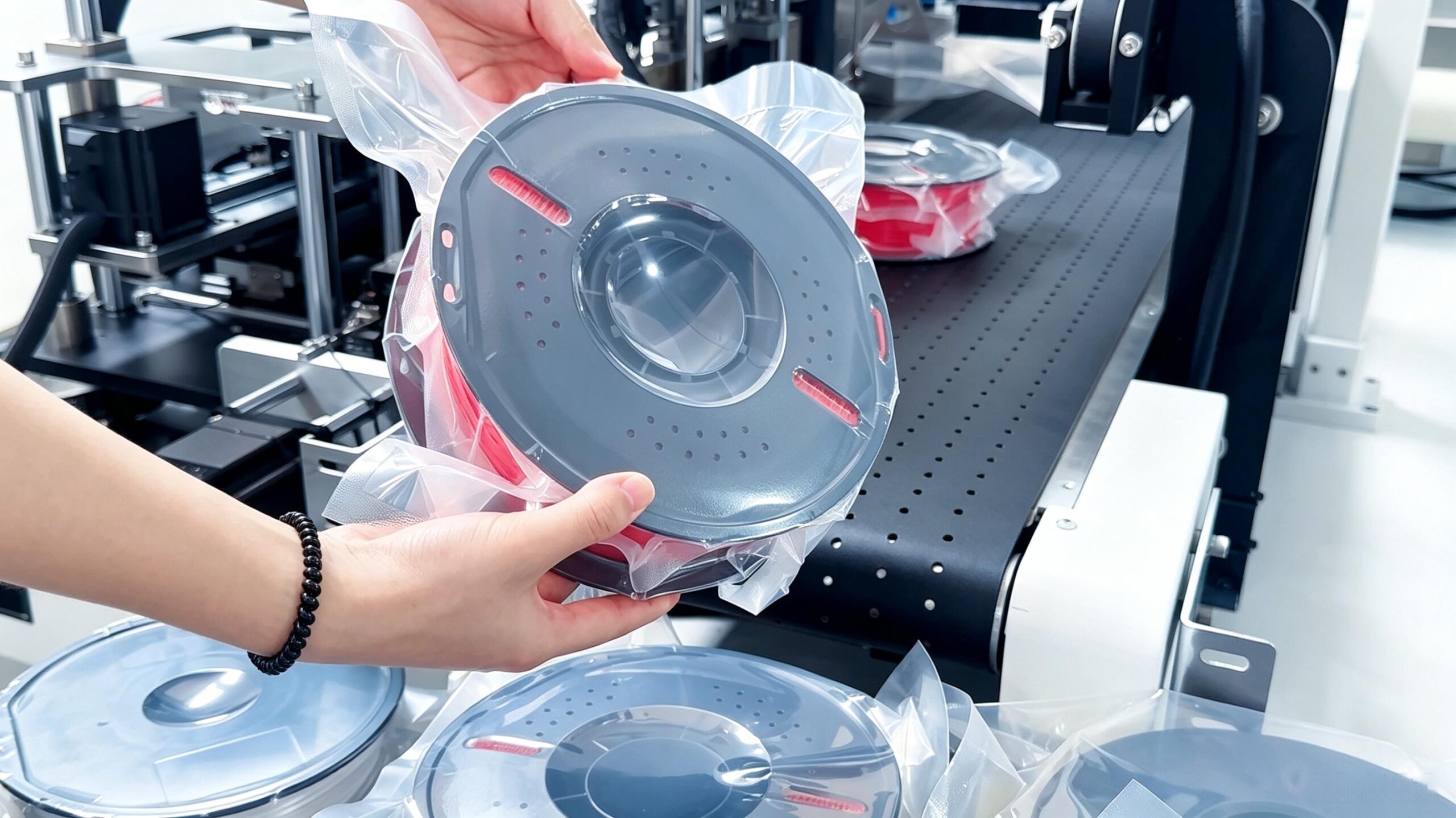
A vacuum bag tail seal is the seam left where the film closes past the product, and it is the part of the bag that decides whether a bagged spool goes into a mailer box or stops at the lip.
Nobody designs for it. The bag is designed to protect the filament, the seal to hold air out. And then the bagged spool arrives at the insertion station with a stiff handle on one side, and the operator cannot get it over the box edge.
The interesting thing is that the bag passes every check it was given. The seal is intact, the vacuum held, the film is the barrier it was specified as. The failure is mechanical, not a quality failure, and it arrives downstream of a station with no way to see it coming.
The filament vacuum sealing article on this site covers what vacuum sealing does for the filament. This one is about what the seal does to the shape of the pack, and why that shape matters a long way from the sealer.
What the Tail Seal Actually Is
When a bag is sealed, the film closes beyond the product. That closed section is the tail: two layers of film welded together, usually with a folded or pleated section between them. It is the only part of the bag with no product inside it.
That fact is the whole mechanism. Vacuum sealing removes the air around the product, so the film collapses onto it and the pack takes the shape of the spool rather than the shape of the bag. The tail is the one place where the air cannot be removed, because the film is folded there before it is sealed. Everything that follows comes from the vacuum bag tail seal, the only part of the pack that does not conform.
So the tail is a double layer of film with folded material trapped inside it, welded at the end. After the vacuum pulls, the rest of the bag hugs the spool. The tail keeps its own shape, because there is nothing pulling it flat.
| Part of the pack | What it is | What happens to it under vacuum | What the insertion station feels |
|---|---|---|---|
| The film against the spool flange | One layer, drawn down onto the product | Pulled tight, follows the spool contour | A soft, conforming surface |
| The film over the spool barrel | One layer, drawn down onto the product | Pulled tight, follows the barrel | A soft, conforming surface |
| The tail seal | Two layers with folded film trapped between them | Stays at the shape it was sealed in | A stiff edge, a ridge, something to catch on |
| The side gussets | Single layer film pulled in against the flange | Wrinkle inward, sometimes sharply | An uneven surface with loose material |
Why the seam is stiff
A single layer of film can fold and drape. Two layers welded together cannot. The weld has no give in it, and the film between the layers has been creased into a pleat so the bag could close past the product. Both make the tail a ridge rather than a surface, and the bag rigidity at the seam follows from it.
How stiff depends on three things. How many layers the tail is folded into, which is the bag design. How wide the pleat is, which is the sealer setup. And how much the material was creased before the weld, which is the folding sequence. That is the vacuum seal geometry of the pack, set long before anyone looks at the box.
This is why the same bag on the same sealer can behave differently from batch to batch. The pleat that ends up under the weld bar one time is spread one layer across the other the next. The difference is visible in the pack and invisible in the settings.
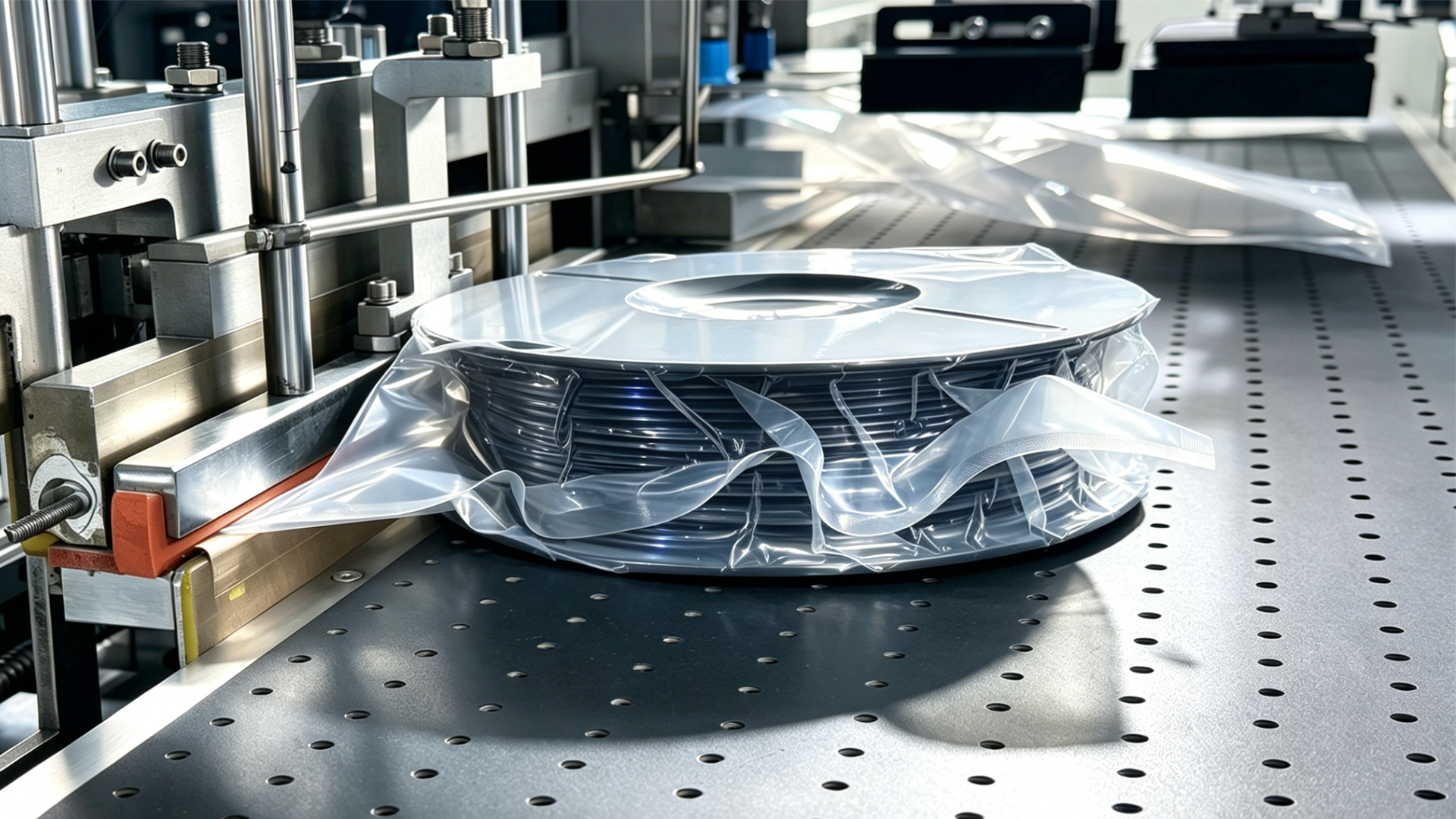
This is what a vacuum bagged spool looks like from above. The film is pulled down onto the spool and wrinkles where it cannot follow the contour. Look along the edge and the tail is the line where the wrinkle pattern stops and a flat double layer starts.
How the Tail Changes the Handling
Here is the chain that causes the jam, in four steps. Each one is mechanical and each one can be seen. The vacuum bag tail seal is the first link, and the only one nobody planned for.
The first step is that the pack stops being a soft object. A bagged spool with a tight film is something an operator can pick up with one hand and turn. Add a stiff tail and the same object has a place where the hand cannot go and where the pack cannot be turned flat.
The second step is that the way the pack drapes changes. A spool in a loose bag settles into the box because the bag folds out of the way. A spool in a bag with a rigid tail settles onto one side and the tail sits on the edge. That is the spool bag drape problem, invisible until the pack is in the box.
The third step is the clearance at the lip. The mouth of a mailer box is a plane, and the pack has to cross it at an angle. A pack with a tail has to present its flat side to the lip and thread the tail through the opening. A pack without one just goes in. This is the box lip clearance problem, where most jams stop.
The fourth step is the corner. Once the pack is partly in, the tail is either in the box or outside it, and it is catching the lid panel or the side wall. The operator is holding a bagged spool that will not go in and will not come out cleanly, and the carton line stops.
| Where the problem shows up | What the operator sees | What is actually happening | What it gets mistaken for |
|---|---|---|---|
| At the box lip | The pack will not go in and has to be pushed | The tail is catching on the edge of the lip | A box that is the wrong size |
| Inside the box | The pack sits diagonally and will not lie flat | The tail has bridged across the corner and is holding the pack up | The operator pushing it wrongly |
| At the closing step | The lid will not close, or closes with the tail sticking out | The tail is between the lid and the pack | A lid that does not fit |
| After the box is closed | A bulge on one side of the box, or a corner that looks wrong | The tail is still inside, occupying space the product needed | Damage to the product |
| On the output conveyor | One box in a run comes out at an angle | That one pack had a tail in a different place | A random machine fault |
The variation is what makes it look random
Here is why this gets written off as an operator problem. Every spool in the run has a tail. Most of them go in. One in a run does not, and nothing on the bag tells the operator which one before it reaches the box.
The tail lands where the film was pleated when it went under the weld bar. That position depends on how the bag was opened, how it was presented to the sealer, and how the operator’s hands moved. It is not fixed to the spool, so it is not fixed to the pack.
So the operator learns a work-around. They turn the pack a particular way, or push the tail in with a finger, or lift the bag over the lip in a particular direction. The work-around is learned rather than written down, so it leaves with the operator.
This is the pack at the sealing station. The bag is still open around the spool and the film has not been drawn down yet. Where the tail ends up is decided here, when the film is folded and welded, and by the time the pack reaches the cartoning station that decision is a long way in the past.
What to Look At
The diagnosis starts at the sealer. The insertion station is where the symptom appears; the cause was set when the tail was sealed. The bag tail seam is the evidence, and it is evidence you can lay out on a table. Every vacuum bag tail seal question starts with finished packs, not with the machine.
| What to check | Where to check it | What it tells you | What it changes |
|---|---|---|---|
| How wide the pleat is under the weld | The tail on finished packs, laid out and measured across | Whether the pleat is consistent or varies pack to pack | The folding setup at the sealer |
| How many layers the tail has | The bag design, or the tail on a finished pack | How much stiffness the pack is carrying | The bag itself, not the machine |
| Whether the tail is folded or flat | The tail on finished packs | Whether the bag design is producing a handle or a ridge | Whether the bag suits the downstream station |
| Whether the tail position varies | Several packs from the same run, laid out in order | Whether the variation is random or systematic | Which of the two causes to chase |
| Whether the pack has any give at the tail | Picking up a finished pack and trying to fold the tail | How much the tail resists | Whether an operator work-around is realistic |
Which direction the fix goes
Two directions, and they are not equally available.
The first is the sealer. The pleat setup, the way the film is folded and presented, the shape of the weld bar. This is a machine setting, and it can be changed without changing anything the plant buys from anybody else.
The second is the bag design. A bag with a flat tail and no pleat makes a pack with no handle. A bag whose tail is folded away from the product tucks the stiff part under the spool rather than off one side. These are supplier decisions and they take longer, but they change every pack rather than some of them.
What does not work is asking the insertion station to cope. A gripper has to grip something, and the stiffer the tail is the less it has to work with. Fixing the shape at the sealer is the more durable answer.
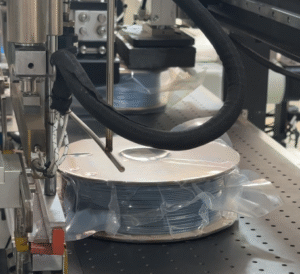
Film gathered and folded around the spool before the weld. Whatever this fold becomes is the tail that later has to go over the box lip, so the folding setup here is the place the vacuum bag tail seal problem is actually decided.
Why the Insertion Machine Needs to Know
An insertion station is designed to grip a product. A bagged spool is a product in a bag, and the bag changes what the gripper is gripping. The insertion grip on a bagged spool is a different problem from the grip on a bare spool, and the bag is what changes it.
The product insertion guide on this site covers how a bagged product is handled when it is inserted rather than dropped. The point here is narrower and comes earlier: the shape of the bag is an input to how the machine has to grip, and it is an input nobody usually passes.
The spool vacuum packaging machine article covers the sealing side of the same pack. Both halves sit in different articles because they sit in different departments, which is why the fault gets passed around.
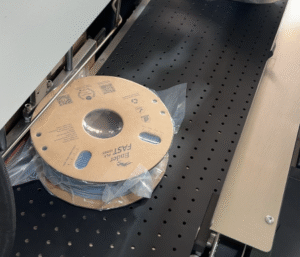
The pack on the bed with the film still loose around it. This is the shape the insertion station will be handed if the sealer does not get the tail right, and the last point at which anybody can see the problem.
The equipment on the sealing side is in the bagging machine range. When a bagging proposal is written, the shape of the finished pack is worth a paragraph, because it decides something on a line that proposal does not own.
[Send us a batch of sealed packs and we will lay them out and show you where the tails are, whether they are consistent, and whether the variation is coming from the pleat setup or from the bag design.]
Email: helen@huanlianauto.com
FAQ
What is a vacuum bag tail seal?
The closed section of the bag beyond the product, where two layers of film are welded together with folded material trapped between them. Because there is no product inside it, the vacuum cannot pull it flat, so it keeps a shape of its own. It is the only part of a vacuum bagged pack that behaves like a rigid edge.
Why does the tail seal affect spool insertion into a mailer box?
Because it changes the shape of the pack. A stiff tail means the pack cannot be turned flat, has to be threaded over the box lip rather than pushed through it, and ends up bridged across a corner where it holds the spool off the bottom of the box. The insertion station feels a spiky pack that was not designed to be spiky.
Does a heavier vacuum make the tail seal worse?
The vacuum pulls the film tighter against the product, which makes the body of the pack more conforming and easier for a gripper to take. The tail is not affected by the vacuum level in the same way, because the air does not leave it. What changes the tail is the pleat width and how the film was folded before the weld.
How do we find out where the tail varies?
Lay out a run of finished packs in the order they were sealed and look at the tail on each one. A tail that lands in the same place every time is a pattern from the folding setup. A tail that lands anywhere is a pattern from the bag design or from how the film is presented to the sealer.
Can the insertion machine be adjusted to cope with a rigid tail?
Sometimes, and it is worth knowing the limits. A gripper can be positioned to take the pack away from the tail, and the tail can be presented to the box first rather than last. What a gripper cannot do is remove stiffness from a pack. Fixing the shape at the sealer is the more durable answer.