A case erector FAT scope is the document that says where the supplier’s responsibility stops and the plant’s begins. Written properly it prevents the argument everyone expects to have three months after the machine is running.
A plant ordered a carton erecting machine. The acceptance test passed. The machine stood on the floor and formed boxes. The problem was the machine not at all. Nobody had written down whose job it was to feed it, and the line starved between the erector and the packer.
That is the whole subject of this article. Not how the acceptance test is run. Where it stops. A case erector FAT scope is short, and it is written before anybody travels.
The carton erector acceptance test checklist on this site covers the checks themselves. This one covers the boundary you write before any of them happen, so the checks answer a question that both sides agreed the question was.
What Belongs Inside the FAT
The factory acceptance test is the last chance to find out whether the machine does what the plant bought it for, before it is bolted to the plant’s floor and surrounded by the plant’s material. A case erector FAT scope is what makes that test mean something.
Four things go inside the scope, and they are not interchangeable. The first is the machine. The second is the material. The third is the standard. The fourth is the signature. A case erector FAT scope that leaves out any of them turns the test into a demonstration.
| Part of the scope | What it fixes | What it has to name | Why it cannot be left open |
|---|---|---|---|
| The machine configuration | What is physically being accepted | The model, the format range, the fitting set, the guarding and the ancillaries | The supplier accepts a machine that is not the one quoted |
| The material | What the machine is tested on | Blank supplier, board specification, die source, flute and the sample blanks used | The machine passes on the supplier’s board and fails on the plant’s |
| The standard | What counts as a good box | Which dimensions are checked, by what method, and what a reject is | Both sides count rejects differently and the count decides the outcome |
| The signature | Who decided what | The names on both sides and what each name covers | Acceptance becomes an opinion that either side can revise later |
The material is the part that decides the outcome
A machine forms boxes from whatever is fed into it. Feed it the supplier’s board and it will do a good job. Feed it the plant’s board and the result may be different, and the difference is not a machine fault.
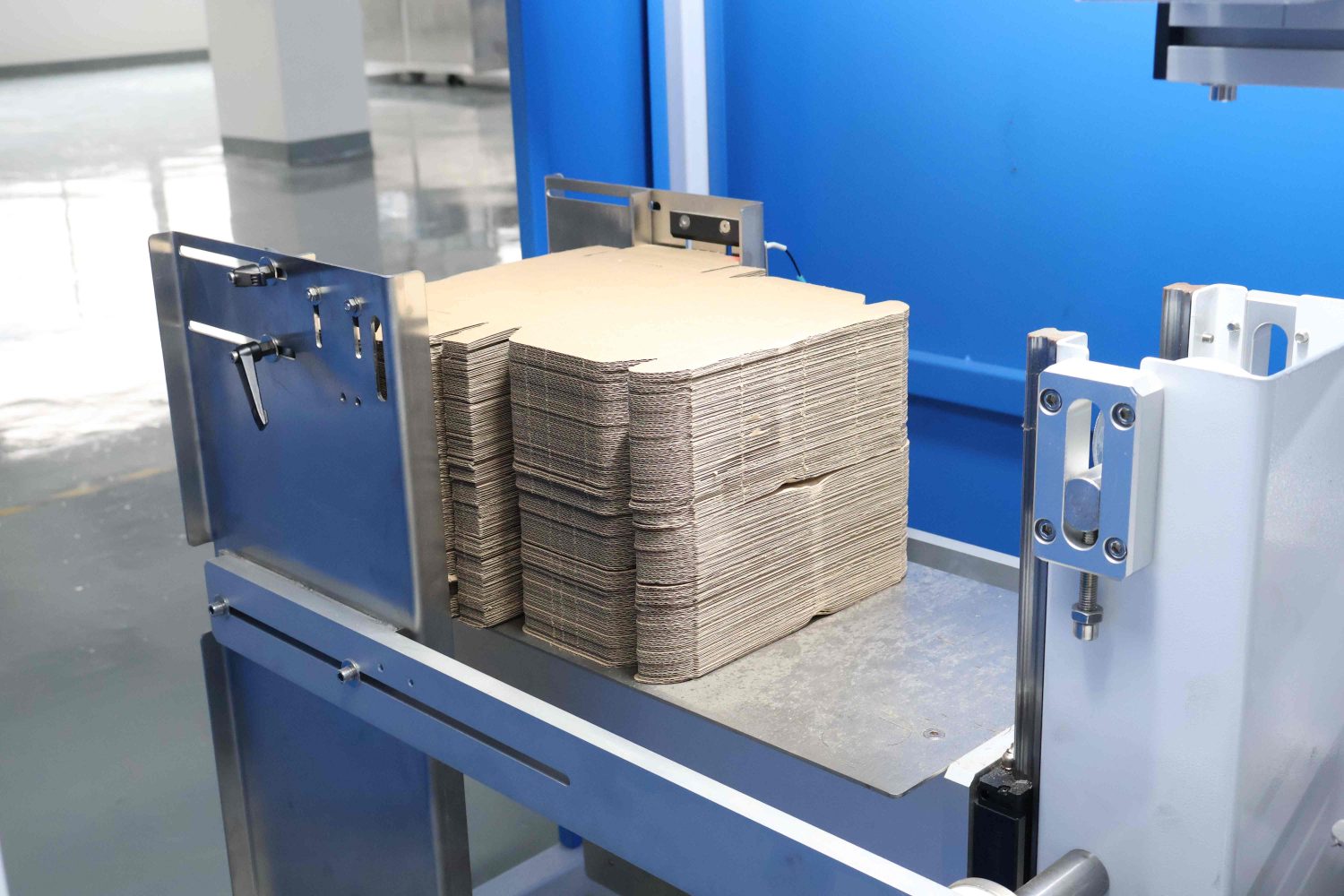
This is why the sample blanks for FAT belong in the scope by name, not as a general reference to the plant’s material. Which blank supplier, which die, which flute, how many blanks, and whether they come from the plant’s own stock or from the supplier’s sample room. If the blanks used in the test are not the blanks used in production, the test proved something about a different material.

Blanks from the plant’s own die, in the plant’s own board. This is the stack the machine should be tested against, and naming it in the scope is what keeps the test honest.
What counts as good case output
An empty case erector test produces an empty box. The word good is where the argument starts, so it has to be defined before the test, not during it. That definition is the rejection criteria the whole sheet hangs on.
Good case output is a set of things a box can be, checked by a method, with the method written down. Which dimensions are checked, where on the box they are checked, and whether the check is by eye, by template, by go and no-go gauge or by a camera. A box that meets the dimension check but has a torn crease is a reject, and so is a box that meets the crease check but is out of square.
The case packing SKU verification article on this site makes the same point about weight checks on a packed case. A single passing check does not establish that the thing is right. Several checks, written down, do.
Empty boxes coming off a forming station, each one standing on its own creases. Whether the plant’s definition of good case output would pass these is a question the scope has to answer before the machine is running, because afterwards the operator will pass them without thinking about it.
| What the plant checks on the formed box | How it is checked | Who does it | What a failure means |
|---|---|---|---|
| Whether it stands up on its own | Placed on a flat surface and released | The line operator | The bottom flaps are not locked or the score did not take |
| Whether the creases hold | By eye along the fold, and by opening and closing the box | The line operator | The score rule width or the board is wrong for this box |
| Whether the panels are square | Against a template or a gauge | Quality | The blank or the tooling is out |
| Whether the flaps are the right way round | By eye at the station | The line operator | The dieline and the machine disagree about the fold direction |
| Whether the box is the right one | Against the format the station was set to | The line operator, with the format visible | The wrong format is running, or the changeover did not complete |
What a rejection looks like
A rejection has to have a definition too, and this is the point where most FAT scopes are silent. A box that falls over when the operator reaches for it is a rejection. A box with a lifted corner is a rejection. A box out of square by more than the template allows is a rejection.
Two rules make the count mean something. First, the count is written on the sheet as it happens, not reconstructed afterwards. Second, a rejected box is set aside and kept until the end of the test, because the argument about whether it was a rejection is usually about the box, not about the number.
And there is a third rule, which is the one that changes behaviour: a rejection stops the test until it is understood. Not a percentage tolerance, not a number allowed per run. The test stops, the cause is found, and the test restarts. Otherwise the test runs to the end and the number at the end describes a machine that was struggling rather than one that was working.
The Line’s Job After Handover
The handover boundary that matters most is the one nobody writes down, because it is not about the machine. It is about everything around the machine. The case erector FAT scope is where that gets written.
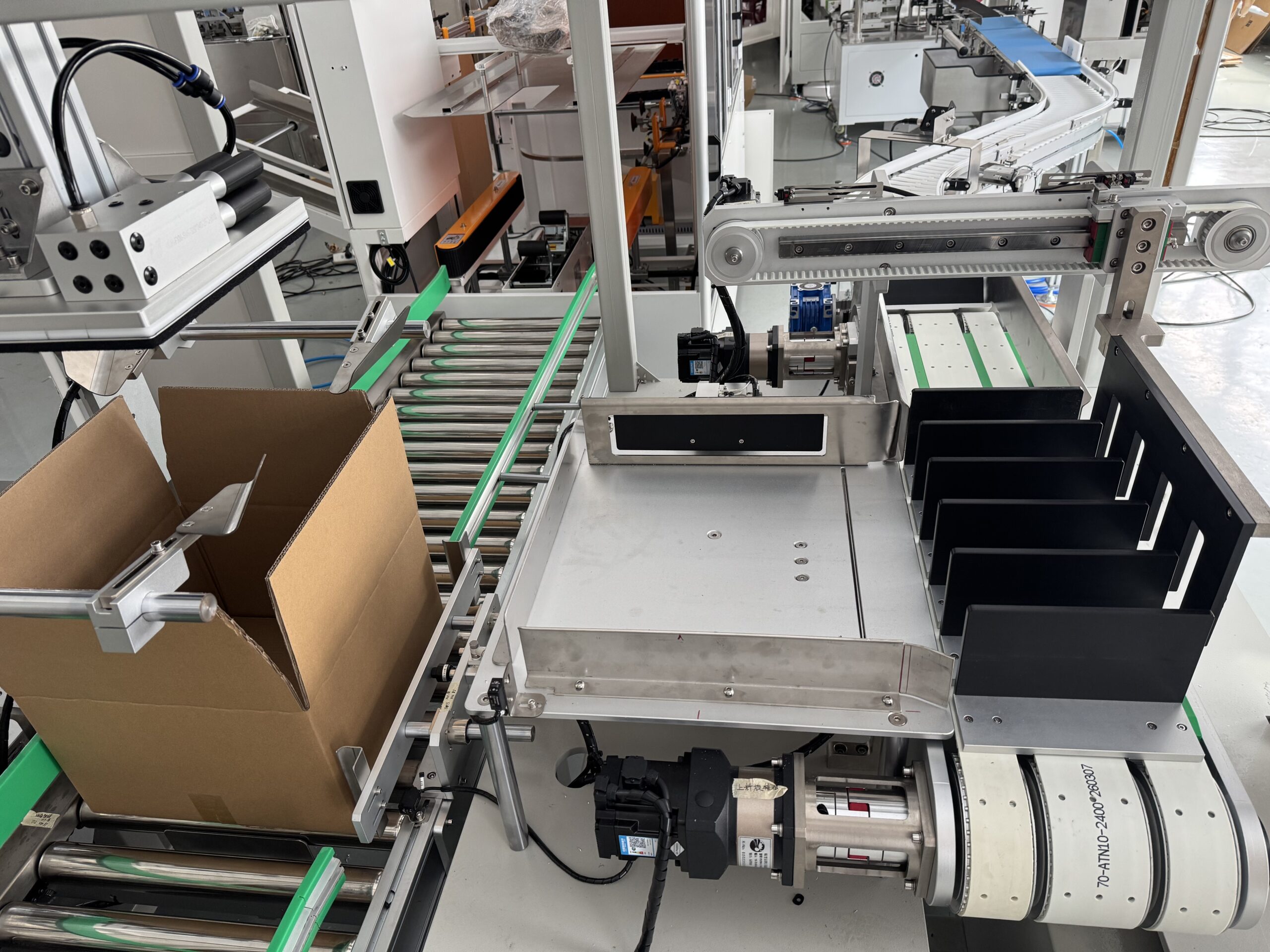
An erecting machine needs to be fed. It needs blanks delivered to the right place in the right orientation. None of that is in the machine specification, and all of it belongs in the scope. It needs someone to remove the empty boxes. It needs space for the formed boxes to accumulate before the next station takes them. It needs the changeover to happen at a defined point, with a defined person, on a defined signal.
<>Who is called, what is logged, and what the plant does meanwhileThe line stops and nobody knows who to ring
| Task around the erector | Who owns it after handover | What the scope should say about it | What goes wrong when it is not written |
|---|---|---|---|
| Feeding blanks to the machine | The plant, or the supplier during a period | Who loads, how often, and what happens when the stack runs out | The machine starves and the line waits |
| Removing formed boxes | The plant | Whether a person takes them or the conveyor does | Boxes pile up at the station |
| The format changeover | Named on both sides | Who performs it, how it is signalled, and what the machine does during it | Two people do it, or nobody does |
| Rejects and the scrap bin | The plant | Where rejects go and whether the supplier wants to see them | The reject rate is invisible |
| Cleaning and routine access | The plant, with a supplier method | What has to be opened to get at it, and how often | Nobody cleans it because nobody knows how |
| The fault response | The supplier, with a named route |
The line the erector sits on
Not every erecting machine needs to stand alone. On a mailer box line the erector feeds the folding station, the product goes in, and the box closes. Each of those handoffs has to be written into the scope with the same care as the machine itself, because a machine that forms a beautiful box and then waits for the next station is not a problem the FAT will ever find.
The cartoning line integration article on this site sets out the handoffs that decide a line’s speed. The scope for the erector should at least name the machine on the other side of the handoff and who owns the interface.
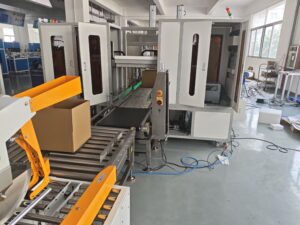
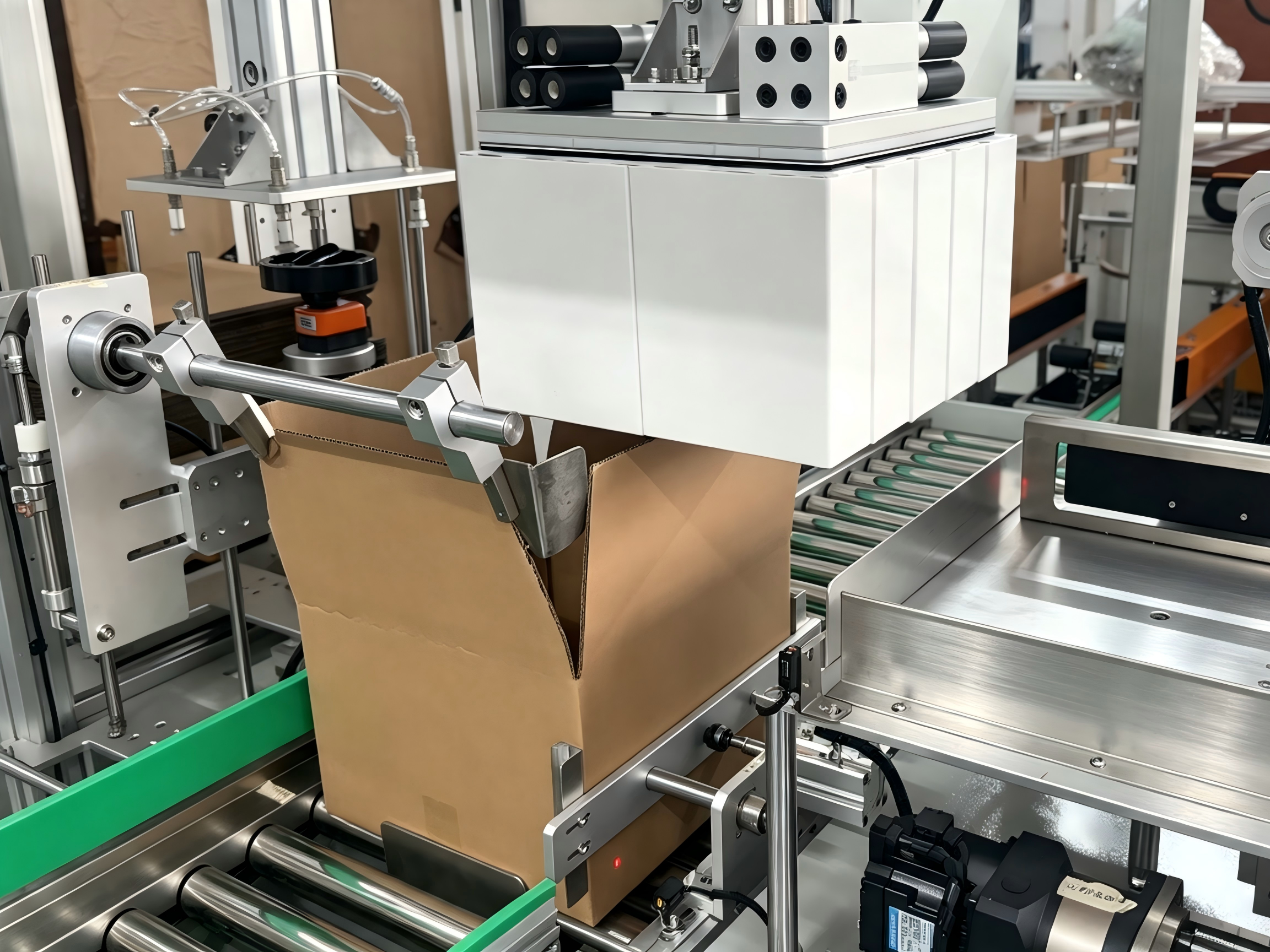
An erector on a roller conveyor with an open carton on it. The factory acceptance test scope has to define what a good box looks like coming off this machine, and the plant is the only party that knows what one is worth.
Writing the Scope
Two documents. The first is the case erector FAT scope, written before the test, and it is short. The second is the test record, written during the test, and it is a list of the checks with results beside them.
The scope has a header that says what document it is, a list of what is inside the FAT, a list of what is explicitly outside it, the material by name, the standard by reference to a written check method, the reject rule, and the names on both sides with the date.
The section that gets skipped is the exclusion list, and it is the one that does the work. It says what the FAT does not cover: the plant’s conveyor, the plant’s operator training, the upstream machine, the downstream machine, the plant’s own material handling, and anything on the line that was not quoted. Each of those is a real task. None of them is the supplier’s, and each of them will otherwise arrive as a claim.
There is a second thing the scope has to say that is not a task at all, and it is the one that saves the most trouble. It has to say what happens if the test does not pass.
Not in the language of contracts. In the language of the shop floor. Does the machine stay at the supplier’s works and the plant get another one. Does it stay at the plant’s works and the plant runs the old manual operation in the meantime. Does the plant pay for the freight twice. A scope that says what happens next is a scope both sides can sign, because neither of them is being asked to guess what they are agreeing to.

After the signature, the machine belongs to the plant’s maintenance routine and the plant’s operators. The scope is where that transfer happens, and it is worth naming who is trained on what before the test rather than after it.
The equipment being scoped sits in the carton folding machine range. The carton folding machine selection guide covers what to check when comparing machines. Neither of those conversations is worth having if the case erector FAT scope has not been written, because the scope is what the test will be measured against.
[Send us the box you intend to run and the checks your operators already make, and we will tell you which parts of the FAT scope are missing before the test date is agreed.]
Email: helen@huanlianauto.com
FAQ
What should a case erector FAT scope contain?
Four things: the machine configuration being accepted, the material it is tested on by name down to the blank supplier and die, the standard that decides good case output, and the names on both sides. It should also carry an exclusion list, because the tasks that go wrong after handover are usually the ones nobody wrote down.
Which blanks should be used for an empty case erector factory acceptance test?
The plant’s own blanks, from the plant’s own die, in the plant’s own board. If the test blanks come from the supplier’s sample room rather than from production, the machine has been tested against a different material and the result does not transfer. Bring production blanks to the test.
Who owns feeding the erector after handover?
The scope has to say, because it is the task most often assumed and most often disputed. Name who loads the blanks, how the format changeover is signalled, who removes the formed boxes, where rejects go, and what the plant does while a fault is being answered. Each is a real task and none is obvious.
What makes a case erector FAT fail?
A box that does not meet the written check method: one that will not stand up, one with a crease that lifts or tears, one out of square against the template, one with its flaps folded the wrong way, or one that is not the format the station was set to. The failure needs a definition written down before the test, and a reject that stops the test until it is understood.
Can the factory acceptance test be run on the plant site?
Sometimes, and it changes what the scope needs to cover. A test run at the plant’s own site exercises the real conveyor, the real material flow and the real operators, which removes a whole set of arguments about the interface. It also means the machine has already been installed when the test happens, so the exclusion list has to be tighter rather than looser.