A T-shirt line and a hoodie line share the same end goal — a folded, bagged, labeled piece ready for retail or fulfillment — but the path to get there is meaningfully different. Hoodies, sweatshirts, zip-up jackets, and heavy sportswear are longer, thicker, and heavier than jersey knit tops. They take more time to place at the infeed, the fold arms need to handle more material resistance, and the infeed-to-fold cycle is slower because the operator cannot move a 600-gram hooded sweatshirt through the infeed as quickly as a 180-gram T-shirt. A hoodie folding machine is not just a faster pair of hands — it is a machine configured specifically to handle the physical demands of thick, long garments without sacrificing fold consistency.
Why Thick Garments Need a Different Folding Approach
Length: Long Garments Require More Fold Steps
A standard adult hoodie or sweatshirt is 65–80 cm in body length — significantly longer than a T-shirt at 65–70 cm, and substantially longer than a polo at 60–65 cm. The extra length means the fold sequence must account for more material in the longitudinal direction. On the FC-252A, the garment length range accommodates up to 1,200 mm before folding, which covers hoodies, long-line sportswear, and most jacket styles without requiring a different machine model.
Fabric Thickness: The Fold Arms Must Work Harder
Heavy fleece, French terry, and brushed sweatshirt fabrics have substantially more body than a single-layer jersey. When the fold arm pushes the fabric over the fold edge, thick fabric resists and partially springs back. Machines designed only for thin garments lose fold precision on thick material — the finished fold is slightly open or asymmetric, which affects bag entry and pack presentation. The FC-252A’s “thick-and-thin” (厚薄款) designation means the fold mechanism is designed to apply the force and speed profile required for heavyweight fabrics without being destructive to lightweight ones.
Infeed Pace: The Rate-Limiting Step
On any folding line, the maximum throughput is set by the slowest step. For hoodies and heavy sportswear, that step is almost always the infeed — placing a long, heavy garment flat on the conveyor, orienting the hood or collar correctly, and smoothing out any bunching before the piece enters the fold zone. This physical placement task takes more time per piece than placing a T-shirt. As a result, a hoodie line on the same machine as a T-shirt line runs at a lower pieces-per-hour rate — not because the folding mechanism is slow, but because the infeed pace is governed by garment size and weight.
How the Double-Fold Sequence Works on the FC-252A
The FC-252A executes a two-stage fold on each garment. Understanding the sequence makes it clear why it handles hoodies effectively:
First Fold — Bilateral Lateral Fold
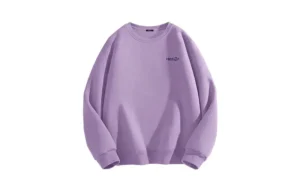
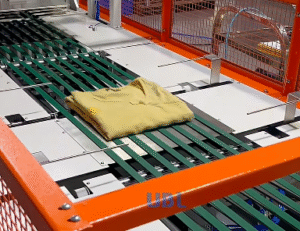
The garment lies flat on the infeed conveyor. The fold arms simultaneously push the left and right sides inward toward the center line, folding both edges over so the garment becomes a narrow, tall strip — roughly the width of the final package. For a hoodie, the arms fold in the sleeves and the body sides in one synchronized motion. After this step, the piece looks like a long, narrow rectangle, with the hood or collar at the top. This is the fold you can see in the first image — the garment has been collapsed to a single-width strip, uniform along its length.
Second Fold — Longitudinal Double Fold
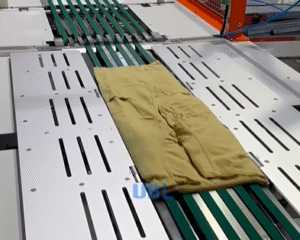
The narrow strip then moves to the longitudinal fold station. Here, the front section folds forward and down, and a second fold brings the piece to its final compact, near-square shape ready for bagging. For a long hoodie or jacket, this step is where the length is managed — the fold sequence converts 70+ cm of folded length into a finished pack typically 25–35 cm long. After this step, the piece is approximately square, uniformly flat, and ready to enter the polybag.
Bagging and Sealing
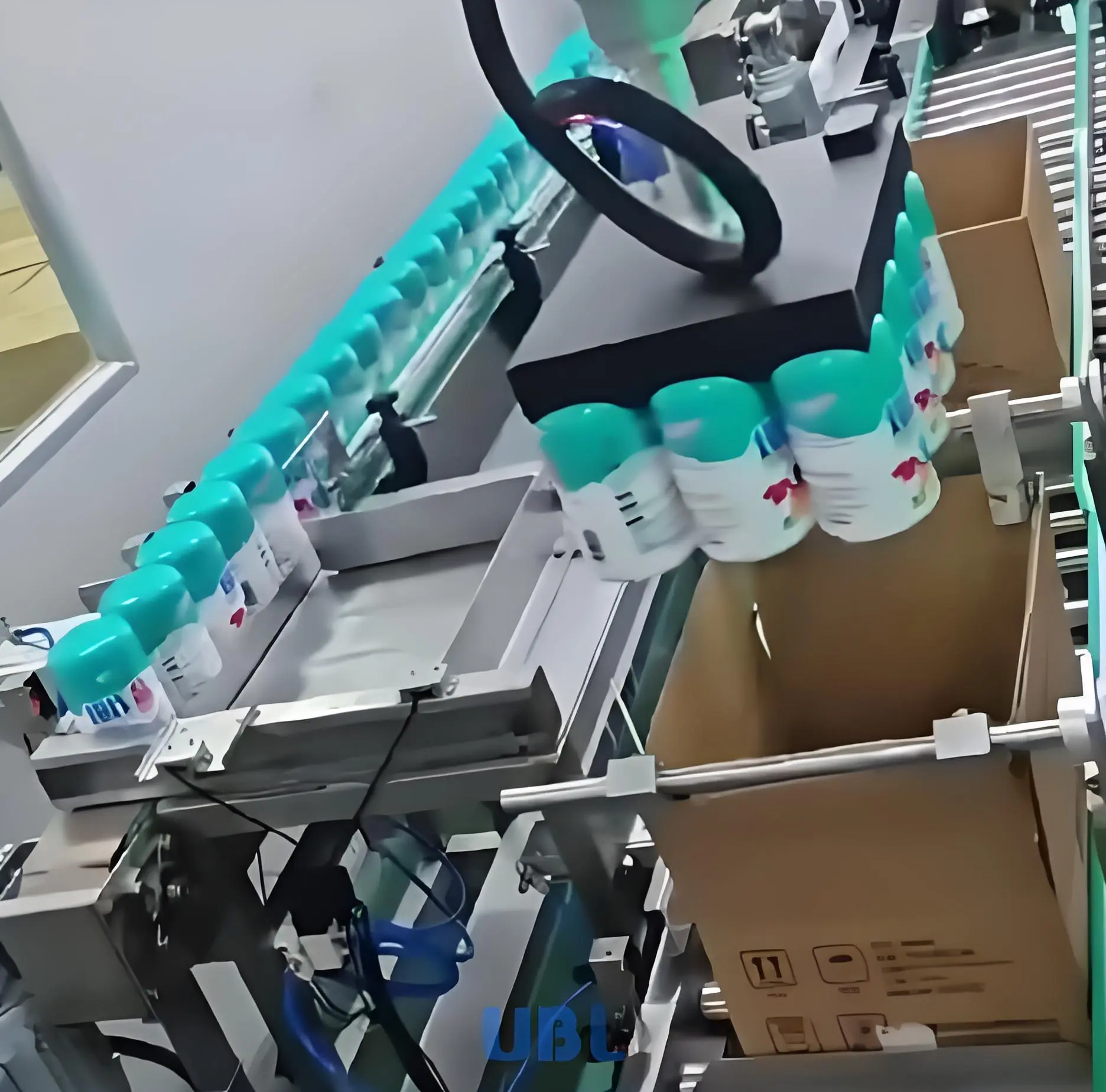
The folded piece transfers directly into the polybag. The seal station closes the bag — heat-cut seal or adhesive strip depending on the configuration — and the finished pack exits to the takeaway conveyor. If a labeling module is fitted, the product label is applied in this same continuous sequence before the pack exits.
Click to see how the UBL garment folding machine operates
Speed: What to Expect on a Hoodie Line vs. a T-Shirt Line
The FC-252A is rated at 600–700 pcs/h for thin garments (T-shirts, polo shirts, lightweight tops). For hoodies, heavy sportswear, and long-format garments, the practical throughput is lower — primarily because the infeed pace is governed by garment length and how quickly an operator can place and align each piece. A realistic throughput for a hoodie line on the FC-252A is approximately 500–600 pcs/h, depending on garment length and the operator’s placement pace.
This is still dramatically faster than manual folding. A skilled manual folder working on hoodies averages roughly 3–5 pieces per minute — equivalent to 180–300 pcs/h. A single FC-252A at 500 pcs/h represents at least a 2× throughput improvement over the fastest manual folder, with the added benefit that the machine’s output is consistent from the first piece to the last piece of the shift.
Garment Types the FC-252A Handles
| Garment Type | Typical Speed | Notes |
|---|---|---|
| T-shirts, polo shirts | 600–700 pcs/h | Fastest infeed pace; lightweight and short |
| Casual shirts, light jackets | 550–650 pcs/h | Slightly longer; moderate weight |
| Hoodies, sweatshirts | 500–600 pcs/h | Longer garment body; hood adds placement time |
| Zip-up jackets, sportswear | 500–580 pcs/h | Heavier fabric; longer placement time per piece |
| Uniforms, workwear | 500–600 pcs/h | Varies by cut and fabric weight; consistent fold output |
| Jeans, trousers | 550–650 pcs/h | Long-format; fold configuration set per size run |
Applications: Who Uses a Hoodie and Sportswear Folding Machine?
Sportswear Manufacturers
High-volume sportswear factories producing hoodies, zip-tops, training jackets, and fleece pullovers in seasonal runs face exactly the throughput challenge described above: garments are heavier and longer than summer basics, the packing window is compressed by seasonal delivery deadlines, and adding temporary manual labor to cover the gap is expensive and inconsistent. A full-auto FC-252A line handles the heavy-garment throughput requirement without the staffing variability.
Uniform and Workwear Suppliers
Uniform suppliers producing corporate shirts, industrial workwear, and institutional garments in large, identical runs benefit from the FC-252A’s HMI parameter storage — up to 99 garment configurations can be saved, so switching between uniform styles or sizes is a recall operation rather than a recalibration. Fold consistency is especially important for uniform packing because bulk-packed cartons of identical items need every piece to be folded to the same dimensions for carton utilization efficiency.
Fashion E-Commerce with Oversized and Premium Categories
Premium fashion e-commerce operations often stock oversized hoodies, heavyweight sweatshirts, and long-line outerwear alongside basic tees. Rather than running two separate packing lines — one for lightweight garments and one for heavy — the FC-252A’s thick-and-thin capability allows a single line to handle both categories, with a 10-minute parameter changeover between garment types.
Common Questions About Hoodie and Sportswear Folding Machines
Can the machine handle garments with drawstrings or hoods?
Yes. Hooded garments are placed at the infeed with the hood positioned at the collar end (consistent with the body orientation). The fold arms handle the hood as part of the garment body — it is folded in with the rest of the piece on the lateral fold. Drawstrings that are loose rather than secured may require the operator to tuck them in at the infeed before the piece enters the fold zone, which adds a small amount of time to the infeed placement step.
How does the machine switch between T-shirt and hoodie runs?
The switch involves recalling the stored HMI parameter set for the hoodie configuration — fold dimensions, bag size, speed profile — and making the corresponding physical adjustments to the conveyor width and fold arm positions. Total changeover time is approximately 10 minutes. No tools are required; the adjustments are made via hand-crank settings on the machine’s width controls and a parameter recall on the touchscreen.
What is the maximum garment length the FC-252A can handle?
The FC-252A handles garment lengths up to 1,200 mm before folding (garment width up to 850 mm). Long-line hoodies, extended outerwear, and most adult jackets fall within this range. For very long or oversized garments outside this range, contact UBL to discuss the appropriate configuration.
Is sample testing available for our specific hoodie styles?
Yes. Send your hoodies, sweatshirts, or sportswear samples to UBL — including any specific fold specification or bag dimensions you require — and we run the full fold-bag-seal cycle on video. You see the finished pack before committing to a purchase.
Related Reading
- UBL Garment Folding Machine — Full Product Line Including FC-252A Thick-and-Thin Model
- T-Shirt Folding Machine: Automating T-Shirt and Polo Folding for High-Volume Production
- Jeans Folding Machine: Automating Denim and Pants Folding for High-Volume Apparel Manufacturers
- Garment Folding Machine: How to Match the Right Model to Your Industry, Volume, and Packaging Format
Ready to Automate Your Hoodie and Sportswear Packing Line?
Whether your line runs hoodies, zip jackets, uniforms, or a mix of thick and thin garments across shifts, the FC-252A is configured to match your specific fold requirements before it ships. Sample trials with your actual garments are standard practice — we show you the fold quality and finished pack before you buy.
Contact us to discuss your heavy-garment folding line:
Email: Helen@huanlianauto.com
Website: ublpackaging.com