
Growth is supposed to fix problems. Bigger orders, more production, more revenue — that is the logic most factory owners operate on when they decide to scale. But there is a version of growth that breaks that logic: when the costs of scaling rise faster than the revenue it generates, and the factory owner is left staring at a larger operation that somehow produces smaller margins than the operation it replaced. This is the story of exactly that situation — and how a single automated laundry strip packaging machine resolved it.
The Growth That Didn’t Pay Off
Orders Were Up. The Decision Made Sense.
A bath and personal care supplier — producing laundry strips, bath products, and household cleaning items — had been growing steadily. Order volumes had climbed consistently over the previous year, and the owner made the decision that any growth-minded manufacturer would make: scale the operation. The factory expanded its production floor, brought in additional manufacturing equipment, signed a lease on additional space, and hired ten new workers to handle the increased packaging workload. From the outside, it looked like exactly the right move.
The Numbers Told a Different Story
Two months after the expansion, the owner sat down with the finance team and reviewed the P&L. Output had increased. Revenue had increased. But the monthly profit figure was almost identical to what it had been before the expansion — and on some lines, slightly below. The owner’s first reaction was that this was temporary: the operation was still settling, new workers were still getting up to speed, the additional costs would be absorbed as volume continued to grow.
The finance manager’s analysis was less optimistic. The new production equipment had added to the asset base, and the lease on additional floor space had added a fixed monthly cost. Both of those were expected and accounted for. What had not been properly modeled was the packaging labor cost. Ten new workers had been added to handle back-end cartoning of laundry strips — the open-box, fill, seal, and stack sequence that sits at the end of every production run. That headcount addition, combined with the existing packaging staff, had pushed the total back-end labor cost to a level that was consuming the margin the higher output should have generated.
The owner put it plainly: “The factory got bigger. The bills got bigger. But the profit didn’t get bigger. That’s not how this is supposed to work.”
The finance manager’s conclusion was direct: “The problem is packaging labor. We added 10 people to packaging, and even with 10 more people, output still can’t keep up with the orders. If we add more workers, the labor cost will exceed the revenue increase. We can’t solve this by hiring.”

Why Manual Packaging Doesn’t Scale Linearly
Laundry strip cartoning — erecting the carton, counting and inserting the strips, folding and sealing the flaps — looks straightforward when one person is doing it. It becomes a structural problem when it needs to scale. The issues are predictable and well-documented in any operation that has tried to solve volume growth through manual packaging labor:
- Each additional worker adds cost but adds diminishing throughput — coordination overhead, training time, and supervision requirements grow with headcount
- Manual consistency degrades at high speed — under time pressure, sealing quality drops, count errors increase, and rework rises
- Absence and turnover are structural risks — a packaging line staffed by 10 workers is one unexpected absence day away from a throughput gap
- Floor space per unit of output is inefficient — 10 workers at packing tables occupy substantially more floor space than a single machine running the same throughput
The owner had unknowingly walked into a scaling trap that every manufacturing operation hits at a certain volume: the point where manual labor stops being the solution and starts being the cost.

The Automated Solution: One Machine, Three Functions
After reviewing the finance team’s analysis, the owner investigated automated cartoning options and contacted UBL. The conversation started with a simple question: what does automation actually replace, and what does it cost?
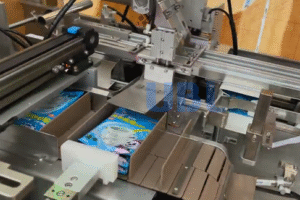
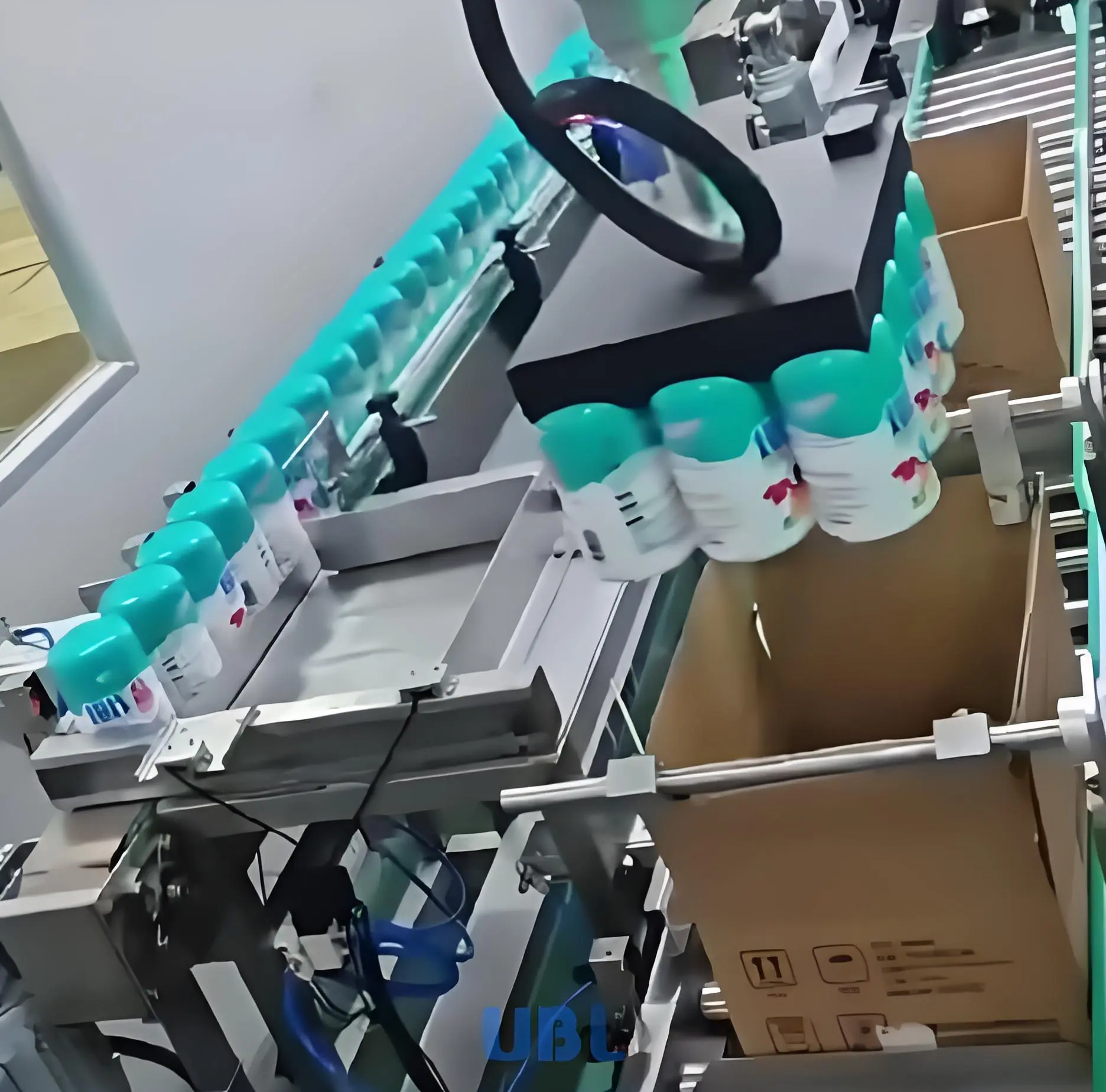
UBL’s cartoning machine for laundry strips handles three sequential functions automatically:
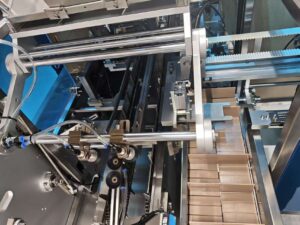
- Automatic box erection — flat carton blanks are fed from a magazine, erected, and positioned for loading without manual handling
- Automatic product loading — laundry strips are automatically fed and inserted into the open carton in the correct count and orientation
- Automatic sealing — carton flaps are closed and sealed (tuck-end or hot-melt glue, depending on carton specification) and the finished carton exits the line ready for secondary packaging
Three functions. One machine. One or two operators for monitoring and magazine replenishment. The rest of the back-end packaging staff — the people who had previously been standing at tables erecting boxes, inserting strips, and folding flaps by hand — were no longer needed for that task.
The Result: What Changed After Installation
Labor Reduction
The cartoning machine replaced the function previously performed by approximately 10 packaging workers. The owner retained 1 operator on the machine and 1 worker for output handling and carton magazine loading — a total of 2 people for a task that had required 10. Back-end packaging headcount dropped by approximately 40% across the full packing team, not just the cartoning station.
Throughput Increase
With consistent machine-speed cartoning replacing variable manual throughput, the packaging line no longer bottlenecked production. Overall packaging output increased by approximately 30% — not because the machine ran faster than 10 people in absolute terms, but because it ran consistently, without fatigue-related slowdowns, without absence gaps, and without the coordination overhead of managing a large manual team.
The First Monthly Report After Installation
One month after the cartoning machine went live, the owner reviewed the financial report. The labor cost line had dropped significantly. Output had increased. Margin per unit had improved. The owner’s assessment: “At this pace, with stable order volumes and the output the machine produces, we’ll recover the full investment in approximately 4 months. After that, everything the machine saves is pure profit.”
📹 Watch the actual production line in operation: see the UBL cartoning machine running laundry strip cartons from open to sealed at line speed. [Customer site video — link here]
The Payback Calculation
The math behind the 4-month payback figure is straightforward:
| Item | Before Automation | After Automation |
|---|---|---|
| Back-end packaging staff | 10+ workers | 2 operators |
| Staff reduction | — | ~40% of total packaging headcount |
| Packaging output | Baseline | +30% increase |
| Monthly labor saving | — | Equivalent to 8 workers’ monthly wages |
| Machine investment | — | One-time capital outlay |
| Payback timeline | — | ~4 months at stable order volume |
After payback, the monthly labor savings become direct margin. A machine with a useful life of 6–8 years under normal operation — and 10 years or more with proper maintenance — continues generating those savings long after the initial cost has been recovered. Over an 8-year operational life, the cumulative labor savings are a multiple of the machine’s original cost.
What This Means for Laundry Strip Manufacturers Considering Automation
The pattern in this case is not unique. It repeats across manufacturing operations in the laundry care, personal care, and household cleaning segments: manual packaging labor scales with volume, but not efficiently; at a certain throughput level, a machine is simply the better economic choice. The specific trigger point varies — some operations hit it at 3,000 boxes per day, others at 10,000 — but the logic is consistent.
Signs Your Operation May Be at the Automation Threshold
- You have hired additional packaging workers in the last 12 months but profit has not grown proportionally
- Your packaging team is the consistent bottleneck on your production floor — production runs faster than the packing line can clear
- You are losing orders or turning down volume because you cannot commit to delivery timelines with your current packing capacity
- Quality complaints about packaging — loose seals, inconsistent count, damaged cartons — are coming from buyers
- You are pricing quotes based on current labor cost but know that labor cost will rise if you accept the order
What UBL Offers Before You Commit
UBL’s process starts with a sample trial: send your laundry strip product and carton specifications, and UBL will run a live test on the machine and provide video documentation. You see the actual output — speed, seal quality, carton integrity — before any purchase decision is made. For operations with non-standard requirements, UBL provides two layout options (A and B) for your production floor, including equipment placement, footprint, and integration with your existing line.
Standard configurations ship the next business day after contract signing. Custom configurations — including non-standard carton dimensions, special seal requirements, or integration with upstream production equipment — typically deliver within approximately 3 months.

The Owner’s Final Assessment
Twelve months after installation, the owner’s view of the decision is uncomplicated: “The upfront cost was real. But it was a one-time cost. The labor saving is every single month. The machine will run for 8 years minimum — probably 10 if we maintain it well. You do that math, and it’s not even a close decision. The only thing I’d change is that I’d have done it earlier.”
For laundry strip and laundry sheet manufacturers currently running manual cartoning at mid-to-high volume — or planning a production expansion — that is the relevant data point. Not what the machine costs. What the machine saves, month after month, for the next decade.
To discuss your specific production volume, carton format, and automation requirements, contact UBL at info@ublpackaging.com or visit ublpackaging.com.


2 responses
The point about growth not always being profitable really resonates. It’s easy for manufacturers to assume bigger orders automatically mean higher revenue, but costs can scale faster than expected. This case is a good reminder to evaluate efficiency and cost structure before expanding production.
Hahahaha You are so good