
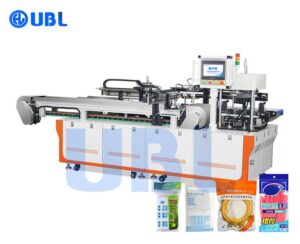
For 3D printing filament manufacturers, the bagging station is where packaging automation delivers its most visible impact. A filament bagging machine replaces the most labor-intensive step in the packing process—manually inserting each spool into a bag—with a continuous, machine-driven operation that opens, fills, and advances packages without stopping the line.
This guide covers how filament bagging machines work, the choice between roll film and premade pouches, compatible spool sizes, and how the bagging station connects to a complete filament packaging line.
What a Filament Bagging Machine Does
The bagging station handles one deceptively complex task: getting a cylindrical spool—ranging from lightweight 200g desktop formats to heavy 5kg industrial spools—into a sealed bag, consistently, at production speed.
The Automatic Bagging Cycle
On a UBL filament bagging machine, the entire process runs without manual intervention in the product path:
- Bag opening: The machine pulls film from the roll (or picks a premade pouch from the magazine) and opens the bag mouth using air jets or mechanical spreaders
- Product infeed: The operator places the spool on the infeed—or an automated conveyor delivers it—and the machine’s pusher mechanism advances the spool into the open bag in a single controlled motion
- Optional desiccant insertion: If configured with an automatic desiccant dispenser, a sachet drops into the bag before or during spool insertion. See our guide on filament vacuum packaging for desiccant options and specifications
- Sealing: The bag mouth is heat-sealed. On roll-film configurations, the film is also cut to length at this stage
- Discharge: The sealed spool exits on the discharge conveyor, ready for the vacuum sealing or labeling station downstream
Human involvement is limited to loading spools at the infeed and managing material replenishment (film rolls or pouch magazines). The machine handles everything in between.
Roll Film vs. Premade Pouches: Which Is Right for Your Operation?
UBL filament bagging machines support both film formats. The choice between them affects cost, flexibility, and the appearance of the finished package.
Roll Film (Form-Fill-Seal)
Roll film is the standard choice for most filament manufacturers. The machine pulls film from a roll, forms it around the spool, seals the side and top seams, and cuts each package to length—all in one continuous motion.
Advantages of roll film:
- Lower material cost: Roll film typically costs less per package than premade pouches, particularly at higher volumes
- Size flexibility: The same roll of film can package different spool lengths by adjusting the cut length—no bag inventory to manage across sizes
- Continuous production: Roll changes are infrequent (one roll covers hundreds to thousands of packages), minimizing production interruptions
- Custom printing: Film can be printed with your brand, material specifications, and regulatory information before it reaches the packaging line
Limitations:
- Initial machine setup requires film threading and seam alignment
- Film waste from test cycles during changeover
- Seal quality requires consistent film tension and temperature control
Real-world case: View our roll film bagging case study →

Premade Pouches
Premade pouches are pre-formed bags supplied by the customer or sourced to specification. The machine picks pouches from a magazine, opens them, inserts the spool, and seals the open end.
Advantages of premade pouches:
- Package appearance: Premade pouches can achieve finished packaging with precise dimensions, rounded corners, hang holes, and complex print designs that are difficult to replicate with roll film
- Retail presentation: For consumer-facing filament brands with display packaging requirements, premade pouches offer higher visual quality
- Simplified changeover: Switching between pouch sizes requires only a magazine change, without film rethreading
Limitations:
- Higher per-unit cost than roll film
- Requires carrying pouch inventory in multiple sizes
- Customer must supply or specify pouches—UBL can advise on specification but pouches are customer-sourced
Real-world case: View our premade pouch bagging case study →
Which Format to Choose
| Factor | Roll Film | Premade Pouch |
|---|---|---|
| Material cost per unit | Lower | Higher |
| Package appearance | Functional | Premium retail-ready |
| Size flexibility | High (adjustable cut length) | Fixed per pouch size |
| Changeover time | 10–20 min (film rethread) | ~15 min (magazine swap) |
| Inventory management | One or two roll specs | Multiple pouch SKUs |
| Best for | Industrial OEM, high volume | Consumer retail, display packaging |
Compatible Spool Sizes and Changeover
UBL filament bagging machines are configured to handle a range of spool dimensions. Reference compatibility parameters for standard configurations:
| Dimension | Reference Range | Notes |
|---|---|---|
| Length (L) | 250–350 mm | Spool outer diameter direction |
| Width (W) | 110–220 mm | Spool hub width / depth |
| Height (H) | 40–90 mm | Spool flange thickness direction |
These are reference parameters for standard configurations. Because spool sizes vary significantly across the 3D printing industry—from compact 200g desktop spools to 5kg+ industrial formats—UBL machines are customized to each customer’s product range. Contact us with your specific spool dimensions for an accurate compatibility assessment.
Changeover Between Sizes
When switching between spool sizes, the machine requires mechanical adjustment: guide widths, pusher travel, and bag forming parameters all change. For trained operators, this takes approximately 15 minutes—comparable to other format changes in packaging operations.
Changeover steps typically include:
- Adjusting side guide width to match new spool diameter
- Setting pusher stroke length for new spool depth
- Updating bag length (roll film) or swapping pouch magazine
- Verifying desiccant dispenser timing if configured
- Running test cycle to confirm alignment and seal quality
Changeover parameters can be stored as named recipes on the machine’s control panel, allowing operators to recall settings for each spool format without manual measurement—reducing both changeover time and setup errors.
Integration: From Standalone Machine to Complete Line
The filament bagging machine is designed to work as a standalone unit or as an integrated station in a complete packaging line. This flexibility supports manufacturers at different stages of automation.
Standalone Operation
A standalone bagging machine works with manual infeed and discharge. The operator loads spools one by one and collects sealed packages for manual handling downstream. This approach suits lower-volume operations or manufacturers transitioning from fully manual packing—capturing the efficiency of automatic bagging without committing to a full line investment.
Full Line Integration
For higher-volume operations, the bagging machine becomes one station in a coordinated automatic filament packaging line:
- Upstream: Automatic infeed conveyor delivers spools from winding or accumulation—removing the operator from the loading step entirely
- Integrated desiccant: Automatic desiccant dispenser inserts sachets during the bag cycle, as covered in our vacuum packaging guide
- Downstream — vacuum sealing: Sealed bags feed directly into the vacuum sealer, where air is evacuated to -0.08 MPa and the bag is permanently heat-sealed under vacuum
- Downstream — labeling: After vacuum sealing, spools pass through a labeling machine for barcode, product information, and batch code application
- Downstream — cartoning: Labeled spools are loaded into retail or shipping cartons by a cartoning machine, completing the secondary packaging stage
This end-to-end capability—from raw spool to labeled, boxed, retail-ready product—is at the core of UBL’s one-stop packaging approach. Rather than sourcing bagging, vacuum sealing, labeling, and cartoning equipment from different suppliers and integrating them independently, manufacturers work with a single supplier who designs and supports the complete system.
Modular Line Design
As described in our filament packing line overview, UBL’s line design is modular—machines have fixed dimensions but connect in flexible configurations. Lines can be arranged in straight runs, L-shapes, or U-shapes to fit your production floor. This means the bagging machine’s position in the line can adapt to your available space without compromising throughput or integration.
Operating the Filament Bagging Machine
Control System
UBL bagging machines use a touchscreen HMI control panel with Chinese and English language interfaces (other languages available on request). The interface displays current production count, running speed, fault status, and material consumption. Operators without technical backgrounds typically reach independent operation within 2–3 days of hands-on training, following a 2-hour initial training session.
Material Replenishment
The main operator task during production is monitoring and replenishing consumables:
- Film roll: Roll-change frequency depends on roll size and production speed; most operators change rolls once per shift or less
- Pouch magazine: Premade pouch magazines hold 50–200 pouches depending on configuration; low-level sensors alert operators before depletion
- Desiccant hopper: If configured, the desiccant dispenser hopper holds several hours of sachets with low-level alert
Common Issues and Quick Fixes
As with any packaging machine, the most common operational issues trace to a small set of causes:
- Missed bag opening: Usually caused by low air pressure to the spreading jets or worn spreader fingers—check supply pressure and inspect spreader condition
- Incomplete seal: Caused by temperature drift, film tension variation, or contamination on the sealing bar—verify temperature setting and clean sealing bar surface
- Product misalignment: Pusher timing or stroke length needs adjustment—check against the stored recipe parameters for the current spool size
For issues that can’t be resolved through these standard checks, UBL’s technical team provides remote support within 4 hours—video call guidance to diagnose and resolve problems without waiting for an on-site visit. Wear parts including sealing elements, belts, and spreader components are available directly from UBL as the equipment manufacturer.

Next Steps: Configure Your Filament Bagging Solution
The right filament bagging machine configuration depends on your spool sizes, production volume, film format preference, and integration requirements. UBL works with 3D printing filament manufacturers to specify equipment matched to their exact needs—including product testing with your actual spools before equipment selection.
Whether you need a standalone unit to replace manual bagging or a fully integrated station in a complete packaging line, we’ll help you identify the right solution and demonstrate it running your product.
Explore our complete 3D printing filament packaging solutions to see how bagging fits into the full production picture.
Contact UBL Packaging to discuss your filament bagging requirements:
📧 Email:
WhatsApp:+86 13602308576


11 responses
It’s interesting to see how automation is transforming the packing process for 3D printing manufacturers. The shift from manual labor to fully automated bagging is not only a time-saver but also improves consistency in packaging. I can see how manufacturers would appreciate the flexibility of choosing between roll film and premade pouches depending on their needs.
This breakdown of how filament bagging machines streamline the packaging process really highlights the shift toward automation in 3D printing manufacturing. It’s fascinating to see how replacing manual spool bagging with machine-driven efficiency can significantly improve throughput and reduce labor costs. The distinction between roll film and premade pouches also offers practical insight for manufacturers weighing their packaging options.
This breakdown of how filament bagging machines streamline the 3D printing filament packaging process really highlights the shift toward automation in manufacturing. It’s fascinating to see how replacing manual spool bagging with machine-driven efficiency can significantly boost throughput and reduce labor costs. The comparison between roll film and pre-printed options also offers practical insight for manufacturers evaluating their packaging strategies.
The shift from manual spool insertion to a continuous, machine-driven operation is a game-changer for filament manufacturers looking to scale. It’s fascinating how automating the bag opening, filling, and advancing steps directly addresses the labor bottleneck you described. This kind of targeted automation is exactly what’s needed to keep 3D printing production lines flowing smoothly without interruptions.
It is fascinating to see how automating the insertion and sealing steps transforms a labor-intensive bottleneck into a continuous, high-throughput process for 3D filament producers. Addressing the difference between roll film and pre-made bags would likely be a crucial detail for manufacturers weighing upfront material costs against long-term operational flexibility.
This is a timely read, especially regarding how automated bagging directly replaces the most labor-intensive manual steps in the filament production line. The transition to continuous machine-driven operations for opening, filling, and advancing packages is clearly a game-changer for scaling 3D printing manufacturing efficiency.
This is a crucial insight for 3D printing manufacturers, especially regarding how automating the bagging station eliminates the bottleneck of manual spool insertion. The shift to continuous, machine-driven operations clearly stands out as the most effective way to improve both efficiency and consistency in the packaging line.