
Moisture is the enemy of 3D printing filament. Even a small amount of absorbed water degrades print quality—causing bubbling, stringing, and brittle layers. For filament manufacturers, the question isn’t whether to protect against moisture, but how effectively that protection is built into the packaging line. A filament vacuum packaging machine is the primary defense: evacuating air from each spool package, sealing it under vacuum, and delivering product to customers with shelf-stable moisture protection.
This guide covers how filament vacuum packaging works, the technical parameters that matter, and how desiccant and bag material choices combine with vacuum sealing to deliver complete moisture protection.
Why Vacuum Packaging Works for Filament
Filament absorbs moisture from air. The speed of absorption depends on the filament material—nylon and PVA absorb moisture aggressively within hours; PLA and PETG absorb more slowly but still degrade with prolonged exposure. Once absorbed, moisture doesn’t just affect print quality; it can cause hydrolysis in certain materials, permanently altering molecular structure and making the filament unusable even after drying.
What Vacuum Packaging Actually Does
Vacuum packaging removes the air—and with it, the atmospheric moisture—from inside the package. Without air contact, filament cannot absorb moisture during storage or transit. The spool arrives at the customer in the same condition it left the packaging line: dry, within specification, and ready to print.
Vacuum packaging also eliminates the oxygen that contributes to oxidative degradation in some materials. For specialty filaments like metal-filled or carbon fiber composites, this is an additional quality benefit beyond moisture control alone.
Vacuum vs. Desiccant-Only Approaches
Some filament brands rely on desiccant sachets without vacuum. This approach has limitations: desiccant has finite capacity, and once saturated, moisture protection stops. In a sealed but non-vacuum bag, residual air contains moisture that the desiccant must absorb—consuming capacity before the package even reaches the customer.
Vacuum packaging reduces this residual moisture load dramatically, extending effective desiccant life and providing more reliable protection over longer storage periods.
How a Filament Vacuum Packaging Machine Works
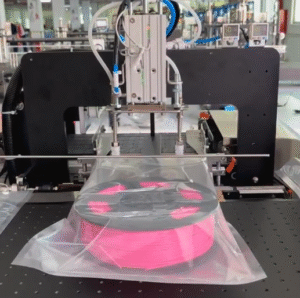
The core function of a filament vacuum packaging machine is straightforward: place the spool in a bag, remove the air, and seal the bag before air re-enters.
The Vacuum and Seal Cycle
- Bag loading: The spool is placed into an open bag—either manually or by an automatic bagging station upstream
- Chamber sealing: The bag mouth is positioned at the sealing bar and the vacuum chamber closes
- Air evacuation: The vacuum pump evacuates air from inside the bag until the target vacuum level is reached
- Heat sealing: With the bag still under vacuum, the sealing bar applies heat and pressure to the bag mouth, creating an airtight heat seal
- Chamber venting: The vacuum chamber returns to atmospheric pressure, and the sealed spool is released
Vacuum Level: What -0.08 MPa Means in Practice
UBL’s filament vacuum packaging machines achieve a vacuum level of -0.08 MPa (equivalent to approximately 80 kPa below atmospheric pressure, or roughly 80% vacuum). At this level:
- The bag conforms tightly to the spool shape, giving the characteristic “skin-tight” appearance of properly vacuum-packaged filament
- Residual air inside the package is reduced to approximately 20% of its original volume
- Moisture-carrying capacity of residual air is reduced proportionally
- The package becomes structurally rigid, providing additional physical protection during shipping
For most filament materials—PLA, ABS, PETG, TPU—a vacuum level of -0.08 MPa provides effective moisture protection. For highly hygroscopic materials like nylon (PA6, PA12) or PVA, combining this vacuum level with appropriate desiccant gives comprehensive protection for storage periods of 12–24 months.
Heat Sealing: The Seal That Holds
After evacuation, the package is sealed by heat sealing—applying a controlled temperature and pressure to the bag mouth to fuse the film layers together. The heat seal must occur while the vacuum is maintained; if the chamber vents before sealing completes, air re-enters the package and vacuum protection is lost.
Seal quality depends on three variables: temperature, pressure, and dwell time. These are set based on the bag film material and adjusted for ambient conditions. On UBL’s machines, these parameters are stored and recalled as production recipes, ensuring consistent seal quality across shifts and operators.
Desiccant Integration: Automatic and Manual Options
Vacuum packaging alone addresses moisture in the air within the package. Desiccant provides additional protection by absorbing any residual moisture that enters over time—through microscopic seal imperfections, bag permeability, or during the brief period between bag opening and use.
Manual Desiccant Insertion
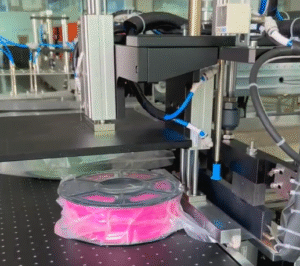
In semi-automatic or lower-volume operations, the operator places the desiccant sachet alongside the spool before the bag is sealed. This is reliable at modest throughput—the operator handles both product placement and desiccant insertion as a combined step. The limitation is speed: at higher volumes, manual desiccant insertion becomes the pacing constraint on the line.
Automatic Desiccant Dispensing
For higher-volume or fully automatic lines, UBL integrates an automatic desiccant dispenser into the packaging sequence. The dispenser works similarly to a card dispenser or ticket machine: as each spool is positioned for bagging, the dispenser releases one sachet automatically—no operator intervention required. Count sensors verify that each package receives desiccant before sealing proceeds.
This approach eliminates the most common desiccant-related quality issue: missed packets. In manual operations, a distracted operator occasionally skips a sachet. With automatic dispensing, every package is verified before the vacuum cycle runs.
Desiccant Specifications
The desiccant type and quantity depend on your specific requirements—filament material, expected storage duration, and target humidity level inside the package. Common options include:
- Silica gel sachets: Most common, cost-effective, available in a wide range of packet sizes (typically 1g–50g per packet). Suitable for most standard filament materials.
- Molecular sieve (4Å or 3Å): Higher moisture absorption capacity per gram than silica gel; better for highly hygroscopic materials like nylon or PVA where maximum moisture protection is required.
- Clay desiccant: Lower cost alternative; effective for general use but lower capacity than silica gel or molecular sieve.
The right specification—type, packet weight, and quantity per package—is determined by your material mix and quality requirements. UBL’s engineering team can help specify desiccant parameters as part of packaging line configuration.
Bag Material Selection
The vacuum packaging machine handles the sealing process, but the bag film determines how well that seal is maintained over time. Choosing the right film for filament packaging involves balancing moisture barrier performance, clarity, heat-seal compatibility, and cost.
PE Composite Film
Standard PE (polyethylene) composite film is the most widely used material for filament vacuum packaging. It offers:
- Good moisture barrier properties suitable for most filament materials
- Strong heat-seal performance across a wide temperature range
- Good puncture resistance for handling spools with plastic flanges
- Cost-effective for high-volume production
PE composite typically layers PE with nylon (PA/PE) or EVOH for improved barrier performance compared to single-layer PE film.
High-Temperature PE Film
Standard PE film has a relatively low heat distortion temperature. For applications where packaged spools may be exposed to elevated temperatures during storage or shipping (e.g., in unconditioned warehouses or during summer transit), high-temperature PE film maintains its barrier and seal integrity at temperatures that would compromise standard PE.
This is particularly relevant for manufacturers shipping to tropical climates or to distributors with uncontrolled storage conditions.
BOPP Film
Biaxially oriented polypropylene (BOPP) film offers excellent optical clarity and good moisture barrier performance. Its standout characteristics for filament packaging are:
- High transparency: Product is fully visible through the package—the spool color, brand, and label are clearly visible without opening. This has retail display value for consumer-facing filament brands.
- Good moisture resistance: BOPP’s low water vapor transmission rate suits the moisture-sensitive nature of filament.
- Stiffness: BOPP maintains package shape well, giving a professional appearance on shelf.
BOPP’s limitation is lower heat-seal strength compared to PE composites, requiring precise temperature control during sealing. It’s typically used when appearance is prioritized—premium consumer brands rather than industrial supply.
Choosing the Right Film
| Film Type | Moisture Barrier | Clarity | Heat Seal | Best For |
|---|---|---|---|---|
| PE Composite | Good | Moderate | Excellent | Standard industrial / OEM supply |
| High-Temp PE | Good | Moderate | Excellent | Warm climate shipping / uncontrolled storage |
| BOPP | Good | Excellent | Good | Premium consumer retail / display packaging |
Semi-Automatic vs. Fully Automatic Vacuum Packaging
UBL offers filament vacuum packaging machines in both semi-automatic and fully automatic configurations. The right choice depends on your volume, budget, and integration requirements.
Semi-Automatic Configuration
In semi-automatic mode, the operator places the spool (with or without desiccant) into the bag and positions the bag mouth at the sealing bar. The machine then automatically runs the vacuum and seal cycle. The operator removes the finished package and loads the next spool.
This approach works well for:
- Operations producing up to a few hundred spools per shift
- Manufacturers with varied product sizes where manual loading provides flexibility
- Facilities where capital budget limits full automation investment
- Products with irregular shapes or special handling requirements
Fully Automatic Integration
In a fully automatic filament packaging line, the vacuum sealer integrates with upstream bagging and desiccant dispensing stations. Spools flow continuously from the bagging station through desiccant insertion to the vacuum sealer, with no manual handling between stations.
Full automation is appropriate when:
- Daily volume exceeds 1,000+ spools per shift
- Labor cost reduction is a primary objective
- Consistent, documented quality is required (e.g., for branded consumer products or contract manufacturing)
- Floor space and utilities support a complete integrated line
Integration with the Complete Packaging Line
The vacuum sealer is one station in a complete filament packaging line. Its performance affects—and is affected by—every other station.
Upstream: Bagging Station
The filament bagging machine delivers loaded, open bags to the vacuum sealer. Bag positioning must be consistent: a bag positioned at the wrong angle or depth at the sealing bar produces incomplete seals. Tight mechanical coordination between bagging and sealing stations is essential for reliable quality.
Downstream: Labeling and Box Packing
After vacuum sealing, spools proceed to labeling and box packing. The sealed package must be dimensionally stable enough for labeling (labels apply poorly to packages that are too soft or irregular). Vacuum packaging at -0.08 MPa produces packages with good rigidity—film conforms to the spool and the package holds its shape through downstream handling.
Line Speed Matching
The vacuum cycle time determines the vacuum sealer’s throughput. A cycle that takes 8 seconds sets a pace of 450 cycles per hour—the other stations must match this pace. For high-speed lines, multiple vacuum sealing chambers can run in parallel, doubling or tripling throughput without increasing cycle time.
Next Steps: Specifying Your Filament Vacuum Packaging Machine
The right filament vacuum packaging machine configuration depends on your product range, volume targets, bag film specifications, and integration requirements. UBL works with 3D printing filament manufacturers to specify equipment matched to their exact needs—including product testing with your actual spools and bags before equipment selection.
Whether you need a standalone semi-automatic sealer for a growing operation or a fully integrated vacuum sealing station for a high-speed line, we’ll help you identify the right solution.


7 responses