In modern packaging plants, speed is often treated as the ultimate benchmark.
A cartoning machine rated at 120 cartons per minute looks impressive on paper—but in real production, that number alone means very little.
Here’s the uncomfortable truth:
isolated high speed does not equal high efficiency.
If a cartoner runs faster than upstream feeding or downstream handling can support, the result is constant stopping, idling, or product buildup. Motors repeatedly start and stop. Operators intervene more often. Mechanical wear accelerates. Labor costs quietly rise.
This is why many factories discover that their “high-speed” cartoning machine becomes a bottleneck instead of a solution.
The real issue isn’t speed—it’s synchronized cartoning.
Traditional cartoners often behave like isolated islands, difficult to integrate with existing legacy lines or equipment from different brands. And in a high-cost manufacturing environment like North America or Europe, every minute of imbalance translates directly into lost money.
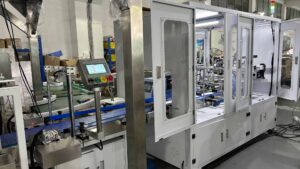
The Bottleneck Effect: Why Balance Matters More Than Speed
Upstream Starvation: When Speed Has Nothing to Process
When upstream supply can’t keep up, the cartoner sits idle—waiting.
This “starvation” causes:
-
Repeated motor start-stop cycles
-
Unnecessary energy consumption
-
Increased mechanical fatigue
Ironically, machines wear faster when they stop and restart constantly than when they run steadily at a controlled pace.
Downstream Blockage: When Output Has Nowhere to Go
On the other end, if downstream equipment—checkweighers, case packers, palletizers—can’t accept output fast enough, finished cartons pile up at the exit.
Eventually, the entire line stops.
The Key Takeaway
A truly efficient cartoning system isn’t defined by maximum speed.
It’s defined by adaptability, balance, and integration friendliness.
That’s the foundation of synchronized cartoning.
Engineering for Synergy: UBL’s Integrated Philosophy
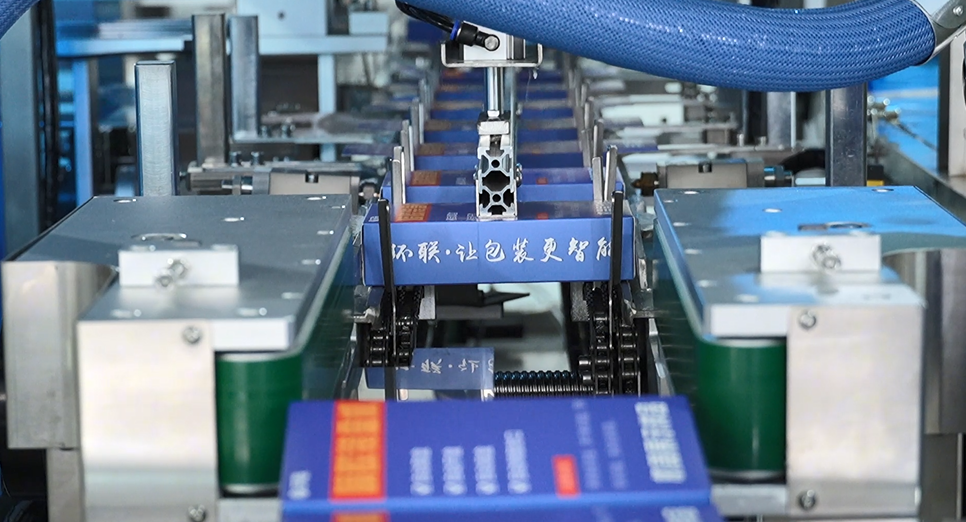
UBL cartoning machines are engineered not as standalone units, but as cooperative systems inside complex production lines.
Flexible Speed Control
UBL systems support smooth speed adjustment from low-speed operation up to 120 pcs/min (≈7,200 pcs/hour).
Instead of forcing the line to match the cartoner, the cartoner adapts to the line.
Communication & Handshaking
Through industrial communication protocols (such as Siemens PLC platforms), UBL cartoners “talk” in real time with:
-
Upstream fillers
-
Feeders
-
Downstream checkweighers and case packers
This real-time handshaking enables automatic speed matching, reducing operator intervention and stabilizing overall line flow.
This is synchronized cartoning in practice—not theory.
Key Integrated Features of UBL Cartoners
Smart Infeed System
Automatically senses incoming product flow and adjusts pick-and-place timing to prevent starvation or overload.
Compact Footprint
Optimized machine layout allows easy integration into space-limited workshops without expensive facility modifications.
Modular Design
Quick-change format parts enable fast size switching, supporting multiple SKUs and flexible production schedules without long downtime.
Together, these features allow the cartoner to behave as part of the line—not a disruption to it.
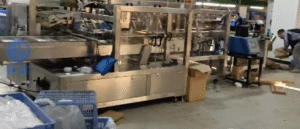
Single Machine vs. Integrated Cartoning System
| Dimension | Traditional Static Cartoner | UBL Integrated System |
|---|---|---|
| Line Coordination | Manual matching, frequent stops | Intelligent synchronized speed control |
| Speed Strategy | Fixed high speed, low flexibility | Adjustable up to 120 pcs/min |
| System Communication | Isolated operation | Real-time PLC handshaking |
| Changeover Cost | Complex, time-consuming | Modular, plug-and-play |
| Impact on OEE | Unstable | Optimized and predictable |
Future-Proofing Production with Synchronized Cartoning
Investing in synchronized cartoning means investing in system-level efficiency, not just a machine.
UBL focuses on improving overall OEE—not by pushing speed numbers higher, but by eliminating imbalance, reducing downtime, and protecting long-term equipment health.
In the future of packaging automation, success won’t belong to the fastest machine on paper—but to the most intelligently integrated system on the floor.
If your goal is sustainable efficiency, scalability, and reliability, synchronized cartoning isn’t optional.
It’s essential.
If you’re planning a new line or upgrading an existing one, talk to us.
UBL engineers will evaluate your upstream and downstream equipment and design a synchronized cartoning solution that fits your real production conditions—not just catalog specifications.
Contact us today. We’ll respond within 24 hours and connect you directly with an engineer to build a future-proof cartoning line.