
The pet food industry is one of the fastest-growing consumer sectors globally, with manufacturers facing mounting pressure to increase output while maintaining product freshness and shelf appeal. A pet food cartoning machine addresses both challenges—automating the entire cartoning process from box opening to final seal, freeing your workforce for higher-value tasks.
This guide covers how modern cartoning systems work for pet food applications, the specific requirements of freeze-dried treat packaging, and how pet toy manufacturers are using carton erecting equipment to dramatically improve line efficiency.
Why Pet Food Manufacturers Need Dedicated Cartoning Solutions
Pet food packaging presents unique challenges that standard packaging equipment wasn’t designed to handle:
Product Variety and Fragility
From crunchy kibble to soft chews, freeze-dried strips to liquid treats, pet food products vary enormously in shape, density, and fragility. Freeze-dried products are particularly delicate—the lyophilization process removes moisture and creates a porous structure that crumbles under excessive pressure. Packaging equipment must handle these products gently while maintaining throughput.
Soft treats and wet food pouches have different challenges: they deform under pressure, stick together, and require precise insertion angles to avoid product damage during the cartoning cycle.
Hygiene and Food Safety Requirements
Pet food is subject to increasing regulatory scrutiny. Equipment must be cleanable to food-grade standards, with stainless steel contact surfaces, accessible wash-down areas, and no hidden cavities where product residue can accumulate. Proper maintenance protocols are especially critical in food-adjacent manufacturing environments.
E-Commerce-Driven SKU Proliferation
A decade ago, a pet treat brand might sell three flavors. Today, the same brand offers 15 SKUs—different proteins, sizes, life stages, and dietary formulations. Each SKU requires its own carton size and artwork. Equipment that can’t change over quickly becomes the bottleneck that limits how many SKUs you can profitably produce.
How a Pet Food Cartoning Machine Works
Modern pet food cartoning machines handle three core functions automatically:
Automatic Box Opening (Carton Erecting)
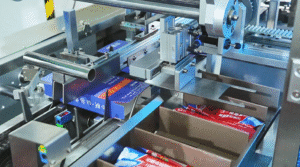
Flat carton blanks are stored in a magazine and picked by vacuum suction cups. The machine folds and locks the base of each carton, forming a rigid box ready to receive product. This happens continuously at rates matching your production line—no operator required to hand-form boxes.
For glue-seal cartons, hot-melt adhesive is applied to the base panels before forming. For tuck-end cartons, the base panels are folded mechanically. Both methods produce a stable, square carton that feeds smoothly through the loading station.
Product Loading (Pusher or Pick-and-Place)
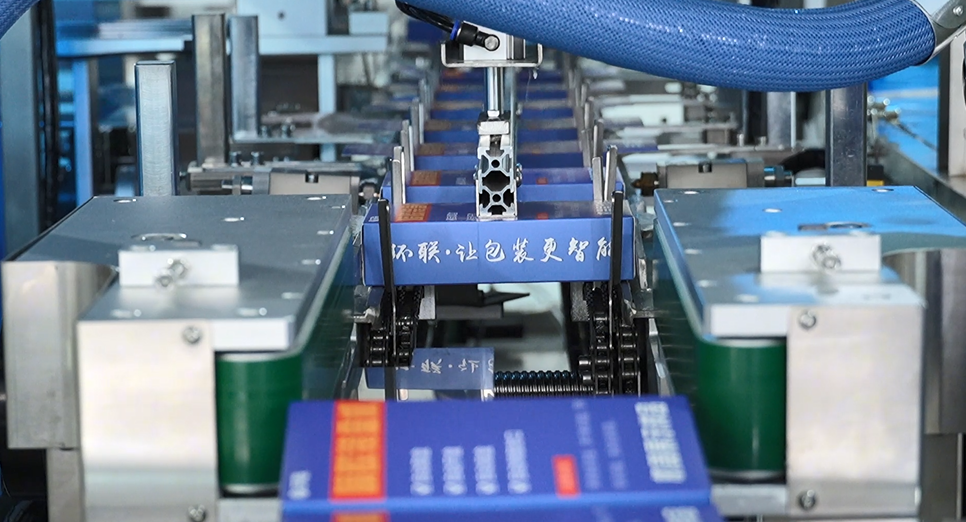
Product enters the cartoning machine from an infeed conveyor. A servo-driven pusher or robotic pick-and-place system loads the product into the open carton. The loading method depends on product characteristics:
- Pusher systems: Best for uniform products like freeze-dried strips, stacked treats, or rigid pouches. The pusher moves horizontally, inserting products cleanly in one motion.
- Pick-and-place systems: Better for delicate or irregularly shaped products that can’t withstand the force of a pusher mechanism.
- Bucket conveyors: Used when multiple pieces need to be grouped before insertion (e.g., 10 freeze-dried strips per carton).
Automatic Sealing
After loading, the carton top panels are folded and sealed. Tuck-end closures use mechanical fingers to fold the flaps in sequence. Glue-seal closures apply hot-melt adhesive for tamper-evident packaging. The sealed carton exits to a discharge conveyor for labeling, coding, or case packing.
Real-World Application: Freeze-Dried Pet Treat Strips
One of the clearest illustrations of cartoning automation value comes from freeze-dried treat production. Consider a manufacturer producing freeze-dried chicken strips for dogs—a product that’s sold in boxes of 10 strips, a format popular with premium pet treat brands.
The Packaging Challenge
Freeze-dried strips are lightweight (each strip weighing 3–8 grams), fragile, and irregular in shape. Manual packaging required operators to count 10 strips, insert them into an open box, fold the top flaps, and move to the next unit. At 400 boxes per hour per operator, a modest production run of 4,000 boxes per shift required 10 operators just for the cartoning stage.
The Automated Solution
Installing a dedicated pet food cartoning machine with a strip-counting infeed system transformed the operation:
- Strips are conveyed from the freeze-dryer to a counting station that groups them into sets of 10
- The cartoning machine automatically opens carton blanks from the magazine
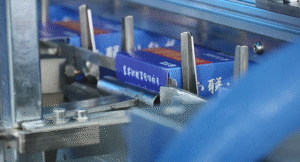
- A horizontal pusher mechanism inserts each group of 10 strips in a single motion
- Top flaps are folded and tucked automatically
- Sealed cartons exit at 2,400 units per hour—a 6× throughput increase
The entire operation now runs with 2 operators: one monitoring the infeed and one handling finished carton transfer. Labor cost per 1,000 cartons dropped by over 70%.
Key Equipment Specifications for This Application
| Parameter | Specification |
|---|---|
| Output speed | Up to 2,400 cartons/hour |
| Carton size range | L: 80–250mm / W: 40–120mm / H: 20–80mm |
| Loading method | Servo-driven horizontal pusher |
| Closure type | Tuck-end or hot-melt glue (interchangeable) |
| Changeover time | 15–20 minutes between SKUs |
| Contact surfaces | 304 stainless steel, food-grade |
Real-World Application: Pet Toy Carton Erecting
Not every packaging challenge requires a full cartoning line. For some pet product manufacturers, the bottleneck isn’t sealing or loading—it’s the simple, labor-intensive task of forming carton boxes before products can be packed.
How One Pet Toy Company Solved Its Carton Forming Problem
A pet toy manufacturer producing rope toys, squeaky toys, and interactive puzzle feeders faced a familiar problem: their packaging line employed 12 workers, and 4 of them spent their entire shift forming carton boxes by hand—folding the base, pressing the corners, stacking formed boxes for other workers to fill.
The work was repetitive, physically tiring, and produced inconsistent results. Poorly formed boxes caused jams on the conveyor, and manually folded bases occasionally failed during transit, leading to product returns.
The Lock-Bottom Carton Erector Solution
Installing a single lock-bottom carton erector completely eliminated the manual box-forming bottleneck:
- The machine automatically picks flat carton blanks and forms the lock-bottom base
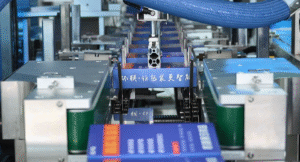
- Formed cartons discharge in a steady stream to the packing station
- The 4 workers previously forming boxes by hand were redeployed to the loading station
- Loading capacity increased by 33% with no additional headcount
One machine resolved the entire carton forming function for the facility. The investment paid back in under 14 months through labor reallocation alone—before accounting for the quality improvements from consistent machine-formed bases.
This model—a carton erector handling forming, humans handling loading—is particularly effective for pet toy products with irregular shapes and varying configurations that are difficult to automate on the loading side. The carton erector handles what machines do best; skilled workers handle what humans do best.
Selecting the Right Cartoning System for Pet Products
Full Automation vs. Semi-Automation
The right level of automation depends on your volume, SKU count, and product characteristics:
Full automatic cartoning (erect + load + seal) makes sense when:
- Daily output exceeds 5,000 cartons per shift
- Products are uniform and machine-feedable (strips, pouches, rigid inserts)
- Labor costs are high relative to equipment investment
- SKU count is manageable (under 10 active SKUs)
Semi-automatic cartoning (machine erects and seals, operators load) makes sense when:
- Products are too variable or delicate for automated loading
- SKU count is high with frequent changeovers
- Volume doesn’t justify full automation investment
- You want to reduce labor on forming/sealing while keeping manual loading flexibility
Carton Style Considerations
Pet food cartoning commonly uses three carton styles:
- Reverse tuck-end (RTE): Top flap opens opposite to bottom—common for retail display. Suitable for lighter products.
- Straight tuck-end (STE): Both flaps open in the same direction—faster loading access. Used for pouches and pre-packaged inserts.
- Lock-bottom (auto-bottom): Base locks mechanically without glue—strong base for heavier products like toys. The preferred style for products with display-worthy tops.
Integration with Upstream and Downstream Equipment
A standalone cartoning machine is rarely the whole answer. Consider the full line:
- Upstream: Counting conveyors, weighing stations, or pick-and-place robots that group product for loading
- Downstream: Labeling machines for barcode and product information, date coders for freshness marking, shrink sleeve applicators for tamper evidence
- End-of-line: Case packers for shipping carton loading, palletizers for warehouse-ready output
UBL’s integrated packaging solutions allow you to configure the right combination of equipment for your specific product and volume requirements.
ROI Calculation for Pet Food Cartoning Automation
Before investing in a pet food cartoning machine, calculate your expected return:
Labor Cost Savings
Manual cartoning at 400–500 units/hour per operator. Automated cartoning at 1,500–3,000 units/hour. If you’re currently using 6 operators at $18/hour for 2 shifts:
- Current labor cost: 6 operators × $18 × 16 hours = $1,728/day
- Automated system labor: 2 operators × $18 × 16 hours = $576/day
- Daily savings: $1,152
- Annual savings: ~$300,000
Quality Cost Reduction
Manual packaging generates 1–3% defect rates (torn flaps, missing products, miscounts). Automated systems achieve under 0.2%. For a manufacturer shipping 2 million cartons annually, reducing defects from 2% to 0.2% eliminates 36,000 defective units—each potentially causing a return, re-pack cost, and customer complaint.
Typical Payback Period
According to PMMI’s 2024 State of the Industry report, packaging automation in food and pet food sectors achieves average payback periods of 18–24 months, with labor-intensive operations seeing returns as fast as 12 months.
Common Questions About Pet Food Cartoning Machines
Can cartoning machines handle wet pet food products?
Yes, but with modifications. Wet pet food is typically pre-packed in pouches or cans, which are then cartoned. The cartoning machine handles the outer carton, not the wet food directly. Stainless steel construction and wash-down capability are essential for environments where liquid contamination is possible.
How long does changeover take between pet food SKUs?
Modern servo-driven cartoning machines achieve changeovers in 10–20 minutes for trained operators. Tool-free adjustment of carton guides, pushers, and folding mechanisms enables rapid SKU switching—critical for pet food brands with multiple flavors and sizes.
What carton sizes can pet food cartoning machines handle?
Most mid-range systems accommodate cartons from 60×30×15mm (small single-serve treat boxes) to 300×150×80mm (large format treat or food cartons). Custom tooling extends the range for specific applications.
Do I need separate machines for carton forming and cartoning?
Not necessarily. Fully automatic cartoning machines include the carton erecting function. However, if you’re using semi-automatic cartoning with manual loading, a dedicated carton erector upstream can significantly increase your overall throughput—as demonstrated in the pet toy case study above.
Next Steps: Configuring Your Pet Food Packaging Line
Every pet food operation is different. The right cartoning solution depends on your product mix, daily volumes, carton styles, and downstream distribution requirements. UBL’s engineering team works with pet food and pet product manufacturers to specify equipment that matches your current needs and scales with your growth.
Whether you need a full automatic cartoning system for freeze-dried treats or a standalone carton erector to solve a specific bottleneck, we’ll help you identify the most cost-effective path to packaging automation.
Contact UBL Packaging to discuss your pet food cartoning requirements:


2 responses
It’s interesting to see how automation in the pet food industry can both maintain product quality and free up staff for more strategic tasks. I wonder how different types of pet food, like freeze-dried treats versus wet food, affect the design of these machines.
As someone who’s followed the pet food industry closely, I appreciate how this post highlights the importance of automation in maintaining product quality while scaling production. The shift toward freeze-dried treats adds another layer of complexity, so having a reliable cartoning solution that ensures freshness and presentation is key. It’s great to see manufacturers investing in systems that support both efficiency and product integrity.