What Is a Servo Motor?
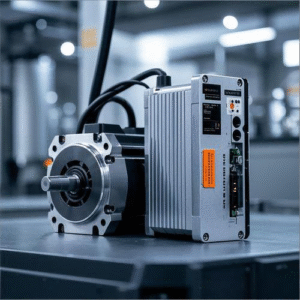
A servo motor is a high-precision actuator designed for closed-loop motion control. By integrating an encoder and feedback system, it continuously monitors its position and speed, then automatically corrects any deviation from the command signal. This allows the motor to achieve highly accurate and repeatable positioning, even under changing loads or speeds.
Key Technical Features
• Closed-loop control: Real-time feedback from the encoder ensures accurate positioning and motion control.
• Fast dynamic response: Excellent acceleration and deceleration capabilities, ideal for high-speed or repetitive motion profiles.
• High positioning accuracy: Maintains precise positioning even when load or speed changes.
• Automatic error correction: Detects resistance, vibration, or motion error and adjusts instantly to keep performance on target.
• Constant torque output: Delivers strong torque even at high speed, supporting demanding applications.
A simple analogy: A servo motor is like a professional driver using GPS and assisted driving. It constantly reads the road, corrects the route, and makes sure you reach the destination fast and accurately.
What Is a Stepper Motor?
A stepper motor converts pulse signals into fixed-angle rotational movement. Each pulse moves the motor a specific step (its “step angle”). A stepper is typically controlled in an open-loop system—meaning the controller sends commands, but there’s no position feedback to confirm whether the motion was completed.
Key Technical Features
• Open-loop control: The controller sends pulses, and the motor moves step-by-step with no validation of actual position.
• Simple structure, lower cost: No encoder required; mechanically simple and cost-efficient.
• High torque at low speed: Delivers strong torque at low RPM, but torque drops rapidly at higher speeds.
• Risk of “lost steps”: Heavy loads or fast acceleration can cause missed steps, and the system cannot detect the error.
• Easy control: Positioning and speed are controlled by pulse frequency.
A simple analogy: A stepper motor is like someone walking with their eyes closed, counting steps instead of looking. They move based on instructions, but don’t actually know if they reached the exact spot or hit something along the way.
Servo vs. Stepper: Core Differences
| Feature | Servo Motor | Stepper Motor |
|---|---|---|
| Control | Closed-loop feedback | Open-loop command |
| Accuracy | Very high, real-time correction | Depends on step angle, can lose steps |
| Speed | Stable at high speed, fast response | Strong at low speed, weak at high speed |
| Torque | High torque across speed range | Torque drops as speed increases |
| Cost | Higher (encoder + advanced driver) | Lower (simple hardware) |
| Noise/Vibration | Low noise, smooth motion | More vibration, especially at low speed |
| Best Use Cases | High-precision automation | Cost-sensitive, lower performance needs |
Choosing the Right Motor for Your Application
Selecting between a servo and a stepper depends on your performance requirements, application goals, and budget.
| If You Need… | Go With… | Typical Applications |
|---|---|---|
| High speed, precision, real-time correction | Servo motor | High-speed labelers, CNC machines, continuous packaging lines, synchronized motion, semiconductor equipment |
| Low speed, basic motion, budget control | Stepper motor | Entry-level packaging equipment, simple sorting devices, basic automation, printers, scanners |
| Feedback and error-free positioning | Servo motor | Any high-precision application |
| Lowest cost and moderate performance | Stepper motor | Lab devices, teaching models, low-cost consumer products |
• A servo motor is ideal for applications requiring high speed, high precision, and reliable stability, and can significantly improve machine performance and productivity.
• A stepper motor works well when performance requirements are modest and cost control is the priority. Its simple structure and low cost make it a solid choice for basic motion tasks.
If you’re still unsure which motor fits your machine or application needs, feel free to drop your question in the comments or click “Contact Us” for expert motor sizing and technical support. We’re here to help you choose the best fit for your production goals